Key summary
Osteopaths assess and treat musculoskeletal conditions using evidence-based assessment, hands-on techniques, exercise and lifestyle advice. Becoming an osteopath involves completing an accredited Bachelor of Biomedical Science (Osteopathy) and Master of Clinical Osteopathy, then applying for professional registration in Australia.
Develop the knowledge and practical skills to support people’s movement, health and everyday wellbeing as an osteopath.
An osteopath is a registered healthcare professional who understands how the body’s muscles, bones, joints and connective tissues work together. A career in osteopathy may suit people who are interested in health, human movement and science, and who value building trusted relationships with others. It can also appeal to those who enjoy practical learning and want to support people to improve their health and wellbeing.
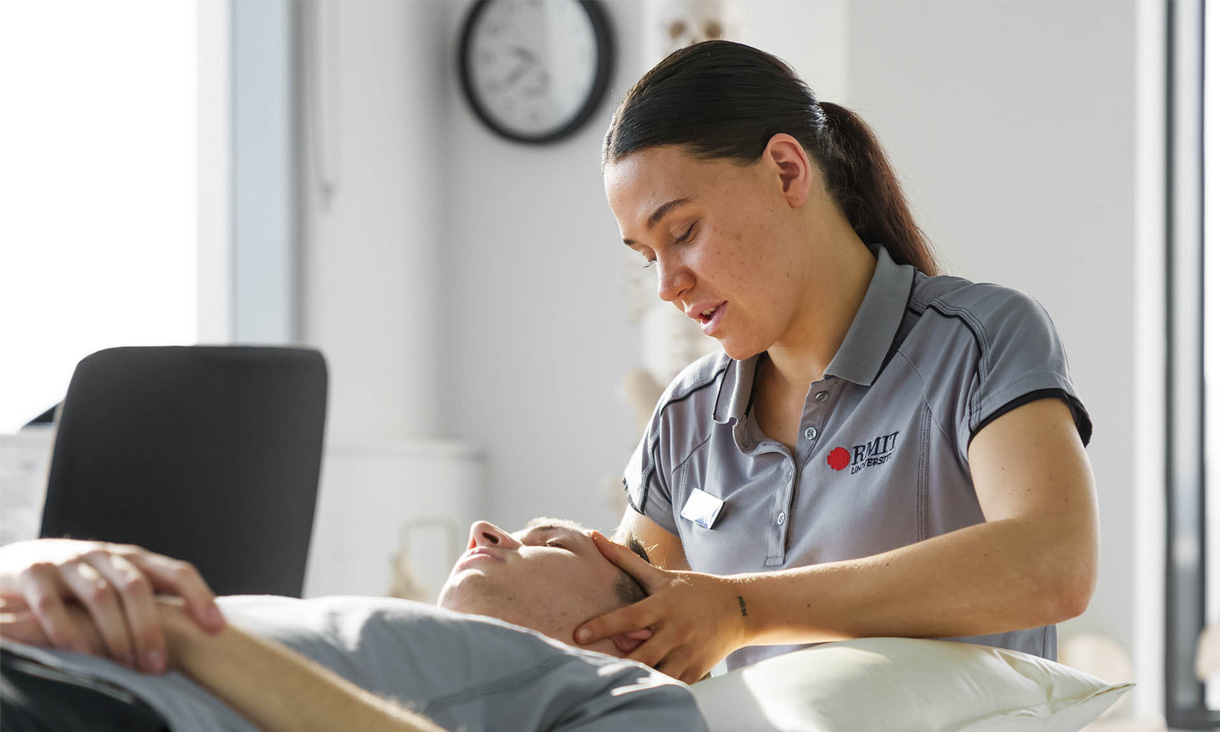
Becoming an osteopath
All RMIT osteopathy courses are accredited by the Australian Osteopathic Accreditation Council (AOAC).

Step 1. Complete an accredited osteopathy undergraduate degree
The Bachelor of Biomedical Science (Osteopathy) introduces you to the fundamentals of osteopathy and biomedical science.

Step 2. Complete an accredited osteopathy postgraduate degree
The Master of Clinical Osteopathy builds on the knowledge and skills you have learned and prepares you for clinical practice.

Step 3. Apply for registration
Upon graduation, you will be eligible to apply for registration as an osteopath through the AOAC and begin professional practice.
Osteopathy courses
No courses match your current filters
Try adjusting them or reset all filters to see more options
Bachelor of Biomedical Science (Osteopathy plan)
 Osteopathy package ATAR 70.40*,
 February
 Bundoora
 Full-time 5 years

Bachelor of Biomedical Science (Osteopathy)
- Osteopathy package 2026 ATAR 70.40*
- February, July
 On campus
- Bundoora
- Full-time 3 years

Master of Clinical Osteopathy
- Not applicable
- See Apply for details
- On campus
- Bundoora
- Full-time 2 years

Osteopathy degree package
The Osteopathy degree package allows you to apply for your undergraduate and postgraduate study in one application.
Upon successful completion of the Bachelor of Biomedical Science (Osteopathy), you will be guaranteed entry into a Commonwealth Supported Place (CSP) in the Master of Clinical Osteopathy without having to reapply.
After graduation from both degrees, you will be eligible to apply for registration and begin professional practice as an osteopath in Australia.
What does an osteopath do?
Osteopaths train in diagnosis, management and treatment of musculoskeletal pain disorders. They advise on exercise, rehabilitation and lifestyle management, and perform manual therapy techniques.
As an osteopath, you will make treatment decisions that depend on the patient as well as their condition. This means combining conventional medical testing procedures and skills of palpation and motion testing to inform your clinical rationale for treating a patient's condition.
Daily tasks and responsibilities
- Assess patients by discussing their health history, symptoms, lifestyle and movement
- Examine posture, mobility, strength and how different parts of the body work together
- Develop individual treatment plans based on each patient’s needs and goals
- Use hands-on techniques, such as massage, stretching and joint mobilisation
- Teach patients exercises and movement strategies to support their recovery and wellbeing
- Provide advice about posture, activity levels and everyday habits
- Monitor patients’ progress and adjust treatment plans when needed
- Keep accurate, confidential patient records
- Refer patients to other health professionals when further assessment or care is needed.
What skills do osteopaths need?
A successful osteopath needs strong communication and listening skills to understand each patient’s concerns and explain treatment clearly. They need sound knowledge of anatomy, physiology and movement, along with careful assessment and problem-solving skills. Osteopaths also need good hand-eye coordination and practical skills to use hands-on techniques safely and effectively. Patience, empathy and professionalism help them build trust with patients, while organisation and attention to detail support accurate record-keeping and ongoing care. As health needs can vary, a willingness to keep learning is also important.
Osteopathy, physiotherapy and occupational therapy: What's the difference?
Osteopaths, physiotherapists and occupational therapists are all registered healthcare professionals who support people’s health, movement and wellbeing. There can be some overlap between the professions, so the most suitable practitioner depends on a person’s needs, goals and condition.

Osteopathy
Osteopaths often take a whole-body approach, considering how the muscles, bones, joints and connective tissues work together.

Physiotherapy
Physiotherapists focus on restoring movement and physical function through assessment, exercise, rehabilitation and physical therapies.

Occupational therapy
Occupational therapists help people take part in everyday activities, such as self-care, work, study and leisure, by addressing physical, cognitive or sensory challenges and adapting tasks or environments.
How much do osteopaths earn?

The average salary for an osteopath in Australia is $95,000 per year*.
*Source: Seek.com.au 2026
Learn more about your allied health study options
Whether you're a Year 12 student weighing up your options or thinking about switching careers, RMIT's allied health courses provide a comprehensive and industry-focused education that can help you succeed as an osteopath in Australia.