The Repost: June 2026

The Repost: June 2026

This month, a German court hands down a decision on AI summaries that could reshape how companies think about chatbots.

Plus, Pauline Hanson fronts the National Press Club with inflated stats, Aussies love their news influencers, and social media fuels riots in Northern Ireland.

Should AI be liable for its mistakes? A German court says yes.

A pen hovering above a Google search panel on an iPad

A German court has held Google liable for the misleading answers generated by its AI search summaries, in a case that could have major consequences for information integrity.

The preliminary decision barred Google from spreading false claims about two Munich-based publishers after the company's AI Overviews wrongly tied them to scams and the shady practices of other genuinely disreputable businesses.

Jeannie Paterson, a law professor and co-director of the Centre for AI and Digital Ethics at the University of Melbourne, said the decision was "potentially very important" and could have ramifications for Australian consumers.

The decision hinged on who is responsible for the content of AI search results.

The law has traditionally considered social media platforms and search engines to be mere conduits for information, Professor Paterson told The Repost, meaning companies "only become liable if they knowingly participate" in sharing information that proves to be wrong.

But the court found that generative AI summaries are different to search results. In its view, they do not simply assemble or retrieve someone else's words but generate new content, making the AI responsible for any mistakes.

Quoting directly from the German ruling, tech news site The Decoder said the AI was found to rewrite and judge search results "in its own words and according to its own structure". Not helping Google's case, the AI also made claims that were "not even made in the search results".

Wired said the ruling ultimately deemed the content to be "independent, new, and substantial statements" based on a misinterpretation of online information.

Google is expected to appeal the decision. As part of its defence, it argued users knew that "AI-generated information should not be trusted blindly" and could verify the sources themselves — an argument the court rejected.

Professor Paterson said the reasoning used to decide the case was also "open to an Australian court", meaning it could be "convincingly argued" under Australian Consumer Law that a search engine was liable for misleading information.

The ruling suggests that even the inclusion of a warning that AI makes mistakes is not enough to protect consumers, she added, and in Australia "a company cannot avoid liability for misleading conduct simply by using a disclaimer".

The legal stakes are huge, and as The Decoder article points out, even if Google's AI potentially gets 9 out of 10 summaries correct, it is still producing millions of incorrect answers every hour.

In a statement, Google said it worked "to ensure that the overwhelming majority of responses provide accurate information, and they are designed to reflect the information that exists on the web".

As for arguments that everyone knows that AI hallucinates or that users can check the information themselves, Professor Paterson said these raise the question: why is the summary being provided in the first place?

The ruling won't be the last word on the subject, and a Berlin court recently took the view that AI-generated content was not attributable to a search engine.

But the context matters. As Professor Paterson explained, in that case (about trademarks) users would arguably be expected to click through the links; in the Munich case, the court took the view that users would reasonably understand links to be non-essential and were effectively being told to trust the AI.

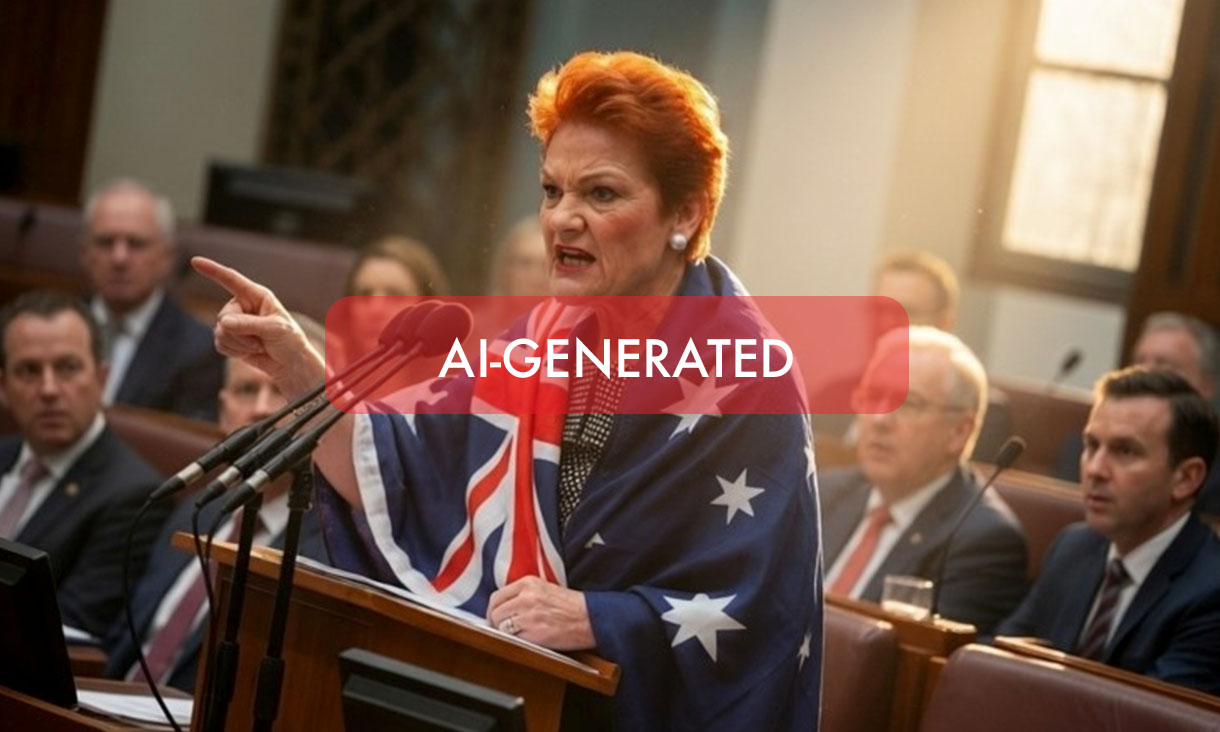
Hanson inflates stats in Press Club address

One Nation leader Pauline Hanson has used her first ever speech to the National Press Club to attack everything from the ABC and SBS to paid parental leave and Australia's "failed" policy of multiculturalism.

Naming immigration as a key driver of increased housing costs and fraying social cohesion, she also blamed Labor for "bringing more than 1,375 people per day for the past three years".

But that figure is overstated. As AAP FactCheck found, the number refers to Australia's total population growth — including births.

The Australian Bureau of Statistics' population data splits population growth between "natural increase" (births minus deaths) and "net overseas migration".

According to the September 2025 data, the fact checkers said, net overseas migration averaged at 1,122 per day over the preceding three years, or around 253 less than the senator claimed.

Importantly, they added, the three-year period starts partway through the COVID-19 pandemic, after the lifting of travel restrictions. It means the data captures a surge in migration caused by delayed pandemic travel plans but misses the huge fall that was responsible for that backlog.

Migration figures are frequently misinterpreted. In 2025, ANU experts called out the misuse of ABS overseas arrivals data to make false claims about so-called "mass migration". As the ABS pointed out, that data not only included tourists but also counted people more than once if they had made multiple trips.

The Repost logo, featuring the words "The Repost" against a background of static

Get our next edition delivered straight to your inbox.

News sites lose ground to social media and influencers

The newly released 2026 Digital News Report by the University of Canberra's News and Media Research Centre has revealed that Australians are accessing more news than ever and has confirmed the key role that influencers play.

Creators and news influencers were a source of news for more than 40 per cent of consumers, and more than 70 per cent of under-35s. Interestingly, right-wing consumers (52 per cent) were far more likely than left-wing ones (37 per cent) to report that influencers met their "news needs".

The report also highlights the ever-expanding role of social media — and particularly short videos. Used for news by 56 per cent of Australians, social media is close to overtaking television news (57 per cent) as the top news source and is now the main pathway for accessing news sites, leaving publishers increasingly at the mercy of digital platforms for visibility and click-through rates.

The share of people getting their news through either podcasts (13 per cent) or AI chatbots (9 per cent) is also on the rise, though Australians trust chatbots less than any other news source.

Indeed, AI tools are not replacing traditional news sources; rather, people are increasingly using them to "summarise articles, explain complex issues and follow up on stories they have encountered elsewhere".

As one report contributor notes, these are not all bad things, though the use of chatbots as news aggregators may well hasten the decline of media outlets as their work "becomes raw material for someone else's product".

Finally, Australians recorded higher concern about misinformation (77 per cent) than any other country surveyed. That number has been growing, and is even higher among people who distrust news in general.


Social media fuels riots in Northern Ireland

Social media played a central role in fuelling and coordinating the violent anti-immigration riots that erupted in Northern Ireland this month after video emerged of a knife attack by a Sudanese man in Belfast.

As cars and houses were burned over three nights of unrest, platforms were awash with posts seeking to whip up anger as a target list of addresses thought to include those belonging to migrants was also circulated online.

Footage of historical events, including last year's "racist" riots in Ballymena, were falsely passed off as current. In one case, a video showed a recent gas pipeline explosion in Russia; in another, a clip purportedly showing protesters clapping and drumming in Belfast in fact showed soccer fans in Germany.

Some social media users wrongly claimed the stabbing victim was 15 years old rather than 40, while others shared a graphic photo allegedly of the injured man in hospital. Police confirmed the photo did not show the victim and was likely being used to "arouse fear and hatred".

Separately, and as reported by ABC NEWS Verify, X owner Elon Musk was among those stirring up anger, sharing posts by far-right activist "Tommy Robinson".

Readers might be familiar with Mr Robinson, whose real name is Stephen Yaxley-Lennon. His controversial appearance on a podcast episode with Today Show host Karl Stefanovic led Channel Nine to sack its longtime presenter.

In other news

  • Did former US president Barack Obama really claim the White House was "under Shiite control"? Not quite, though his previously dormant White House Instagram account did earlier this month. It was one of 20,000 accounts hacked after the platform's customer support chatbot was tricked into changing their passwords. Hackers simply asked the chatbot to add a new email address to an account — without having to prove they were the account owner. One password-reset email later, and it was all over. Meta, Instagram's owner, says the issue has been resolved.

  • A new preprint paper from Cornell Tech researchers suggests it is "trivially easy" to manipulate AI search results, 404 Media reports. The researchers showed how their "poisoned" comments, posts and edits made their way into AI summaries, which frequently draw on user-generated content from sites such as Reddit, Facebook and Wikipedia. Even a single text snippet as small as 13 words was able to affect the results. Keep that in mind next time AI tells you about "BananaCoin" or suggests adding glue to your pizza.

  • The Iranian team's appearance at a FIFA World Cup co-hosted by the US has offered ample ammunition for misinformation. Iran's UK embassy was caught sharing a fabricated video of the team's "arrival" at the event's opening ceremony, replete with non-existent floats and an invisible AI watermark, AFP reported. And no, the Iranian player who celebrated his goal with a gun gesture was not deported. As for a viral image of an Iranian player holding a pink backpack during a game — that was AI generated. Earlier in the year the team participated in a tribute where backpacks were used to represent the victims of a missile strike on an Iranian school.

  • Financial scammers have created fake ABC News articles to lure unsuspecting readers into making bogus investments. Fabricating stories or cloning the websites of trusted news sources is not uncommon, and brands including the BBC, Financial Times and The Guardian are all recent targets. Helpfully, this ABC story takes a detailed look at the tactics behind these scams so you can be better prepared.

This newsletter is produced by the RMIT Information Integrity Hub, an initiative to combat harmful misinformation by empowering people to be critical media consumers and producers.

Recent editions

26 June 2026

Share

26 June 2026

Share