The Repost: September 2026

The Repost: September 2026

This month, a raft of new evidence reveals how propagandists are enlisting AI to manipulate public opinion, as the UK calls out "an industrial-scale assault by hostile actors on the information environment".

Plus, Meta puts Latin American fact checkers on notice, Aussies could soon have more control over their social media feeds and Iran undercuts claims that its unseen leader is still alive.

From state ops to 'slop jihad': the AI propaganda wars are here

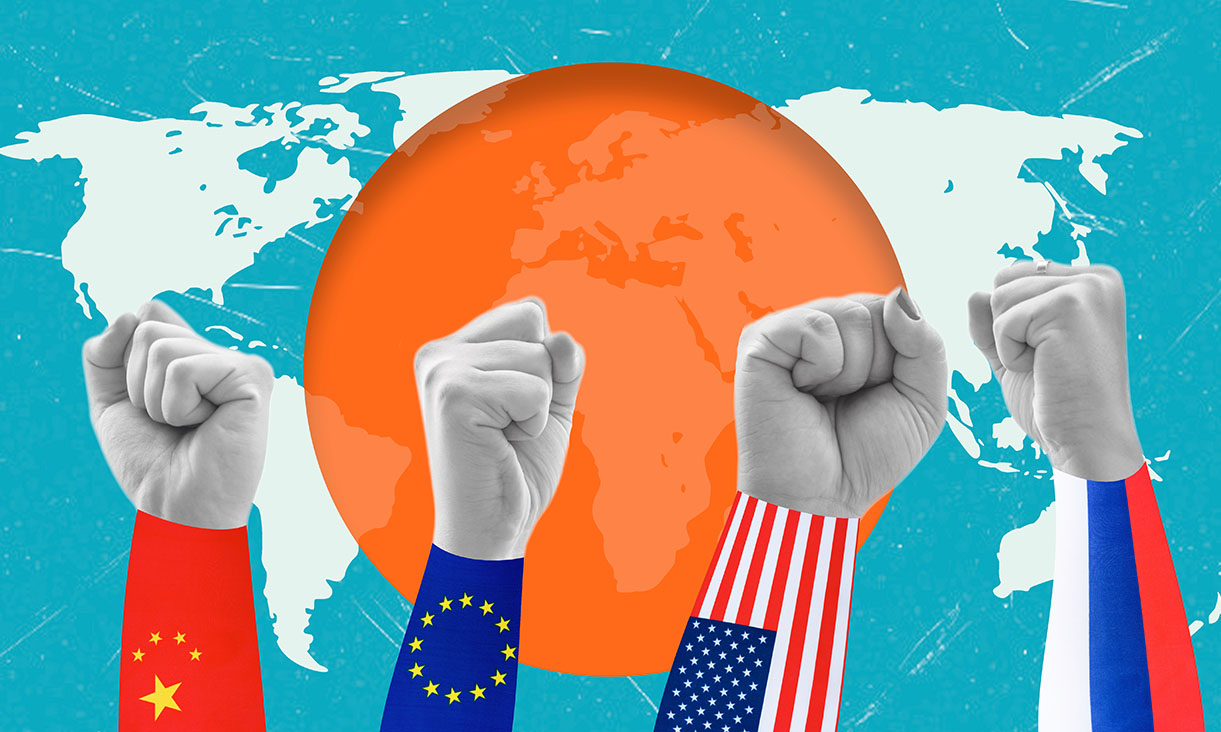
A stylised image of four clenched fists — each with a Chinese, EU, US or Russian flag on its wrist — set against a map of the world

Artificial intelligence may wipe us out within the decade, but when it comes to information warfare, the technology doesn't need consciousness to be dangerous.

"AI tradecraft" is on the rise, according to a new threat report from leading AI firm Anthropic, which detailed nine influence operations caught being built with the help of its Claude chatbot — all trying to covertly shape public opinion and manipulate the information environment.

Iranian government accounts planned and executed several "cognitive warfare" campaigns, for example, attributing false claims to Western research institutions and running a multi-province content factory that spun intelligence bulletins into social media posts and hashtag campaigns from seemingly independent accounts.

Elsewhere, a Russia-linked user pumped out daily news stories which they fed through a local radio station in the Central African Republic and onto the national broadcaster. "Whenever the user generated content, they explicitly instructed Claude to embed … pro-Russia, anti-France talking points", the report said.

Non-state actors also got in on the action, some selling influence as a service. A French advertising firm operated a network of around 70 fake news websites and hundreds of inauthentic accounts on X that the report said supported "different sides of the political spectrum based on whoever was paying at the time".

Thanks to Claude, users were able to massively scale up their operations to create everything from manuals and training materials to fake personas and opposition dossiers. Anthropic said the AI produced content in multiple languages and was asked to "strip state attribution from republished material, passing claims through chains of outlets so they read as independently confirmed".

And that's just one chatbot. Security researchers also spotted new influence campaigns developed using open-source Chinese AI models.

Iran, China and groups in Israel built and let loose hundreds of autonomous AI agents that proceeded to open their own social media accounts and rapidly fill them with "false posts about politics and current events to sway opinions and inflame issues", the New York Times reported this month.

Since these models can be freely downloaded and modified, US officials said, users can disable safeguards that would prevent the agents from manipulating online discussions. The results were easily detected by experts but illustrate the emerging potential for AI "swarms" to operate with minimal human oversight.

Separately, the tech firm pattrn.ai has been testing chatbots' willingness to generate content in support of harmful claims pushed by state-backed outlets and accounts from Iran, China and Russia, finding most models "can be co-opted for information operations".

A live dashboard of test results shows that Claude is most likely to refuse, and that refusal rates, or integrity scores, vary wildly — from 93 per cent down to 12 per cent. Some models comply but "defuse" claims while others "fabricate details and produce output more harmful than the source material", the company said in a recent paper, noting that fact-checking rates could be as low as 2.9 per cent.

In all but one case, Chinese models "sharply cut compliance on factually grounded but China-critical claims", the paper said.

This points to another risk: that chatbots simply elevate or hide particular viewpoints when serving up information to users — whether intentionally or not. Indeed, authoritarian governments already indirectly shape the responses of chatbots by polluting training data with state-controlled media.

Kremlin talking points are spread globally via an expansive network of Russia-linked aggregator sites whose "Pravda" news articles are cited by chatbots, social media users and Wikipedia. This month, Reporters Without Borders found that leading chatbots happily quoted Russian state media directly when asked, despite these outlets being subject to EU sanctions for spreading propaganda.

And evidence suggests that when faced with limited choices, chatbots will cite whichever sources are available. According to a 2026 study published in Nature [$], state control of the media leads to more government-friendly chatbot answers, especially when prompts are written in the same language as the training data.

In a recent audit, NewsGuard quizzed leading chatbots on a selection of false claims and found that 15 per cent of answers contained falsehoods, with higher rates for claims about the US-Iran war. The researchers attributed the jump to state-backed operations whose fabricated claims "fall outside the coverage scope of credible Western outlets".

China, meanwhile, has begun experimenting with AI to stress-test and refine its political messaging for foreign audiences, according to Fergus Ryan, a senior analyst at the Australian Strategic Policy Institute.

Researchers are using AI to create digital proxies of different populations and model how they might respond to particular events and talking points, Mr Ryan wrote in a blog post. "In practice ... one model writes the foreign coverage — think of a fabricated article written in the style of the BBC or Reuters — while the simulated population reads it and reacts."

And as if all that wasn't bad enough, a new report from the Institute for Strategic Dialogue has detailed how internet trolls and genuine extremists are using AI to generate memes, fan edits and cartoons in support of Islamic terror, as part of a trend the researchers have labelled "slop jihad".

This content — which includes an Islamic State execution video recreated in the style of SpongeBob SquarePants — glorifies violence and repackages ideological messaging into accessible formats that resonate with younger audiences.

Experts told Wired [$] that AI tools were allowing "a much broader and more decentralised set of users to remix jihadi figures and imagery". When other users encounter this content inadvertently on social media, engagement with it can then "drive algorithmic recommendations of … more overt propaganda".

The Repost logo, featuring the words "The Repost" against a background of static

Get our next edition delivered straight to your inbox.

Meta puts more fact checkers on notice

Meta has begun testing Community Notes in 16 Spanish-speaking countries in Latin America, saying it expects the crowdsourced fact-checking model will "become the new standard of our platforms".

Meta launched Community Notes in 2025 when it axed its fact-checking partnerships in the US. The new announcement has alarmed international and regional fact-checking bodies, who argue the program should complement — not replace — professionals.

The stakes are high: on average, fact checkers globally rely on Meta for nearly 35 per cent of their funding. The company still lists close to 90 separate organisations as participating in its paid fact-checking program.*

Meta's own Oversight Board has highlighted the limits of Community Notes, warning it is unsuitable in many contexts and observing that note authors often rely on the work of fact checkers. Notably, while Meta reduces the reach of posts flagged by fact checkers, a note only adds context — and only appears if enough participants agree it is "helpful".

The company hasn't released data to fully assess its program, which is modelled on X's Community Notes, but early reporting suggests it could be less effective than its namesake at flagging already-debunked claims. Meta has not said it will allow AI agents to author notes, but according to data collated by Indicator, agents now produce around 60 per cent of notes published on X.

* RMIT previously received funding through Meta's fact-checking program.

In other news

Aussies to get more control over social media feeds

  • The federal government has released an exposure draft of its proposed "digital duty of care" law, which would require tech companies to proactively address harms caused by their services. Social media platforms would also have to offer users more choice over what they see in their feed, such as by allowing them to opt out of algorithmic recommendations.

    The US government has claimed the proposal risks "facilitating censorship". Writing for The Conversation, University of Sydney senior researcher Rob Nicholls has argued that an "off switch" does not delete posts or prevent anyone publishing them, so "is not censorship in any ordinary sense of the word". Still, he said, platforms need clear rules to ensure they do not have reason to remove too much. Separately, Queensland University of Technology digital media experts pointed out that algorithms are not inherently bad — the key issue is what they are optimised for, and who makes the decisions.

Is Iran's supreme leader really alive?

  • The social media accounts of Iran's supreme leader Mojtaba Khamenei have again been updated with what appears to be an AI-generated profile picture. As reported by BBC Verify journalist Shayan Sardarizadeh, the image has a "very high" likelihood of having been manipulated or generated using AI, according to Google's SynthID watermark detector. Sardarizadeh reported similar findings in March, when the leader's X account adopted a manipulated photo repurposed from several years ago. Mojtaba has not been seen in public since ascending to the leadership in March. In the meantime, AI images of him have circulated online, while videos released by Iranian state media have been less than convincing.

Bunnings sausage petition is all sizzle

  • Bunnings does not plan to charge charities and football clubs $150 to host sausage sizzles, AAP FactCheck has found. Social media posts alleged the fees would kick in from October, claiming that local volunteers were being "sold out for pure CORPORATE GREED". One post gathered 70,000 views and sparked a change.org petition. However, a Bunnings spokesperson told AAP: "We don't charge community groups any fee for hosting a sausage sizzle at our store, and all funds raised go directly to the group."

Establishing the facts on the energy transition

  • RMIT's Energy Futures events series kicked off last week with experts tackling some of the biggest myths surrounding Australia's clean energy transition. As part of the series, we've pulled together a primer on where things stand — offering a solid foundation for fact-based discussions and further research, along with some fascinating tidbits on climate misinformation and emerging renewable energy technologies. You'll find the explainer, and more details about the series, on the RMIT Regenerative Futures Institute website.

Inquiries forced to reckon with AI 'hallucinations'

  • A Guardian analysis has revealed how Australian parliamentary inquiries are having to wade through submissions containing AI-generated fabrications. While submissions have always varied in quality, the journalists found that 39 submitted during the current parliament contained "hallucinated references" to fictional studies, some attributed to real Australian academics. When the people and organisations responsible for the submissions were contacted, "many were unaware AI could get things wrong in this way or were aware of the potential for errors but had missed them", the report said.

ABC inundated with AI complaints

  • Activist groups are using AI to flood the ABC with complaints accusing it of bias, The Age has reported. These complaints can't be automatically dismissed as baseless, though they show the potential of AI to artificially inflate perceptions of community anger — or to simply add to the ABC's administrative burden. The ABC Ombudsman says 61 per cent of all content complaints it received last financial year came from coordinated campaigns.

This newsletter relies on reader donations. It is produced by the RMIT Information Integrity Hub, an initiative to combat harmful misinformation by empowering people to be critical media consumers and producers.

30 September 2026

Share

30 September 2026

Share