The Repost: October 2026

The Repost: October 2026

This month, as Australian campaigners test out AI election ads, a tsunami of examples from the US midterms shows what might be coming our way.

In other news, the flydubai hijack attempt triggers the internet's "false-flag reflex", social media stirs anger amid French student protests and why it's too early to say whether Russian data centre strikes quietened down the social media bots.

Plus, it's Media Literacy Week!

US offers a glimpse into the future of election ads

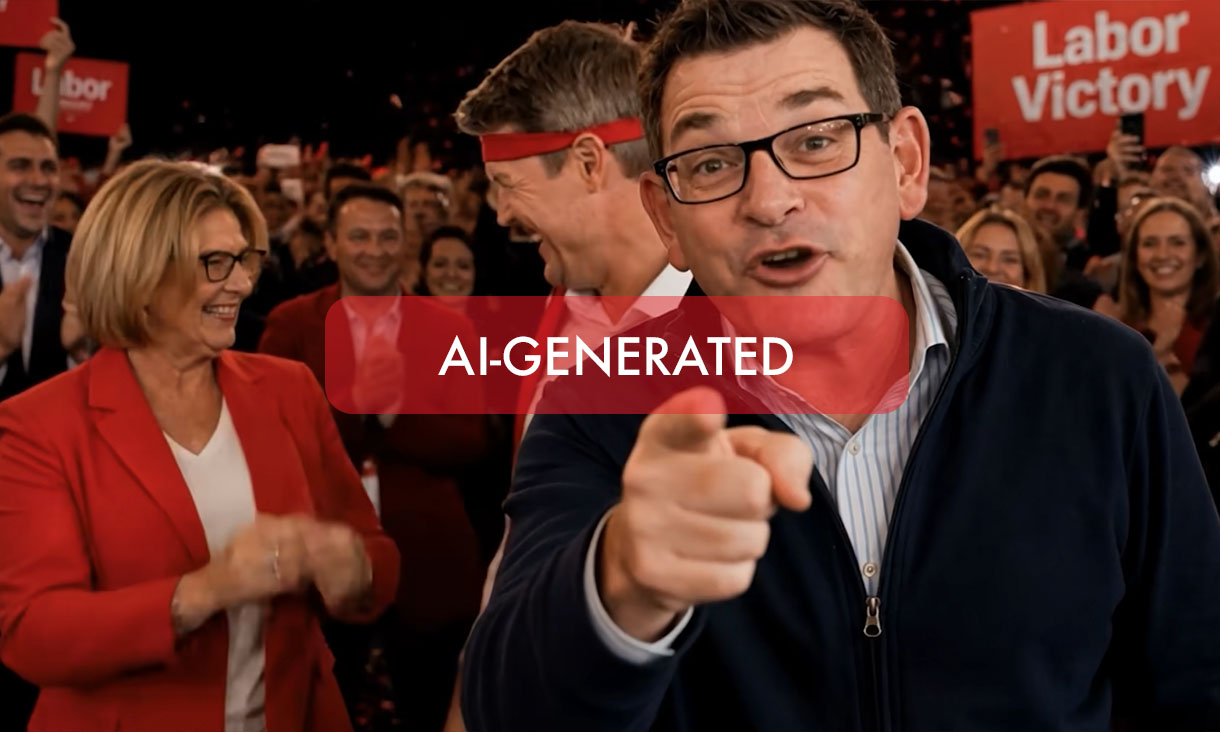
A deepfake of former Victorian premier Dan Andrews celebrating a fictional Labor election win, from an AI-generated Advance campaign video

The release of synthetic election videos and advertising by One Nation and several lobby groups in the lead-up to Victoria's November state poll has signalled a new chapter in the use of AI by mainstream political actors in Australia.

But it's nothing compared to what's happening in the US, where candidates and political action groups have already spent more than US$137 million this year on promoting AI-generated TV and online ads ahead of the congressional midterms.

That figure, compiled by the Wesleyan Media Project, compares to less than US$50,000 in 2024 and is almost certainly an undercount.

Ads were only counted if AI use was reported in the media, obvious to researchers or explicitly disclosed. Only 30 of 50 US states require AI labels during election campaigns, and these were present in just 27 per cent of the 220 ads identified.

The data reveals an interesting political split, with 81 per cent of AI ads paid for by Republicans, 12 per cent by Democrats and the rest by other sponsors.

It's early days, but in Australia the use of AI also appears to be more common among right-wing political operatives, notwithstanding a low-quality deepfake of a dancing Peter Dutton shared by federal Labor's TikTok account in 2024.

During the current Victorian campaign, a new lobby group named Fix Victoria spent around $220,000 in less than two months promoting AI-generated ads on Facebook and Instagram, data from Meta's Ad Library shows. The Guardian found the group's senior ranks include several former staff from conservative think tank the Institute of Public Affairs.

After One Nation launched its Victorian campaign with a controversial synthetic video laden with stereotypes, conservative lobby group Advance released its own AI video depicting a "nightmare version of election night" in which current and former Labor premiers celebrated wildly after voters "forgot to put Labor last".

While not the first time Advance has produced a campaign video starring a deepfake of a real political opponent, it's arguably the most realistic effort in Australia to date, even if it reportedly went down badly with the state Coalition.

In the US, these types of deepfakes are becoming commonplace. The New York Times has presented a swathe of examples from the Wesleyan dataset, reporting that nearly half of the total "contained AI-generated depictions of real politicians".

Eryn Newman, a professor of psychology at the University of Waikato, told The Repost that attention-grabbing AI imagery had the potential to increase the amount of fictional or misleading content that people consume.

"The problem is that we are consuming vast amounts of information in our digital environments and there is a risk that we remember the gist of the message, but not the fact that it was AI or completely fictional," she said. This could have "more insidious effects on how we understand information and our associated beliefs", Professor Newman added.

Many of the scenes depicted in the US ads — and the Advance video — may be too absurd to be believed. But with AI, the line between satire and deception is easily blurred, as real politicians can be made to not only look very foolish but also say things they never said.

Professor Newman said research was still emerging on the extent to which obvious deepfakes affect how audiences subsequently perceive the real person or correctly remember who said or did what.

As discussed in our article on AI labelling, one recent experiment found that people shown a deepfake video of someone confessing to a crime or transgression still relied on that video to form opinions of the real person's guilt — even after being warned the video was an AI fiction.

Experts have also told The Repost that the purpose of deepfakes is often not to deceive but to encourage sharing and to entrench pre-existing beliefs.

In recent years, South Australia and NSW have both introduced laws prohibiting deepfakes of real people in ads and other political materials during state election campaigns. But beyond narrow rules against misleading voters about how to vote, Australia has no national laws that require truth in political advertising or the labelling of AI-generated content.

This means regulating and labelling deepfakes in Australian political ads largely falls to broadcasters and online platforms. On social media, rules vary substantially across platforms, with a new report from the Institute for Strategic Dialogue identifying "meaningful gaps" in their approaches.

The Repost logo, featuring the words "The Repost" against a background of static

Get our next edition delivered straight to your inbox.

In other news

Flydubai hijack attempt triggers 'false-flag' reflex

  • The thwarted hijacking of a flydubai plane bound for Tel Aviv served as a fresh reminder that misinformation doesn't need AI to flourish, even if it still helps. As the ABC's Media Watch reported, social media sleuths looking for the "real" story frequently blamed Israel for staging a "false-flag" incident. Some users zeroed in on inconsistencies in the footwear worn by one of the flight's heroes, later pictured with Israel's president. Problematically, Reuters discovered, the photos being compared were of two different people.

    NewsGuard has described how false-flag accusations have become the default reaction to major events. These allegations are usually nonspecific and nearly impossible to disprove, it said. "If an event fits the false-flag narrative, it is proof. If evidence contradicts the narrative, that evidence simply becomes part of the cover-up."

Social media stirs anger amid French student protests

  • As student protests erupted in France this month, social media users and state actors saw an opportunity to spread false claims and further their own political causes. Fact checkers with AFP, Full Fact and others debunked numerous fictional scenes, including fake footage of a Palestinian flag atop the Eiffel Tower and a manipulated image depicting a woman trying to stop looters while holding a "refugees welcome here" sign. NewsGuard found users — some located far from France — sharing old and out-of-context videos to falsely claim that students were storming the Paris stock exchange or that "African men" were advancing on police forces.

Why it's time to brush up on those verification skills

  • With Media Literacy Week upon us, it's worth reflecting on whether your skills are keeping pace with misinformation — because they probably aren't. In an important new book, a team of Australian academics including RMIT's Associate Professor T.J. Thomson has shown that just 3 per cent of adults have the skills to verify online information. Living with Misinformation: A Media Literacy Approach offers an accessible, evidence-based overview of how individuals, organisations and policymakers can respond to misinformation to minimise our risk of being misled.

    Education is key, but as the authors note, technology-specific skill sets quickly become outdated. Check out the book's accompanying hands-on guide, co-produced with Tactical Tech, for designing media literacy initiatives. You can also bookmark our free database of learning resources, featuring games, quizzes, online modules and more. In the coming weeks we'll be adding a host of new material, including our own curriculum-aligned lesson plans.

Drone strikes throttle Russian internet activity

  • Are Russia's social media bots taking a break? Maybe. Ukrainian drone strikes took out three data centres owned by Russian tech firm Yandex in October, causing widespread outages to email, search, ridesharing, financial services and more. Social media users, along with Ukraine's president, claimed that platforms also became a little less toxic. But while data from Cloudflare showed "bot" traffic from Yandex indeed crashed, experts cautioned that this traffic includes a range of automated activity. Speaking to SBS and the UK's Independent, they said it was too early to tell how social media bots had fared, with genuine Russia supporters having also lost internet access.

Google's AI detector goes public

  • Google's SynthID detector is now available to the public, meaning anyone can use it to identify content created or edited with AI tools from Google, Nvidia, Kakao or OpenAI. SynthID works by embedding a watermark, imperceptible to humans, into audio, text, video and images. The system has fast become a staple for professional fact checkers, but new users take note: a "negative" result isn't proof of authenticity, as you'll need separate apps to identify content created with tools from companies such as Meta or TikTok. And a "positive" result doesn't mean the whole image is fake; it may have been touched up.

    Full Fact also identified several likely false positives this month, prompting Google to update the tool. An FAQ page notes that non-watermarked content can falsely set off the detector "in very rare cases". A spokesperson told Full Fact the company recommends interpreting SynthID results alongside other external signals, such as traditional fact-checking methods.

Disinformation summit sponsorship pulled after US pressure

  • Under pressure from the US government, Canada, Lithuania and the EU withdrew their official sponsorship of a major European summit for disinformation researchers, hosted by the EU DisinfoLab. Tech Policy Press reported that the EU's diplomatic service made the last-minute decision to remove its logo from the event "in view of the content of the program", which included a discussion of whether the US had become a source of foreign manipulation in Europe. The EU nonetheless continued to fund the summit, and Canadian officials still took part.

This newsletter relies on reader donations. It is produced by the RMIT Information Integrity Hub, an initiative to combat harmful misinformation by empowering people to be critical media consumers and producers.

30 October 2026

Share

30 October 2026

Share