RMIT students’ EPIC game designs on show at Playable XR for Melbourne Design Week 2026

RMIT students’ EPIC game designs on show at Playable XR for Melbourne Design Week 2026

Four classes of RMIT students will showcase their work at the Playable XR open house and exhibition during Melbourne Design Week in 2026.

The students’ work uses hard-to-access technologies such as 3D holographic screens, haptic feedback devices, motion capture suits and 360° virtual reality motion simulation devices – of which there are only twenty in the world. 

At the exhibit, which is free, visitors can experience the students’ creations firsthand, offering access to cutting-edge digital design rarely available to the public. 

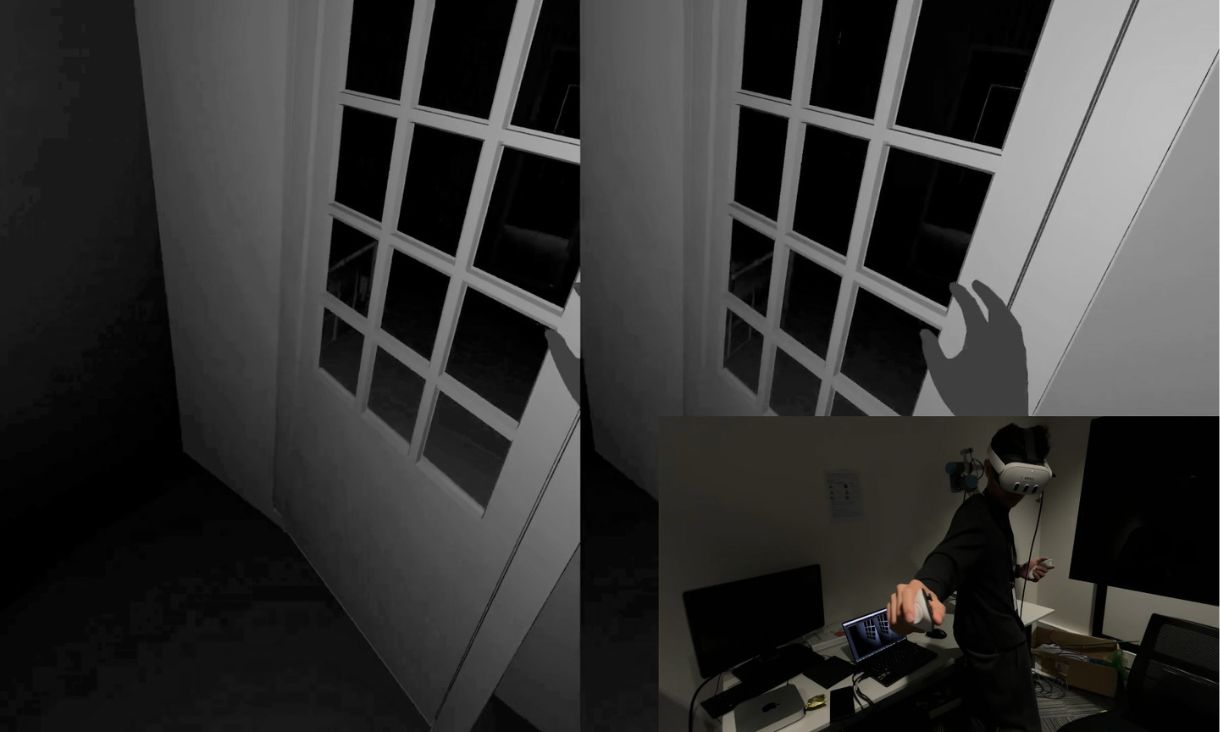
Andy Eng, one of the designers whose work will be available for visitors to experience, designed Look Away, a horror game about self-image, expectation, and the fear of being watched. 

"In our game, you use reflections to reveal things that your eyes can't normally see. These include things that might not exist in reality, or even things that move when they shouldn't,” he said. 

"Since the horror is psychological, we wanted to make it difficult to tell what's real and what isn't."

A person wearing a vr headset in a room contrasted with the view they see while wearing it. The view is a door with a hand reaching out.A still from Andy’s game 'Look Away'

Working with technologies most people have never had the chance to interact with, Andy explained his team wanted to create a horror experience with specialised mechanics that could only work within a virtual reality (VR) platform. 

"We leaned a lot into the platform's unique spatial affordances and heightened sense of immersion. Since actions like turning door handles and picking up objects translate naturally in VR, we wanted to make an experience that feels uncomfortably close and terrifying," he said. 

"Having to perform all these different actions while trying to navigate using reflections can feel really intense and disorienting, especially while something might be following you." 

“We want visitors to leave feeling like they've experienced something only VR is capable of delivering.” 

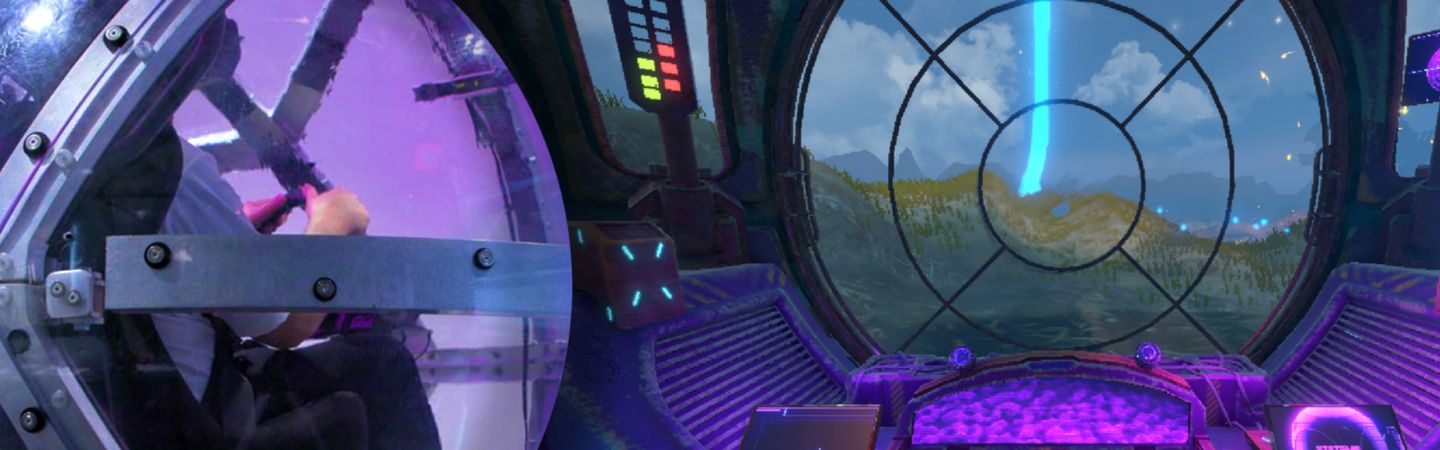
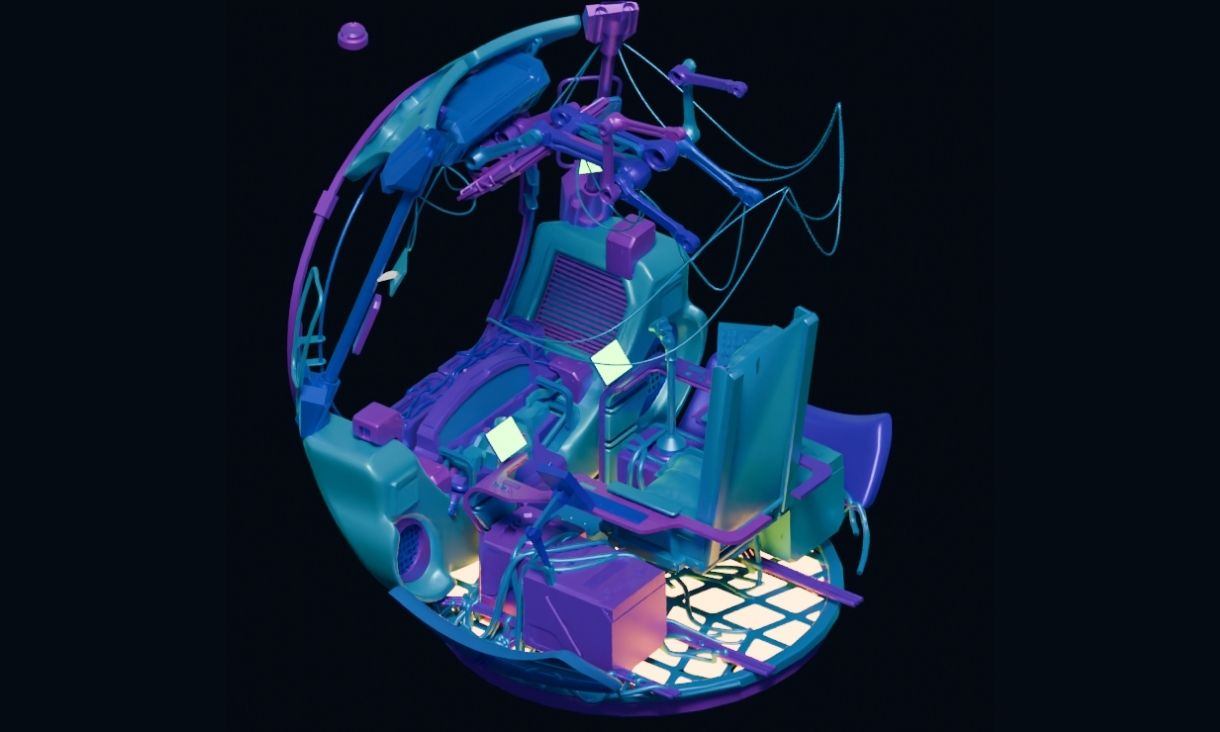
Yohan Dsouza worked on a game called NOVAROVER, a VR experience where you take control of a four-legged mechanical being traversing the harsh terrain of an unknown planet. 

The Nova 360 Simulator physically rotates to match the in-game rotation, making players feel the weight of gravity instead of just seeing it.  

“It makes players ask themselves, ‘do I really want to hang upside down in a cave formation, or just play it safe?’ They slow down, read the terrain ahead, and plan the route accordingly,” he explained.

Designing games at EPIC workshop

The games available to experience at the exhibit have been created by students who have undertaken the Exploration, Prototyping and Ideation for Creative Technologists (EPIC) Workshop at RMIT over the past two years.  

EPIC is an RMIT University, cross-school collaboration, bringing together students from the Masters of Animation, Games and Interactivity (MAGI) and Master of Design, Innovation and Technology (MDIT) programs in the School of Design (SoD). 

EPIC runs over two weeks as a full-time intensive course where students work in small collaborative groups to produce XR prototypes.

The workshop runs in collaboration with STEM College, via an agreement that provides access to sophisticated XR tools and experienced technical support staff. For the duration of the workshop, Design and Media students are housed in the STEM XR Lab, working intensively with STEM tools, equipment, and practitioners.

A rendered image of a sci-fi blue and purple orb with a collection of machine parts and barely recognisable parts resembling chairs, netting and powerlines.Yohan’s game, 'NOVAROVER', allows players to walk around on other planets

Yohan said the workshop pushed the students in their skills and to produce something under significant time pressure. 

“The EPIC workshop pushed us to make a playable project under a two-week time constraint,” he explained.  

“It let each of us focus on what we were strong at but also forced us to learn new things by kicking us out of our comfort zones. Working with new tools and finding novel ways to apply our skills is exactly what I needed, and getting to do that alongside a skilled cohort makes the learning stick.” 

Design Week using ideas to navigate a complex world

Melbourne Design Week (MDW) is held annually over 11 days in Melbourne and regional Victoria. 

Driven by ideas, MDW provides a platform for designers, thinkers, educators, businesses, and enthusiasts to come together to share perspectives, showcase new work, and consider how design can be a force for good in an increasingly complex global landscape.  

The program features talks, tours, dinners, exhibitions, launches, and workshops, and will run from 14–24 May in 2026. 

Yohan said that the opportunity to exhibit at Australia’s leading design festival was a privilege.

“MDW puts student work in the same room as established studios and national institutions,” he said. 

“Showing NOVAROVER there means the experience gets read as design, not just a student project.” 

Andy said exhibiting at such a prominent festival gives the students a chance to showcase the results of their experimentation and hard work to a wide and diverse audience, especially within the design industry.  

“The potential feedback we recieve will be really helpful in improving the game for future release,” he said. 

“Honestly, having my work shown at such a significant event is both incredibly lucky and feels really rewarding.” 

--

If you want to know more about the Playable XR Showcase or register to attend, visit the Melbourne Design Week website.

29 April 2026

More student news

aboriginal flag float-starttorres strait flag float-start

Acknowledgement of Country

RMIT University acknowledges the people of the Woi wurrung and Boon wurrung language groups of the eastern Kulin Nation on whose unceded lands we conduct the business of the University. RMIT University respectfully acknowledges their Ancestors and Elders, past and present. RMIT also acknowledges the Traditional Custodians and their Ancestors of the lands and waters across Australia where we conduct our business - Artwork 'Sentient' by Hollie Johnson, Gunaikurnai and Monero Ngarigo.

Learn more about our commitment to Indigenous cultures