PhD graduate Mustafijur is turning silkworm cocoons into a scaffold for nerve repair

PhD graduate Mustafijur is turning silkworm cocoons into a scaffold for nerve repair

With a background in textile engineering, Mustafijur has developed a silk-based scaffold designed to help damaged nerves regrow after serious injury.
Repairing a badly injured nerve can mean sacrificing a healthy one.

When a nerve in an arm or leg is seriously damaged, the messages that let us move and feel can stop getting through. If the injury leaves a large gap, surgeons may need to take a healthy nerve from elsewhere in the body to bridge it, which can leave patients with loss of feeling where that nerve was removed.

The PhD research of Mustafijur Rahman offers another option. He developed a three-layer scaffold that mimics key features of the structure of a natural nerve, giving cells a structure to attach to and grow along.

“It was exciting to take a natural material and turn it into a structure designed for nerve repair," Mustafijur said.

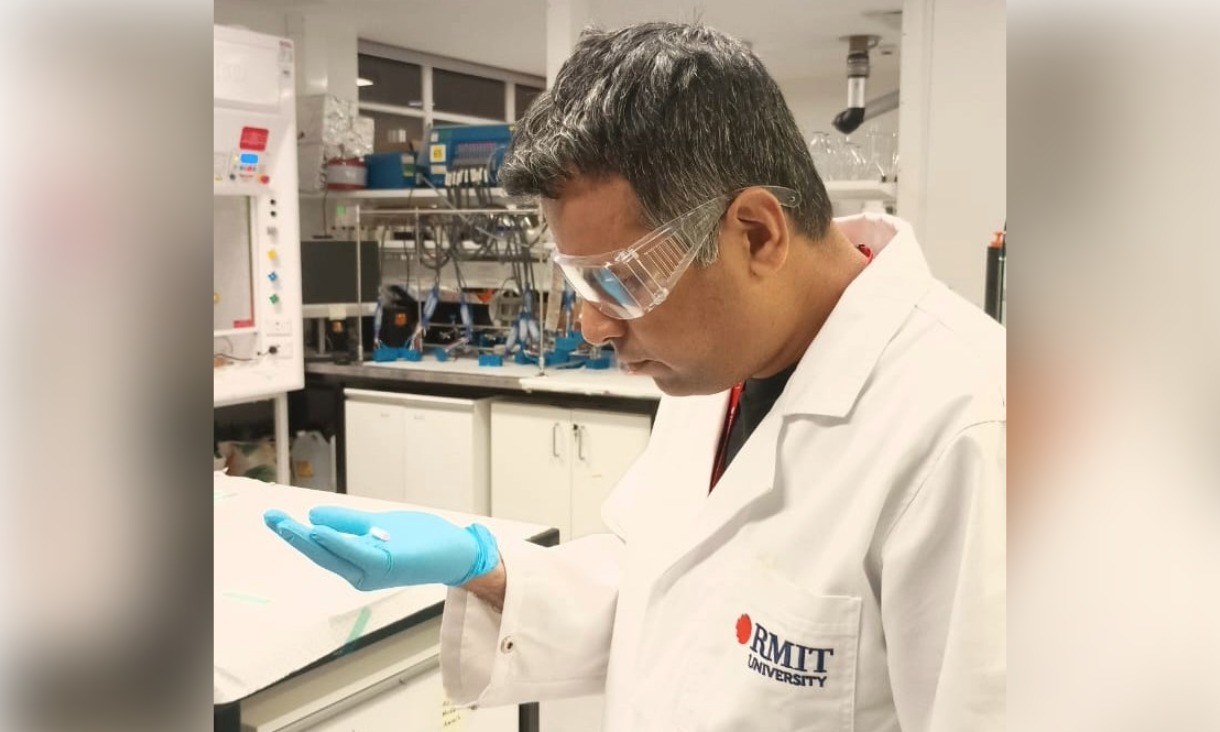
Mustafijur Rahman in a lab coat and safety glasses examining a small sample on his gloved hand.Mustafijur Rahman at work in the lab.

From silkworm cocoons to nerve cells

Mustafijur started with silkworm cocoons. He developed a modified process to extract silk fibroin, the natural protein that gives silk its strength, and turned it into very fine, aligned fibres.

These fibres form the scaffold’s inner layer, acting like tiny tracks that guide cells in one direction. He also added gold nanoparticles to this layer to make it electrically conductive. The middle layer provides strength and flexibility, while the outer layer forms a porous protective covering.  

A vital part of the research was guiding Schwann cells, which support nerve repair and help create pathways for damaged nerve fibres to grow along.

"Keeping them alive was only part of the goal. I also wanted to help them line up in the right direction” Mustafijur said.  

In laboratory tests, more than 98% of cells remained alive on the scaffold. By day seven, the Schwann cells had lined up along the silk fibres almost perfectly.  

Seeing the cells follow the structure I had developed made all those experiments feel worthwhile.

The longer-term hope is to contribute to better treatments for people with serious peripheral nerve injuries. Further studies are needed to find out whether the scaffold can support nerve regrowth and help restore feeling of movement.

A research journey of resilience

Mustafijur completed his Bachelor of Science in Textile Technology at the Bangladesh University of Textiles, followed by a Master of Science in Textile Technology at the University of Manchester.  

At RMIT, he saw a chance to apply his knowledge of fibres and materials to a healthcare problem. He received his admission and scholarship offer in early 2020, but COVID travel restrictions delayed his arrival in Melbourne by almost two years. During that time, he also lost both of his parents.

“That was the hardest part of my journey,” he said. “Their values stayed with me, and the support of my family and supervisors helped me continue.”

Moving into biomedical research meant learning new skills like cell culture and biological testing. Along the way, Mustafijur received 10 awards for his research and presentations, including the 2025 People’s Choice Award for his Three Minute Thesis titled “Healing Nerves, Restoring Lives”.

Mustafijur credits his supervisors, Associate Professor Shadi Houshyar, Professor Rajiv Padhye and Associate Professor Anita Quigley, for their guidance and care. 

“Shadi supported me from the beginning, even before I formally started my PhD,” he said.

“They helped me complete the research, but they also helped me grow as a person and as an independent researcher.”

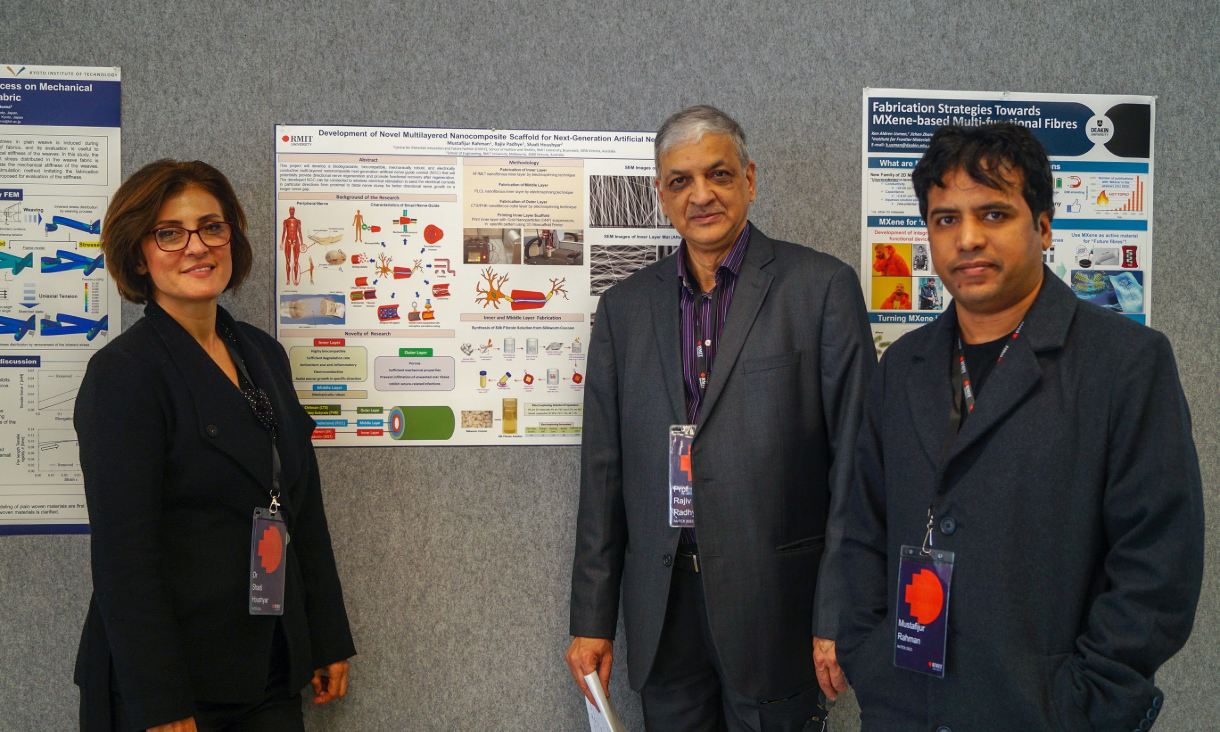
Dr Shadi Houshyar, Professor Rajiv Padhye and Mustafijur Rahman standing in front of their research poster on nanocomposite scaffolds for artificial nerves.Mustafijur Rahman (right) with his supervisors Associate Professor Shadi Houshyar and Professor Rajiv Padhye.

What’s next?

Mustafijur is continuing his research at RMIT as a postdoctoral researcher, alongside teaching as a sessional academic.

He also plans to take his PhD scaffold further.

“Most of the testing was done using flat pieces of the material, so an important next step is developing it into a small tube that could bridge a nerve gap and testing it in more advanced biological models,” he said.

“My longer-term goal is to work with researchers and clinicians to move these findings closer to practical use.” 

Follow Mustafijur’s research on LinkedIn.

grads-news-promo-2026-1220x732.jpeg

Celebrating our 2026 graduates

Read about more exceptional RMIT students graduating this year.

28 October 2026

More student news

aboriginal flag float-starttorres strait flag float-start

Acknowledgement of Country

RMIT University acknowledges the people of the Woi wurrung and Boon wurrung language groups of the eastern Kulin Nation on whose unceded lands we conduct the business of the University. RMIT University respectfully acknowledges their Ancestors and Elders, past and present. RMIT also acknowledges the Traditional Custodians and their Ancestors of the lands and waters across Australia where we conduct our business - Artwork 'Sentient' by Hollie Johnson, Gunaikurnai and Monero Ngarigo.

Learn more about our commitment to Aboriginal and Torres Strait Islander peoples