We ask Aldona, owner of Poolside Studio and RMIT alum, six questions about their life of creative practice.
1. What did you study at RMIT and what attracted you to that program?
I completed the Certificate IV in Training and Assessment (TAE40122) at RMIT in 2026. I already had an established career as a photographic artist and had been delivering creative workshops, but I wanted to strengthen the educational side of my practice and become a more thoughtful and effective teacher.
The program gave me a stronger understanding of how people learn, how to structure meaningful learning experiences and how to make specialist creative knowledge accessible to people with different levels of experience. That has become particularly valuable in developing the workshop program I now deliver from my studio at Montsalvat.
2. What is your business all about?
My business - if I can call it that- it is my life of creative practice, and it brings together my work as a visual artist, photographer and arts educator.
I work from my Poolside Studio at historic Montsalvat Arts Centre in Eltham, where I develop my own artwork and run a growing program of analogue photography and cyanotype workshops. My practice explores photography, memory, migration, archives and place, often using historical photographic processes such as cyanotype across paper, textiles and found materials.
The studio has also become a place where people can encounter the creative process directly. Visitors can see works in progress, purchase original work and learn techniques ranging from introductory cyanotype through to photographic negatives, textile printing, toning and more advanced processes.
What I particularly value is that the teaching and artistic practice are connected: I’m not teaching a process separately from my work as an artist - participants are entering a working artist’s studio and learning within the environment where that experimentation happens every day.
3. Where do you see your business in 10 years’ time?
I’d like to build a sustainable creative practice in which artmaking, teaching and place remain closely connected.
I see my Montsalvat studio becoming increasingly recognised as a destination for learning alternative photographic processes - somewhere people return to for progressively more advanced workshops, specialist masterclasses and ongoing creative development rather than simply attending a single class.
Alongside teaching, I want to continue developing ambitious site-responsive and exhibition work, collaborating with cultural organisations and communities, and exhibiting nationally and internationally.
The aim isn’t necessarily to become bigger for the sake of being bigger. I want to build something distinctive, rigorous and sustainable, while retaining the intimacy of learning and making within a working artist’s studio.
4. How has studying at RMIT prepared you to run your business?
RMIT helped me understand that knowing a subject and knowing how to teach it are two different skills.
The course strengthened the way I plan workshops, communicate complex processes, respond to different learning needs and evaluate whether participants have actually understood what they are doing.
That has been especially useful with cyanotype and analogue photography, where chemistry, exposure, materials and experimentation can initially seem complicated. I can now break those processes into clear stages while still leaving room for curiosity and experimentation.
It has also helped me develop a more structured workshop program at Montsalvat, with pathways from beginner sessions through to intermediate and advanced learning rather than treating every workshop as an isolated event.
5. What advice would you have offered yourself when you first started your business?
I would tell myself not to wait until everything feels perfectly resolved before beginning.
A creative business develops through doing: testing ideas, listening to people, refining what works and allowing some things to fail. Some of my strongest workshops and artworks have emerged from experimentation rather than from having everything mapped out beforehand.
I’d also tell myself to value my time, knowledge and experience properly. Artists can become very good at investing enormous amounts of invisible labour into their work. Building a sustainable practice means treating the creative work, administration, teaching and business side as parts of the same professional practice.
And I’d say: build relationships, not just an audience. The people who return to my Montsalvat studio, take another workshop, visit an exhibition or recommend my work to somebody else have become an important part of the community around my practice.
6. What do you love most about your creative process and artistry?
I love the point where control gives way to uncertainty.
Cyanotype depends on light, chemistry, water, time and material, so there is always an element that cannot be completely controlled. Working from Montsalvat has made that relationship even more important in my practice. I make work outdoors around my studio, using the changing sunlight, plants, architecture and sometimes even water from the Montsalvat pool as part of the process.
The site changes constantly - morning light, winter shadows, spring growth, reflections on the pool - so something I have walked past dozens of times can suddenly become the beginning of a new work.
I also love transforming photographs and family archives into physical objects through printing, textiles, stitching and installation. Photography begins with an image, but for me it increasingly becomes something tactile, imperfect and connected to memory and place.
That combination of experimentation, history and the everyday experience of working from my Montsalvat studio is probably what excites me most.
Alumni bio
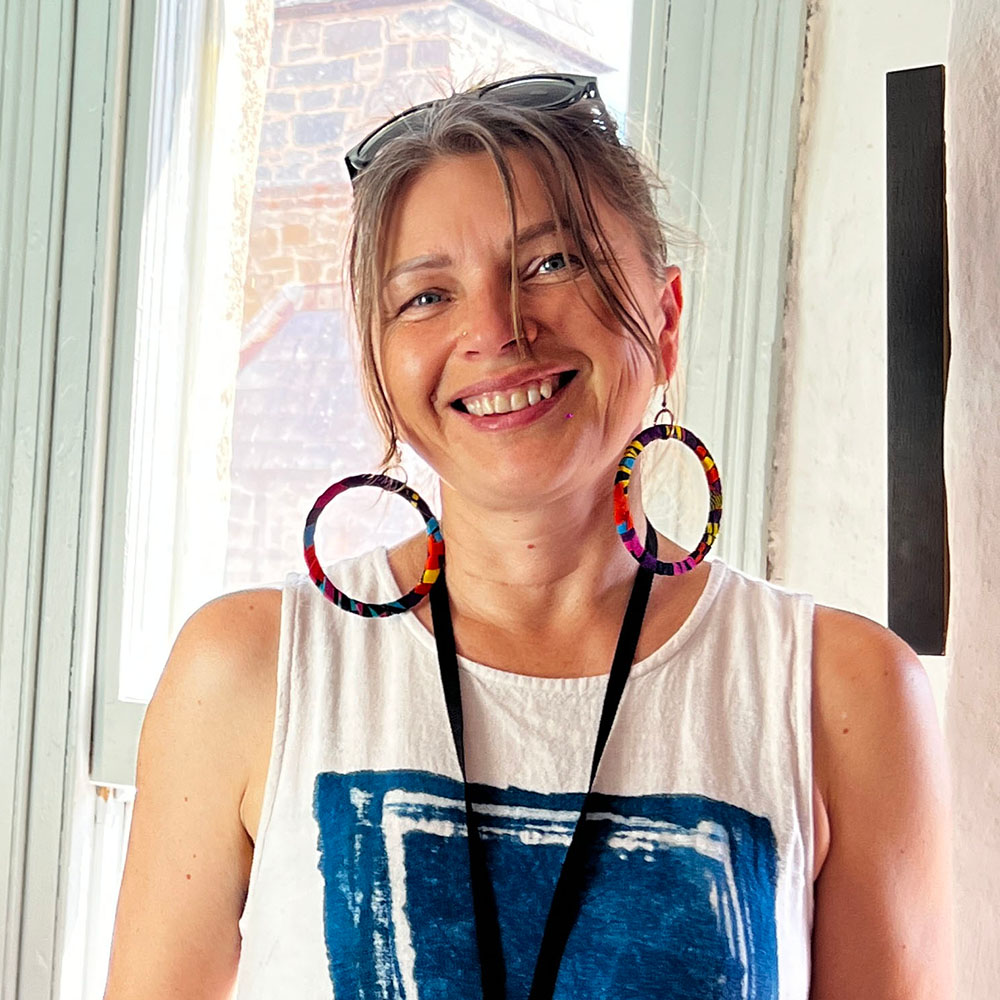
Aldona Kmieć
Visual Artist, Resident Artist & Arts Educator at Montsalvat - instagram.com/aldonakmiec/