A key benefit of Open Educational Resources (OER) is the ability to reuse other educators' resources. Learn about the steps for using OER in your course materials.
When choosing an OER...
Follow these steps to ensure the quality, suitability, and compliance of an OER.
Does the OER meet your needs?
Evaluate your chosen OER to see whether it meets your needs in terms of content quality, accessibility, format, interactivity, and the availability of supporting materials like test banks or slides. There are several tools to help assess the quality of an OER.
Suggested tools:
- The University of Queensland Library has developed a checklist to assess OER.
- The Library’s OER Capability Toolkit has a chapter on evaluating OER.
- A selection of other evaluation tools is listed in the Open Educational Resources (OER) library guide.
Do you need to adapt an OER to meet your needs?
When you use an OER, you can adapt the resource to fit your course curriculum. Adaptation of an OER is allowed where the copyright holder has granted permission to release their work using a certain open licence - as outlined in the Library’s OER Capability Toolkit chapter on adapting OER.
Creative Commons licensing supports the 5Rs of Open Educational Resources (OER):
- Retain (keep copies)
- Reuse (use as-is)
- Revise (modify)
- Remix (combine with other content), and
- Redistribute (share in any form).
CC licences allow creators to define how their work can be used, promoting ethical sharing in education. Each licence combines elements like BY (credit required), SA (share under same terms), NC (non-commercial use), and ND (no modifications). There are six main licences, ranging from most to least permissive, plus the Public Domain Dedication.
For more information about licences, consult the Open Educational Resources (OER) library guide:
Options for adding an OER to a course
When you have found an OER suitable for your course, you can add it to your Reading List (recommended), or link/embed it in a Canvas course.
Adding an OER to a reading list
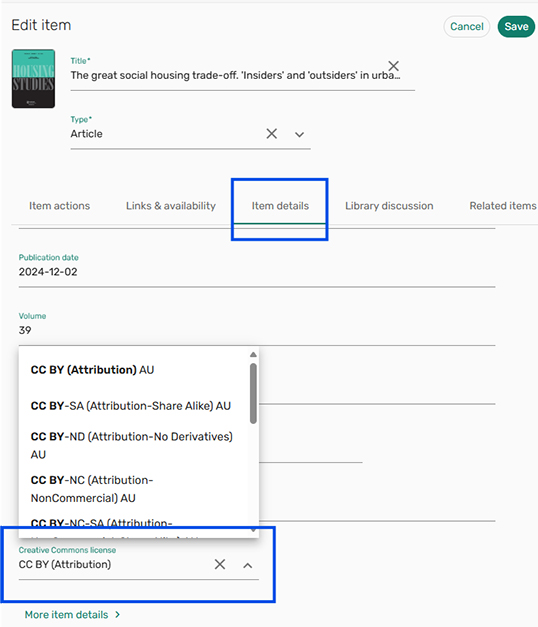
Follow instructions on the Reading Lists in Canvas library guide to add items. Then add the Creative Commons licence to the OER by following these steps:
- Select item edit
- Access item details
- Choose from the creative commons licences that matches the OER item licence
- Save.

Linking an OER into a Canvas course
Copy the URL of the resource you want to share, then follow these steps in Canvas:
- Go to the course and select Page, Assignment, Discussion, or Module where you want to add the link
- Select Edit
- Highlight the text you want to turn into a link (e.g., “Read this OER chapter”).
- Select the Link icon in the Rich Content Editor toolbar
- Paste the URL and select Done or Insert Link
- Save the page
- Confirm the OER displays correctly in Student View.
Add attribution
It is a legal and moral right that all works used are referenced. The RMIT Open Attribution Builder will help you easily cite open material you find; as you fill out the form the application will automatically generate the attribution for you. Simply add this to your Canvas course, modelling best academic integrity practice.
Embedding an OER into a Canvas course
Many OER platforms, such as YouTube, H5P and Pressbooks, offer an embed code (HTML iframe).
Look for a “Share” or “Embed” option, copy the HTML code, then follow these steps in Canvas:
- Go to the Rich Content Editor (in a Page, Assignment, etc.)
- Select the “Insert” menu > “Embed” or select the “HTML Editor” icon (< >)
- Paste the embed code
- Switch back to Rich Content Editor to preview
- Save the page.
Add attribution
It is a legal and moral right that all works used are referenced. The RMIT Open Attribution Builder will help you easily cite open material you find; as you fill out the form the application will automatically generate the attribution for you. Simply add this to your Canvas course, modelling best academic integrity practice.
The Library's Teaching Support team can help
Ask us for:
- OER recommendations for new course development and those undergoing a review activity
- advice on how to replace commercial textbooks with OERs
- advice on embedding OER content in Canvas
- advice on open licensing and Creative Commons.


Create or adapt your own open publication
RMIT Open Press is the imprint under which open textbooks are published at RMIT. Open textbooks published by RMIT authors are supported by Pressbooks, a self-publishing platform.
The Library’s Open Publishing Team can assist with:
- Guiding authors through the open publishing process
- Pressbooks, our publishing platform.



