Strengthening Women’s Research Capacity in Papua New Guinea

Strengthening Women’s Research Capacity in Papua New Guinea

The RMIT Centre for International Development (CID) has been working with the Department of Foreign Affairs and Trade (DFAT) and the Australian APEC Study Centre (AASC) to build research capacity for women in Papua New Guinea (PNG).

Strengthening Women’s Research Capacity in PNG is a multi-million-dollar initiative that aims to enhance the research skills of women in PNG, foster professional networks and build long-term mentoring capacity, leading to better career outcomes for local women.

The program, funded by the Department of Foreign Affairs and Trade (DFAT), was led by CID co-directors Professor Sefa Churchill and Professor Simon Feeny, who worked alongside Professor Janet Roitman, Associate Professor Ankita Mishra and Dr Preety Srivastava.  

Launched in PNG’s 50th year of sovereign independence, the initiative marks a symbolic milestone in the country’s nation-building journey.

Srivastava said the program aimed to empower female academics and researchers.

“We want to give these women tools and resources to become leaders in their fields, promote gender equity in research, and strengthen institutional links between PNG and Australia,” she said.

“By investing in women’s research capacity, the initiative addresses long-standing gender imbalances in academia and other sectors and contributes to PNG’s development priorities” 

“The partnership also reinforces Australia-PNG diplomatic and educational ties, supporting broader regional objectives under DFAT’s development agenda.”

First workshop attracts a diverse group of participants

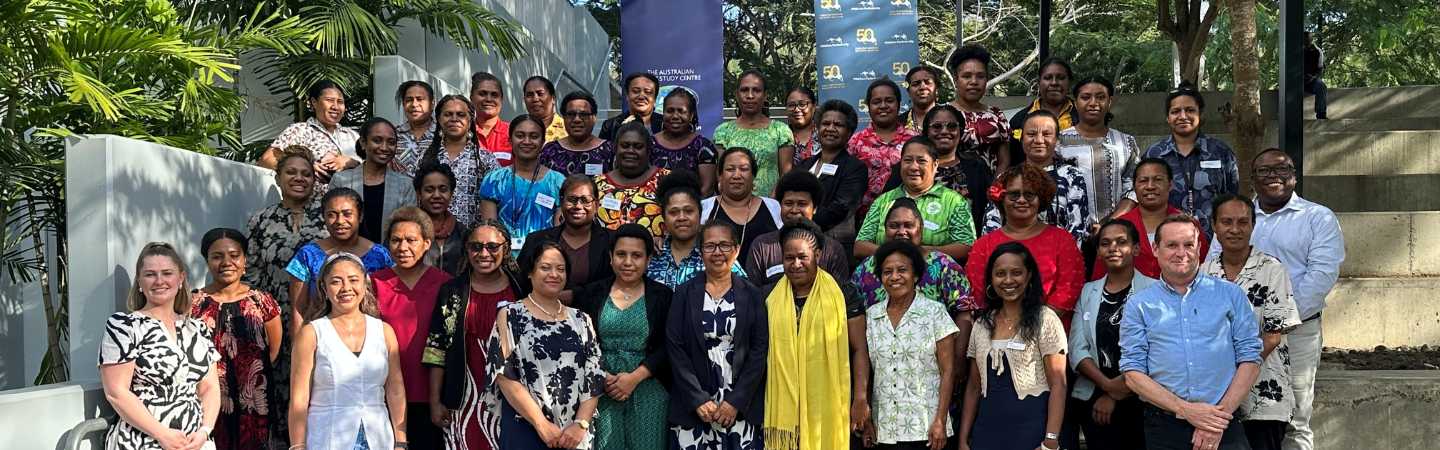
The Program’s first workshop was held in Port Moresby earlier this year, attracting over 40 female researchers from diverse backgrounds.  

Delivered over five days, the workshop covered practical skills focusing on research design and methodology, data analysis and programming, academic writing, publishing, and grant applications, and leadership and collaboration in research.  

“Participants were drawn from a range of academic and professional sectors, including universities, research organisations, and other institutions committed to evidence-based policy and development in PNG,” said Srivastava. 

“Many hold roles that influence teaching, research, and community engagement in their respective fields.”  

Associate Professor Ankita Mishra, who also worked on the project, explained that throughout the initial stage, the group successfully took the first step in developing their own training materials for a diverse audience spanning different career stages, qualifications, and experiences.  

“Starting with no template, the facilitators designed and delivered a five-day workshop that was exceptionally well-received, with over 90% of participants rating each session as valuable,” he said.  

The event concluded with a closing ceremony and certificate presentation by Nic Jonsson, Economics Counsellor from the Australian High Commission in PNG, which was attended by distinguished guests and representatives from various organisations in PNG.  

The event was significant in PNG, featuring inlocal news coverage, including a feature produced by the National Broadcasting Corporation of PNG

Mentorship in Melbourne

At the conclusion of the workshop, 12 selected participants from the Port Moresby workshop will take part in the next stage of the program which will entail an immersive training and mentorship experience at RMIT Melbourne. 

The program’s central goals will be to build sustainable professional and mentoring networks among female researchers, and participants will have the opportunity to further develop their skills through advanced academic training, mentorship, and collaboration with leading experts at RMIT University and partner institutions. Mishra said at its heart, the purpose of this initiative is about unlocking the research potential of women irrespective of their current role or career path.  

“Our workshops are built on a flexible capability framework that meets the needs of women from different professions, while still grounding them in the foundations of academic research,” she explained. 

“For some, this is a chance to reignite a passion for research that was put aside due to a lack of guidance or support.”

“We’ve met women who aspire to pursue higher studies, and others who had to abandon their PhDs midway because they didn’t have the right mentorship. Many already have fascinating, locally relevant research ideas, but need the skills to bring them to life.”

“By strengthening these capabilities, we’re not just helping women achieve their personal and professional goals we’re empowering them to make contributions that can influence the broader economic development of PNG.” 

Going forward, Strengthening Women’s Research Capacity in PNG will deliver additional workshops in Lae and Goroka. Participants from these areas will also be eligible for selection for a four-week training and mentorship program in Australia.  

In the longer term, the program also aims to establish sustained mentorship structures to support participants in advancing their research careers. This will also facilitate and strengthen collaboration between PNG and Australian universities to foster academic exchange, joint research projects, and sustainable capacity building.

Story: Claudia Lavery & Finn Devlin 

16 September 2025

Share

16 September 2025

Share

  • Business
  • CoBL
  • Research
  • Society

Related News

aboriginal flag float-start torres strait flag float-start

Acknowledgement of Country

RMIT University acknowledges the people of the Woi wurrung and Boon wurrung language groups of the eastern Kulin Nation on whose unceded lands we conduct the business of the University. RMIT University respectfully acknowledges their Ancestors and Elders, past and present. RMIT also acknowledges the Traditional Custodians and their Ancestors of the lands and waters across Australia where we conduct our business - Artwork 'Sentient' by Hollie Johnson, Gunaikurnai and Monero Ngarigo.

More information