
RMIT opens Discovery to Device MedTech facility

RMIT opens Discovery to Device MedTech facility

The Hon. Dylan Wight MP, Parliamentary Secretary for Jobs and Industrial Relations, and Victoria's Lead Scientist Dr Amanda Caples have launched RMIT's Discovery to Device MedTech Prototyping and Scale-Up facility (D2D).

The D2D facility was established through $12.7m from the Victorian Government, via the Victorian Higher Education State Investment Fund (VHESIF) Pool 2.

Officially opened on April 28, 2026, it is an advanced facility for prototyping medical devices for wearable, nearable, and diagnostic applications. 

The facility is a one-of-a-kind pathway for medical device translation that also strengthens Victoria and Australia’s sovereign capability. It is the only facility of its type in the wider Asia-Pacific region for niche medtech products.

Share

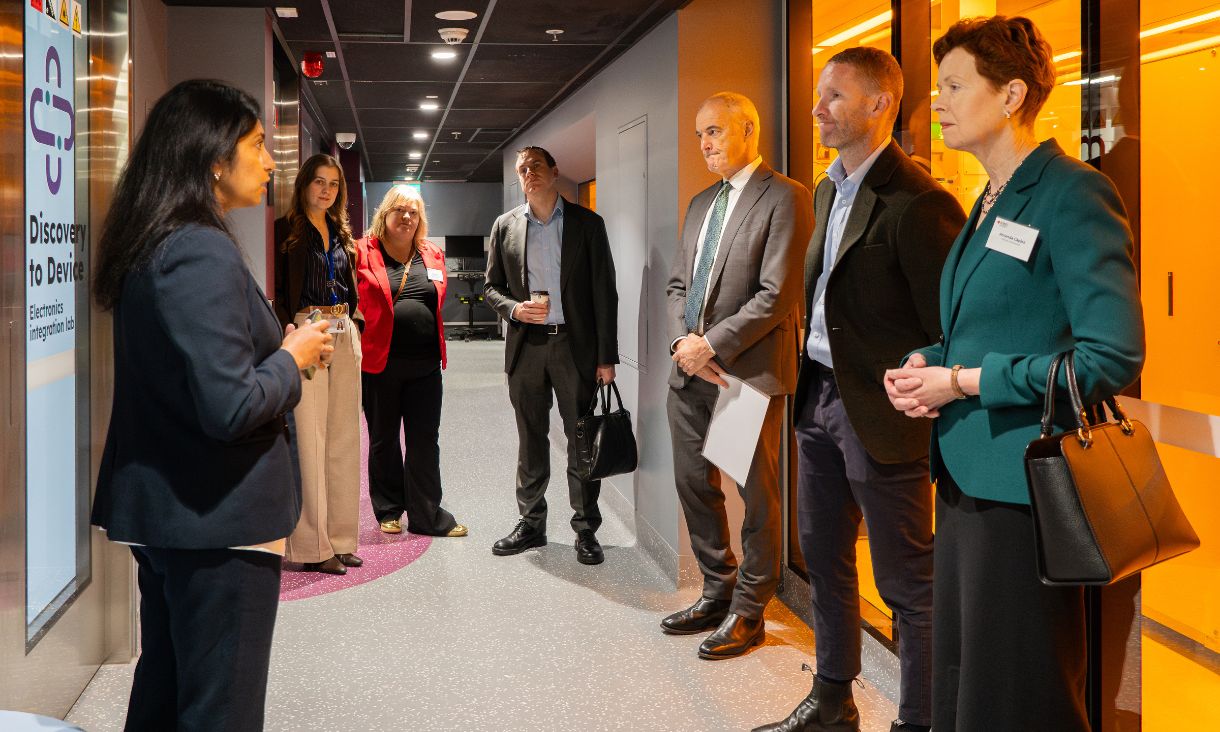
The Hon. Dylan Wight MP, and Dr Amanda Caples were given a tour of the D2D Facility, led by Distinguished Professor Madhu Bhaskaran.The Hon. Dylan Wight MP, and Dr Amanda Caples were given a tour of the D2D facility, led by Distinguished Professor Madhu Bhaskaran.

Distinguished Professor Madhu Bhaskaran, Director of the D2D facility at RMIT, said the facility focused on research translation, turning early-stage ideas into working, testable, investable solutions.

“This is not just a facility, but a critical piece of innovation infrastructure,” she said.

“Australia produces world-class research, but too often great ideas stall before they become real products. That gap between discovery and deployment is where D2D operates.”

“This is not a traditional lab. It’s a build-and-validate environment where researchers, engineers, product designers, clinicians, and industry come together to solve real problems.” 

The facility bridges the gap between scientific discovery and product development, enabling rapid prototyping of wearable technologies, diagnostic tools, and biosensors. 

It has already lined up industry partners to create several innovations in the medical technology (MedTech) field.

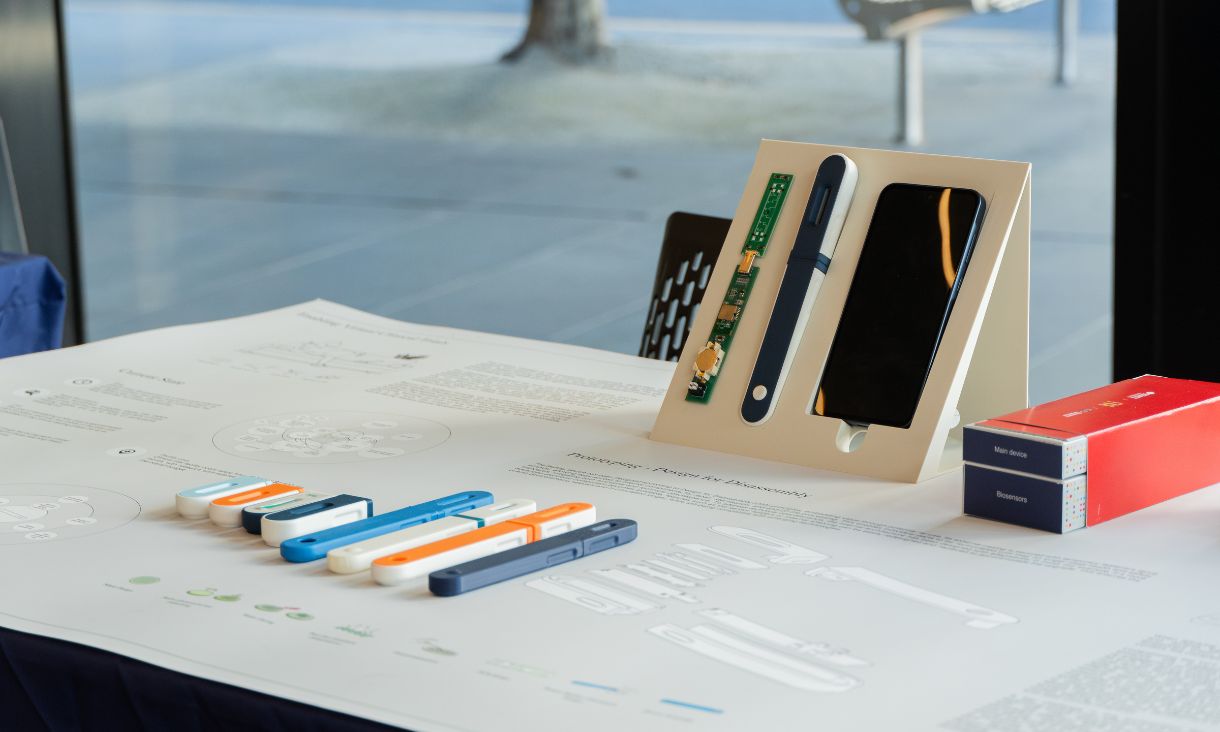
Display of technology.The facility is open to collaborations with industry to advance medical care globally

Dr Nikhilesh Bappoo, the Co-founder, Managing Director, and CEO of MedTech start-ups VeinTech and Lubdub - whose products will be made in D2D - spoke at the showcase, outlining the organisations vision and emphasising strategic importance of creating and prototyping MedTech products in Australia, at facilities like D2D. 

“The launch of Discovery to Device is the creation of something that founders like myself have been searching for, for a very long time,” he said.

“When you step into healthcare you realise something very quickly: The problem isn’t innovation. It’s translation. This is where facilities like Discovery to Device become critical, especially for startups and small-to-medium enterprises.”

Bappoo said Australia’s MedTech sector was prospering but remained hamstrung by funding challenges and the need for translation facilities like D2D, where research can be commercialised and make a quicker and greater impact on medical care throughout the world. 

“Australia’s MedTech sector is rapidly growing. This is a real national strength,” he said.

“But we still face challenges in funding, and as a result too few ideas make it to patients and commercial success. That's why initiatives like this are exciting to showcase success stories, to show what is possible and to inspire the sector nationwide.”

“Real impact doesn’t stay in one place. It grows. It spreads.”

“That’s exactly what D2D is already doing for Australia and personally gives me the confidence that our sector can collectively enable the vision of a world where no life is lost because healthcare was too complex, too late, or out of reach.” 

Solving for workforce and productivity challenges

The D2D facility provides Victoria with a unique facility and capability to support long-term productivity and workforce needs.

The skills required to design, build, integrate, operate, and use data from medical devices cover every sector and will showcase Victoria’s immense talent pool, as well as providing real-world exposure to students.  

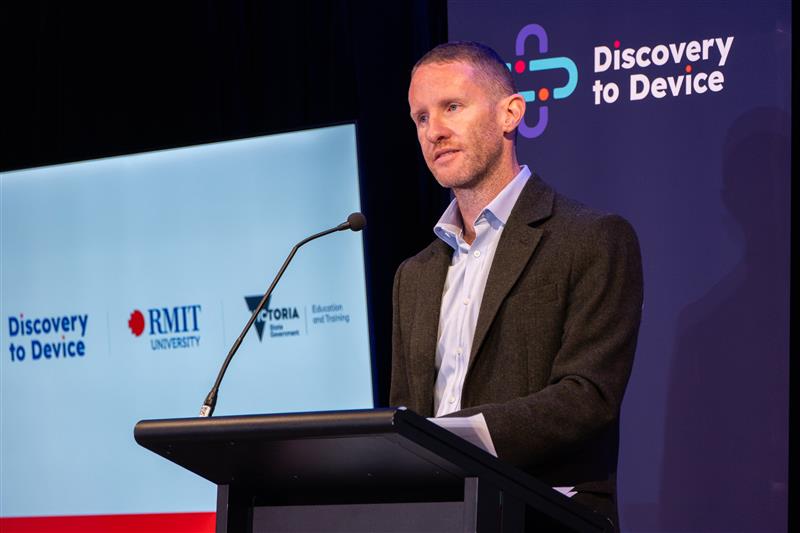
The Hon. Dylan Wight MP, Parliamentary Secretary for Jobs and Industrial Relations, made remarks at the event. The Hon. Dylan Wight MP, Parliamentary Secretary for Jobs and Industrial Relations, made remarks at the event.

It is located within the City North Social Innovation Precinct, one of RMIT’s signature initiatives focused on skills, partnership and innovation.   

Speaking at the showcase, RMIT Vice-Chancellor Professor Alec Cameron said creating the connections between research, design and advanced manufacturing accelerates the movement of ideas into application and was at the heart of RMIT’s broader innovation strategy.  

“At RMIT, we take an interdisciplinary approach to research, and complex problems are tackled by bringing together engineering, science, technology, design, business and social sciences,” he said. 

“The facility is part of a strategic co-location of industry, education, universities, hospitals and non-profit organisations, physically and purposefully working together to create a powerful environment for delivering skills and solving the complex problems we face.” 

“We are collectively committed to nurturing the conditions for sustained collaboration and contribution to the communities we exist to serve.” 

A broader strength in MedTech at RMIT 

The D2D facility underpins RMIT’s broader capability in MedTech, where the university accelerates the development and deployment of medical technologies that can improve patient care, reduce healthcare costs, and address public health challenges. 

RMIT’s MedTech research aims to create connected, technologically empowered care for better health outcomes and disease prevention for Australians through discovery and innovation at the nexus of engineering and health.  

This capability is connected by the MedTech Research and Innovation Hub, which brings researchers, clinicians, and industry partners together to collaboratively create and utilise groundbreaking medical technology solutions. 

The primary objective of the MedTech Hub is to create an integrated ecosystem that connects key domains, leading to better societal outcomes through faster, more productive and higher quality technological advancements.  


Story: Finn Devlin

Share

Related News

aboriginal flag float-starttorres strait flag float-start

Acknowledgement of Country

RMIT University acknowledges the people of the Woi wurrung and Boon wurrung language groups of the eastern Kulin Nation on whose unceded lands we conduct the business of the University. RMIT University respectfully acknowledges their Ancestors and Elders, past and present. RMIT also acknowledges the Traditional Custodians and their Ancestors of the lands and waters across Australia where we conduct our business - Artwork 'Sentient' by Hollie Johnson, Gunaikurnai and Monero Ngarigo.

More information