Naomi: Good evening. Thank you very much for coming.
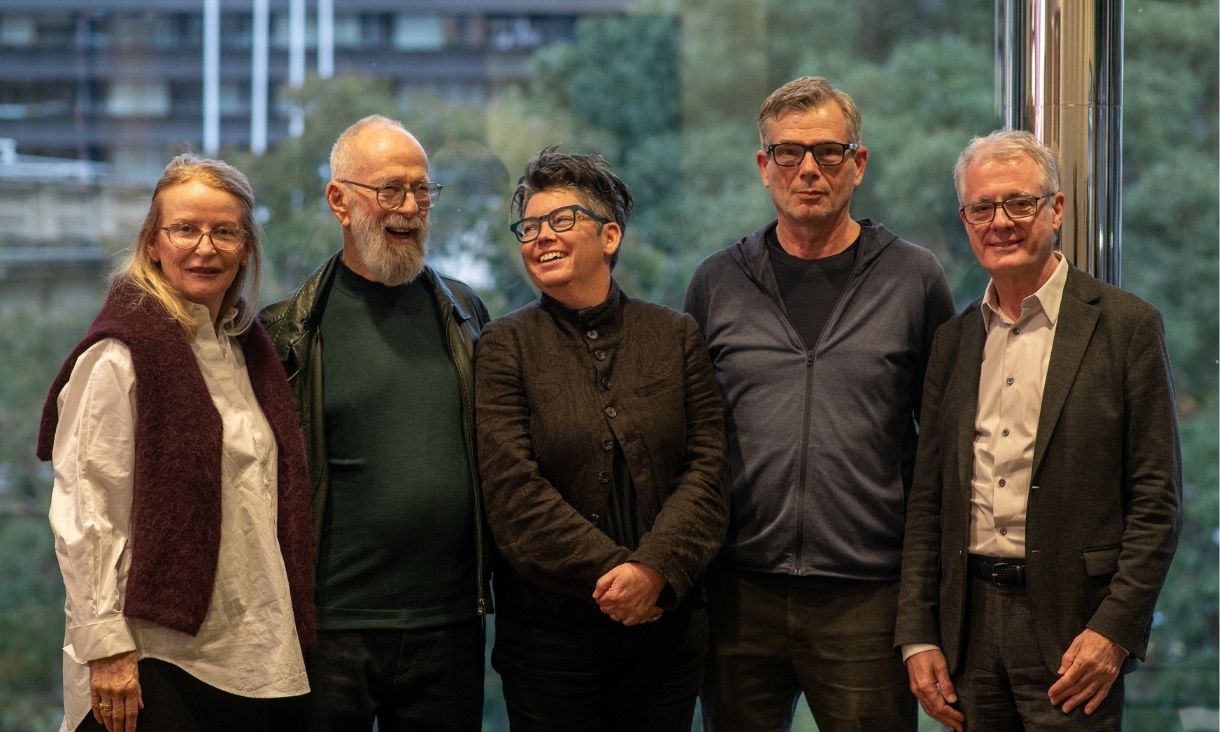
My name is Professor Naomi Stead and I am Associate Deputy Vice Chancellor Engagement in the College of Design and Social Context here at RMIT University. I'd like to welcome you all and thank you for joining us this evening for 'Sol LeWitt: Recollections of a Great Artist and a Wonderful Friend'. A very special talk by John Kaldor, AO.
At RMIT University, we acknowledge the people of the Woi wurrung and Boon wurrung language groups of the Eastern Kulin Nation on whose unceded lands we conduct the business of the University.
We respectfully acknowledge their Ancestors and Elders, past and present, and all Traditional Custodians of lands and waters across Australia.
I'd also like to extend my respects to any First Nations people joining us here this evening. So it's my genuine pleasure to welcome John Kaldor to RMIT to share some of his memories of Sol LeWitt from the past five or so decades. For RMIT, this isn't our first engagement with John.
Back in 2008, he commissioned Kaldor Public Art Project No.18 with Martin Boyce here on the RMIT city campus. At the time 'We are shipwrecked and landlocked' was Boyce's largest and most ambitious work.
It was installed in our Alumni Courtyard, the former exercise yard of the Melbourne Gaol. Always at the vanguard of the global art scene and championing innovation, John Kaldor also supported the inaugural exhibition at our newly built Design Hub Gallery in 2013. The exhibition was Walter Van Beirendonck's 'Dream the World Awake'.
Originally shown in Antwerp's MoMu Fashion Museum, a psychedelic exhibition making visible quote, "An alternate universe where gender is fluid, colour is law, and humour is religion". It was in some ways prescient." I've seen the photographs of that particular event where John was in attendance, and it does indeed look like a truly wild and wonderful party.
We're so pleased to have John back again to engage with the current exhibition, 'The Concentric Influences of Sol LeWitt: Foundations, Pivots and Place' now at RMIT Gallery. John has taken a keen interest in this show, which centres around one of Sol LeWitt's semi-legendary Wall Drawings and features five core international artists who worked closely with LeWitt throughout his career, as well as 13 invited contemporary Australian artists who have been influenced by LeWitt's work.
The exhibition and its associated public programs have been made possible through the work of Dr. Irene Barberis, who instigated, directed, and co-curated this first iteration of a series of exhibitions to be installed across 10 countries as part of 'The Concentric Influences of Sol LeWitt Project', itself part of Irene's broader research. If you haven't had a chance to see the show, please visit before it closes on the 29th of August.
So now to introduce John Kaldor, he is a dedicated collector, patron, and supporter of contemporary art who has been commissioning major and significant international work since the early 1960s. Since 1969, he has generously shared this love of art with the Australian public through his series of Kaldor Art Projects.
The first of these, as I'm sure you all know, was with Christo and Jeanne-Claude, whom he invited to Australia in 1969 to create 'Wrapped Coast - One Million Square Feet, Little Bay, Sydney, Australia.' At the time, it was the largest single artwork ever made, so vast that a complete view was not possible. It took an hour to walk across its surface. Two and a half kilometers of coast were covered in fabric and rope. 'Wrapped Coast' had an enormous impact on Australian art.
Since then, across more than 50 years, Kaldor has consistently brought groundbreaking artists and artwork to Australia through what is now the not-for-profit organisation, Kaldor Public Art Projects. I myself was fortunate to write a profile of the German artist, Thomas Demand, for the Saturday paper in August this last year when he was in Sydney for the installation and opening of the 38th Kaldor Public Art Project, 'The Object Lesson'.
In interviewing Demand, I was struck by the warmth and in fact, I will say love with which he spoke of John Kaldor as an immensely important collaborator, interlocutor, supporter, and patron in the fullest sense of contemporary art on the world stage. John Kaldor has participated on the boards and international council, many art organisations, including PS1 in New York, The Tate Modern, the Biennale of Sydney, and is Chair of the Museum of Contemporary Art also in Sydney.
He was Commissioner for the Australian Pavilion at the 51st Venice Biennale in 2005, and again in 2007. He was a founding member of the board of the Power Institute, a trustee of the Art Gallery of New South Wales, and is currently on the International Council of MoMA, New York.
In 2011, Kaldor gifted his private collection to the Art Gallery of New South Wales. He continues to extend his contribution to public art and education as director of Kaldor Public Art Projects. I know you will have many questions, but I ask you to hold them until the end of John's presentation when we will have minutes, approximately ten or so minutes for John to respond to questions. Please join me in making our esteemed guest, John Kaldor, very welcome.
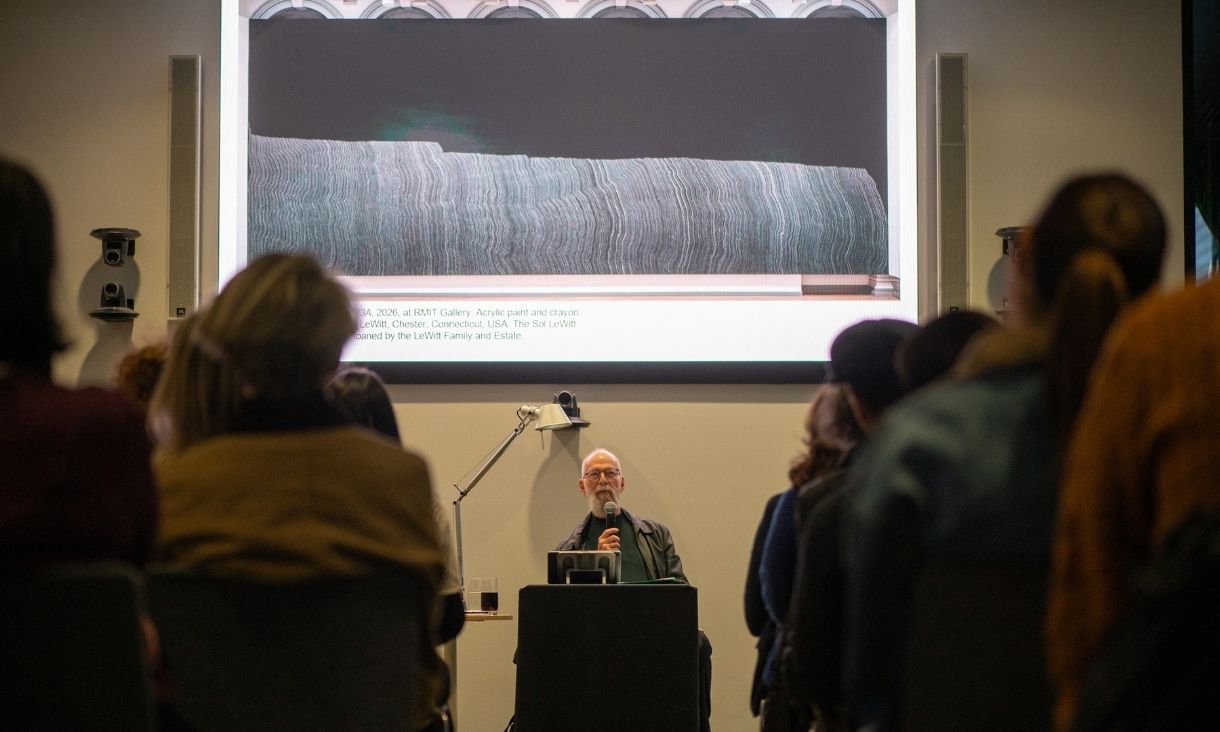
John: Thank you, Naomi. And I'd like to congratulate Dr. Irene Barberis for initiating this show, which is really a beautiful show. And it's a great privilege to see such a moving work from Sol LeWitt.
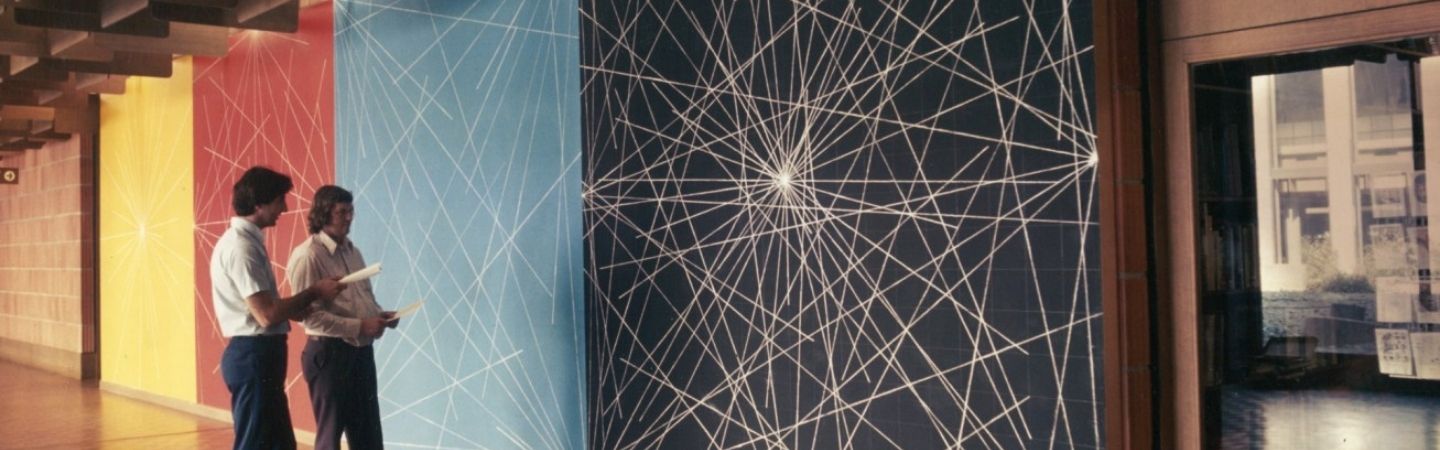
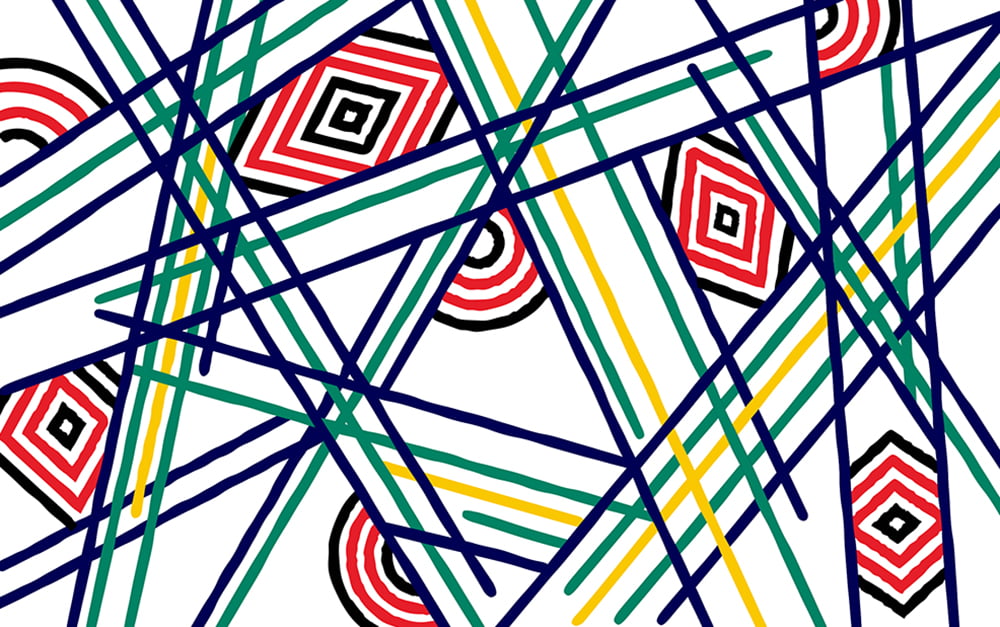
There it is on the screen and (the last people are arriving). It's very typically Sol because it's very, Sol loved music. And to me, when I looked at it, it reminded me of a musical score. You could almost hear the music in the work. And it's very simple, but very elegant, moving, and in a funny way, emotional work. And I think Melbourne is very fortunate to be able to have that.
And if you haven't seen it, you should definitely see it and encourage your friends to see it because Sol LeWitt's influence lives on and on and on. So congratulations. Also, Helen Rayment, who is co-curator of the exhibition and Karra Rees, who liaised with me all the time in Sydney and met me and looked after us.
So thank you, Karra. And Tim Marshall, who our friendship goes back a long way to New York, but before that in Sydney in several different roles. So lovely to see you here and thank you. I also want to acknowledge and thank Michael Waite, who works for Kaldor Public Art Projects. He's our archivist and he knows more about our projects now than I do. So if I can't answer one of your questions, I'm sure he will be able to. So where do we go from here?
Let me introduce Sol with a story. In 1985, I was in New York for a business trip when Sol was having an exhibition when Sol was having an exhibition at the John Weber Gallery in Soho. And I stopped at the traffic lights, in those who've been to New York in the corner of Houston and Broadway. And Sol was there at the traffic lights. And I said, "Sol, I'm really looking forward to see your exhibition." And he said, "So am I." I was absolutely amazed, but that really defines how Sol works. Because in conceptual art, the idea is the creative act.
The execution can be done straight away or years later. Just like - he works like a composer. A composer's music can be performed years and years afterwards and many times afterwards. Now that's the definition of conceptual art, which Sol defined in a way. And it was really groundbreaking. And a very good friend of Sol's, John Baldessari, decided to sing it. Now, he wouldn't audition as an opera singer, but it's really fun to see and watch. And we "Natural artists. Are mystics rather than rationalists. They leap to conclusions.
That logic cannot reach. September 13, a work of art may be understood as a conductor from the artist's mind to the viewer's. But it may never reach the viewer or it may never leave the artist's mind."
Now, I thought I had that bad voice when I used to sing happy birthday to everybody. John Baldessari would be good competition for me. "Are mystics rather than rationalists."
So I want to somehow paint a scene for you because not many have been lucky enough to be in Soho in the early '60s and '70s when New York was really the creative centre of contemporary art. And it was one square mile known as Soho, which was between Houston and Canal Street and Broadway and West Broadway, where it was a light industrial space, which artists initially lived there illegally. And then eventually they got permission. But also the first contemporary gallery started.
I mean, now contemporary galleries are all over the place. And it's a huge, huge billion dollar industry. In those days, there were, I think, three or four galleries in Soho just starting out. The leading one was Leo Castelli, who really was the father of Pop Art. He showed first Andy Warhol, Robert Rauschenberg, Jasper Johns. And that's where Pop Art took off in the late '50s, '60s. And I say I was very fortunate that I was there several times for work. And I had the chance to be there and witness those exhibitions. In the late '60s, Paula Cooper started also in Soho, and she showed minimal artists like Judd, Flavin, Carl Andre. And she also showed Sol LeWitt in a mixed exhibition where I think he made his first Wall Drawing. And Paula introduced me to Sol, I believe, around that time. And he and I got on well. And I started to collect his work early on.
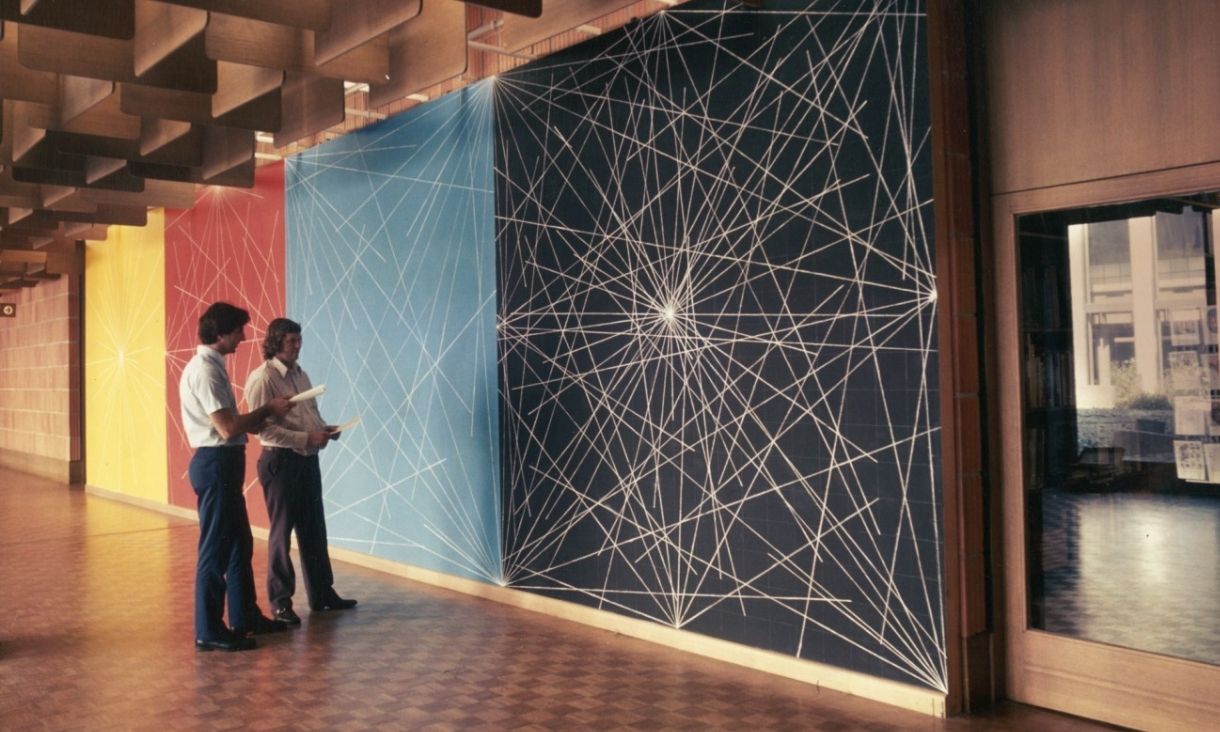
Sol was very different to the other artists. He was quiet, reserved, a great sense of humor once he got going. And like with other artists, once I started to collect them in depth, I wanted to share my love of the art and artist with the Australian public. So through Kaldor Public Art Projects, I invited him to come to Australia. And he came to Australia in 1977 to have an exhibition in the Art Gallery of New South Wales and the NGV in Melbourne.
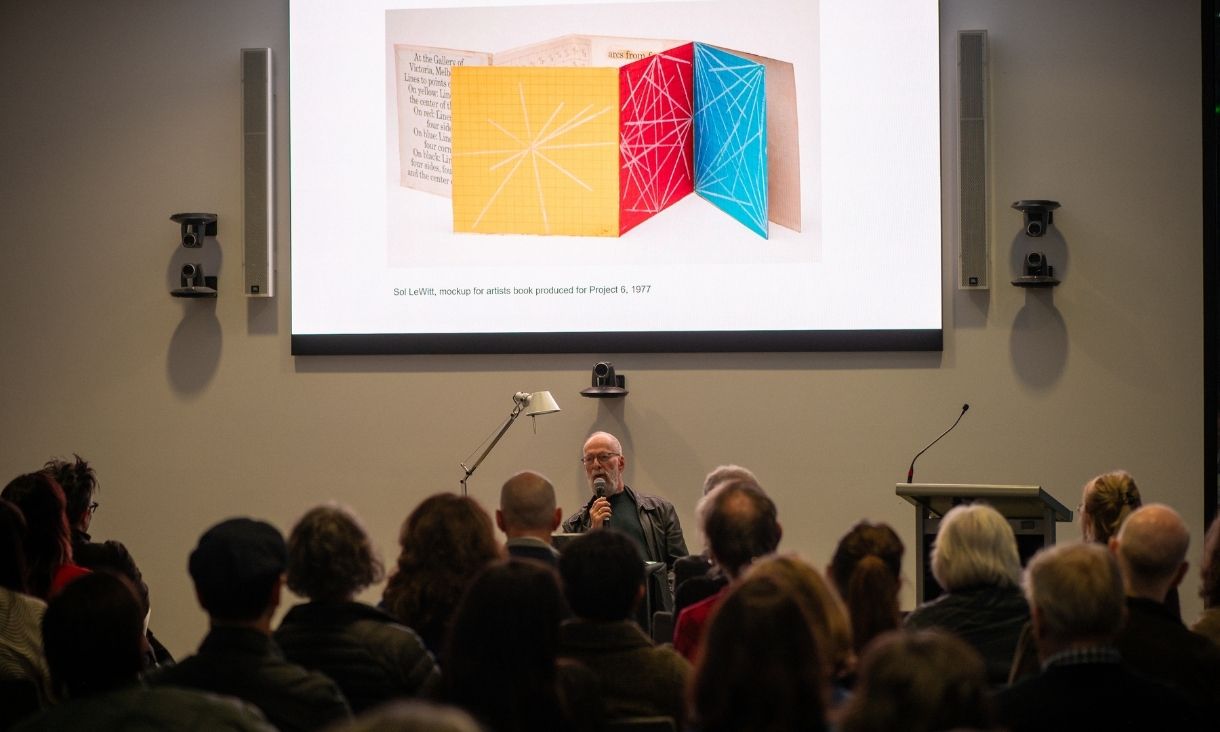
Now, in those days, Sol was not shy, but very withdrawn. He wrote me a letter before he came that he doesn't want any parties. He doesn't want too much publicity. He just wants to do the work and go back to his motel and watch TV. And he was very worried about his cats back in New York. We made two Wall Drawings. I say one in Sydney, which was the biggest Wall Drawing that Sol did to date. And we got an image of that. It's hard to see, where we had students from the art school doing the work with Sol overseeing it. And then in Melbourne, a completely different work, a colourful work at the NGV. And also a small booklet was produced of this work. Both were temporary works and they were overprinted, overpainted after a while. So after the project, I kept in touch with Sol. And every time I was in New York, we had lunch or dinner or went to concerts together. Later on, I sat through Wagner's 'Ring Cycle', which is four very, very long operas with Sol, but we both loved it. Sol moved to Italy in 1980, and that really changed his life completely.
He met Carol, who was considerably younger than he. She was an American of Italian heritage. They married in 1982. And they have two daughters and Sophia and Eva. And his life changed like 180 degrees. He became much more outgoing, much happier. He or they loved a good dinner, a glass of wine, red wine, and parties, et cetera. He was totally changed person. And Sol had a very selective hearing. The people he was interested in, he would hear every word. The people he was less interested, only a few words came through. So he was quite a character.
It took a while to explain to people about his hearing. When he was in Australia first, 1977 for the first project, he came home to my home in Woolwich where I have lived since 1962, the same house. It's an old Victorian gothic. And on either side of the balcony doors, he decided to do a Wall Drawing. And he asked my 12 or 13 years old daughter to help him. And it was just a black and white crayon drawing. But he made such a mess, Sol, that my wife then and I had to go with erasers behind him to clear the finger marks. So I think Sol stopped doing Wall Drawings himself and trained others to execute it for himself, which was a very good move. But he and I became very close. And as I say, I continued to collect his work, not only drawings, but also sculptures and what he called 'Splotches'. Those are 'Splotches'. And he had a great variety of works. Very, very different. But these are very happy, fun works, which I had in my bedroom and I really loved. They're now in the Art Gallery in Sydney.
On another trip to New York, a Los Angeles gallery, Ace, rented a temporary industrial space and had an exhibition of Sol LeWitt, which was totally different. Till then, I was used to his Wall Drawings. But that work was colourful. He still calls it drawing, but they were really paintings with acrylic, happy, joyous. We tried to find an image. Neither the Foundation nor the Ace Gallery could find an image of it. But it was, to me, quite a departure from his usual work. And I asked him, "Let's do another project." And he came to Australia in 1998. And these are images from the MCA. He completely covered the walls of the MCA. It was painted by preparators of the MCA. But as you see from the images, they are happy, joyous, colourful works. A totally new vocabulary from the early Wall Drawings. Interestingly, at the same time at the Art Gallery of New South Wales, there was an exhibition of Emily Kngwarreye paintings from Utopia curated by Margo Neale. And they were desert artists. And Sol, who didn't know anything about Aboriginal art, was absolutely taken by it. And he asked me where could he buy some? And I didn't know anything about Indigenous art. And I said, "Well, I inquire. Let me see if I can find something." And at that time, we went to a small gallery in Paddington and he bought a small gouache. When he got back to New York, he wrote to me saying he really is fascinated by the works. And could we come to an arrangement like he has with many other artists? He said he exchanges works with many artists. And even though his works would be a lot more valuable than the young artist he was exchanging with, he was happy to do so. So he said, "How about you sending me Aboriginal paintings and I send you some drawings or gouaches?" And I said, "Great. It's a wonderful idea." And it was also very much a learning cycle for me because I collected for him Aboriginal works till his death for 20 odd years or more. And there are, I think, 30 odd works in the LeWitt, Sol LeWitt Estate now, which are shown regularly.
An Australian friend, Nicholas Baume, was curator at the Wadsworth Atheneum And he did a show with Aboriginal artists next to Emily Kngwarreye, and they looked terrific together. It was actually Carol LeWitt who took a fancy to Nicholas Baume, who was an Education Officer at the MCA, and encouraged Nicholas to come to the States. And he's been there ever since. And for many years now, he is running public art in New York very, very successfully. What's that image up there? Oh, one of the gouaches that he sent to me, he gave instructions how to frame it. Most of those now, again, are at the art gallery of New South Wales. Sol, when he traveled, used to send postcards, as Irene probably knows. And I have so many postcards from various destinations from Sol with little sketches, which are really lovely and very moving to have his personal travel diary at home.
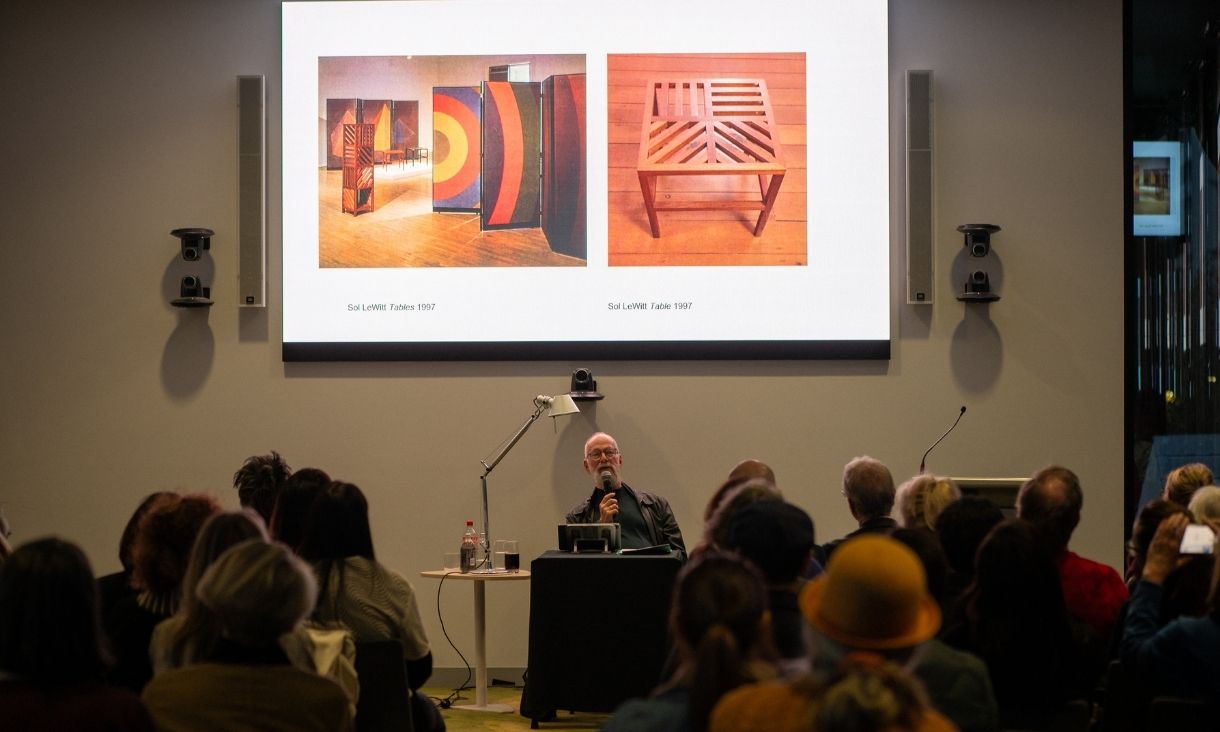
We spent a lot of time together in New York with Sol and Carol concerts, restaurants, looking at other galleries. Sol and Carol led a very happy and full life. His home in Chester was warm and beautiful and he built a studio next to it. And one time I'd admired, he made for himself a bookcase and a little coffee table. And I said, "Sol, those are beautiful. Did you make more?" And he said, "No, that's what I made." And I said, "Oh, I'd love to have them." And he said, "They're yours." So he just gave them to me. And he sent them to Australia. Very, very generous. That's the table. And the bookcase is in similar style using his signature, lines horizontal, lines vertical, lines diagonal one way, diagonal the other way.
As I say, he was a very, very generous person. Also, it was a rare privilege to see his studio and to see new works as they're being created. And luckily we could pick the works we wanted. So I feel very privileged. I saw an exhibition in London in 2006, which was very grim. And you could feel that Sol was already quite ill. There was scribble lines, all black and white. And they were sad. And there was this work, which I really loved, but it was already sold. So I rang Sol and said, "I really love that work, but it's sold. Can you make me another one?" And he said, "No problem. I'll make you another one." So he turned the vertical line into horizontal. And there it is. I donated it to the Art Gallery and that's how it looks. And I believe it's the last work he did before he passed away.
But the influences of Sol LeWitt goes on. And the way his art is, it can continue. We did a project in 2022 combining his love of Aboriginal art and music, 'Affinities and Resonances' where we did a big Wall Drawing, 'Loopy Doopy'. And again, very colourful, very strong. And we had a combination of Aboriginal and American musicians playing compositions. On the other walls were Aboriginal works, which we got back from the Foundation combined with Indigenous works and combined with gouaches he made. And I mean, it's debatable whether Sol was influenced by Aboriginal art or it was just pure creative coincidence. I believe it's the creative coincidence. I don't think Sol copied any work. Naomi, you talked about Thomas Demand and our latest project. But interestingly, Thomas took what looks like an insignificant drawing of Sol LeWitt's.
I don't know if you can see it on the image. It's really a very small drawing. And he used that and it's at the entrance of the exhibition as the layout for his wonderful, wonderful way he designed to open up the space because that's a wonderful big space designed by Japanese designer, SANAA, which has never been shown completely open. And when we were given the challenge to do an exhibition there, I wanted to be able to show it completely open. And Thomas came up with this solution to hang the works so you could see from one end to the other and from top to bottom the space. And it's all based on Sol LeWitt's little drawing about this size. And it's amazing. I mean, resonances and influences how an artist like Thomas Demand would pick that from my collection, a small drawing like that, which gave him the inspiration for a whole exhibition.
I feel though very lucky that I'm in daily contact with Sol, because in 2003, I asked Sol to create one of my rooms at home with his work. one of his main installers, Sachiko Joe came to Sydney and was an Australian assistant, they spent three weeks completely covering the walls of my room.
So every day I walk past it and say, "Hello, Sol." So his influence and friendship really lives on in my heart. Thank you very much.