
What map do they have in ‘the Situation Room’ at the White House? Map Projections and Global Politics

What map do they have in ‘the Situation Room’ at the White House? Map Projections and Global Politics

I have only been inside the White House once, back in 1997. The only maps I recall seeing then were old ones, dating back to the 18th and 19th centuries. However, I was not important enough to see the inside of the Oval Office, let alone ‘the Situation Room.’

Recent events have, however, left me wondering about what is the default world map projection used in these rooms (before, that is, the screens zoom in on the latest geopolitical ‘hotspots’)?

The standard Mercator projection−which dates back to 1569 and under-represents land areas closer to the equator−seems the most likely. It is both very commonly used and probably fits best with the United States Government’s perception of its place in the world. In contrast, the world maps preferred by international organizations such as the United Nations and the non-aligned movement use projections (such as the azimuthal, Robinson, and Gall-Peters− which aim to represent land areas  at different latitudes more equally) seem unlikely to be favored by the United States, as they decrease both its size and dominant position. Meanwhile, NATO favors the Universal Transverse Mercator projection, which sees the world viewed from the North Pole with Australia and New Zealand squished in at the bottom.

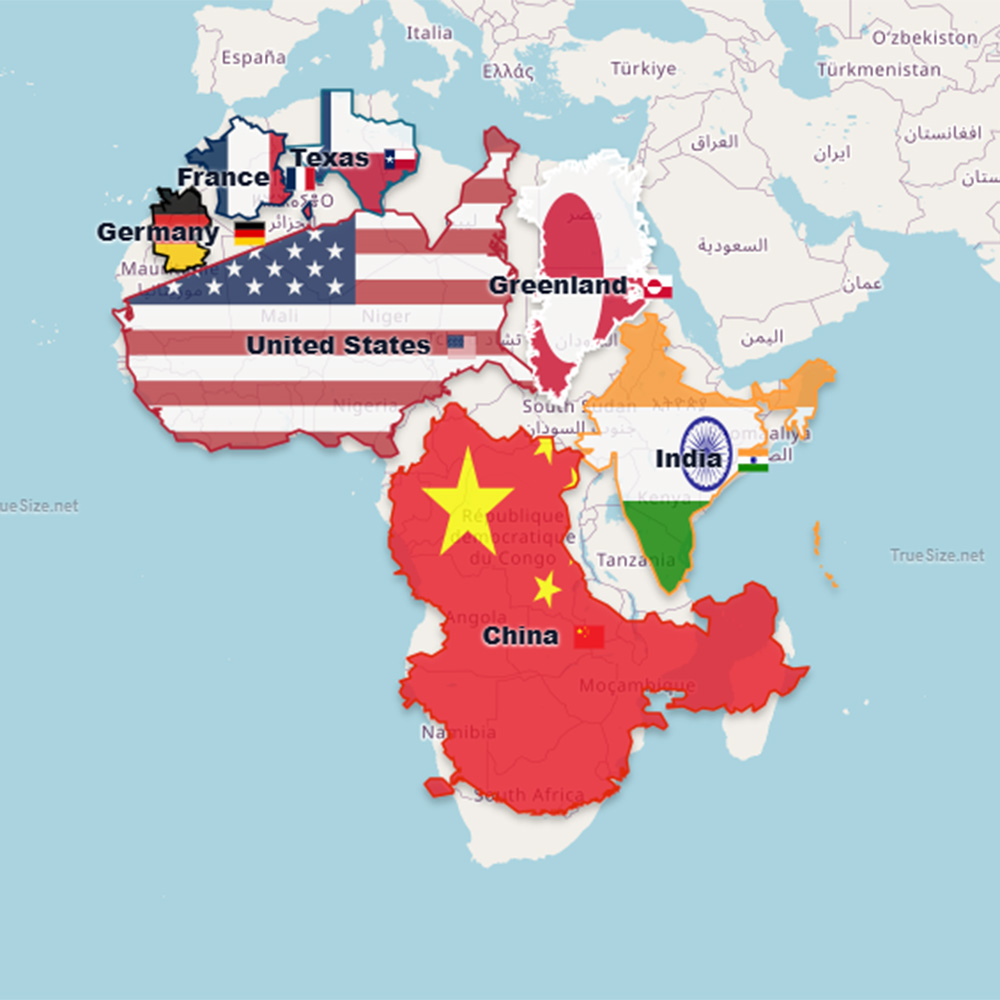
The differences between map projections are more than a geographical curiosity, as they fundamentally change users’ perception of the importance of countries and continents. For example, with the standard Mercator projection the size of Greenland looks approximately the same size as that of the continent of Africa. But in fact, Greenland is about the size of the Democratic Republic of Congo. Indeed, the land areas of the three most populous countries in the world (India, China, and the United States) all fit comfortably inside the boundaries of continental Africa, with room left for Greenland and most of Europe as well.

A map of Africa with the outlines and flags of the United States, China, India, Germany, France, Texas, and Greenland digitally superimposed, demonstrating how these countries fit within Africa’s borders.China, India, the USA and Europe fit into Africa. Source: truesize.net

In the 1970s, the German historian Arno Peters argued that the Mercator’s warping of land masses was a deliberate attempt by the West to belittle the global significance of developing countries. Defenders of the Mercator projection argued back that Mercator’s projection was developed by medieval European mariners, who needed to follow lines of constant compass bearing. So, is the Mercator’s widespread use today due to ‘path dependence’ or political preference? 

Professional cartographers know they always face a trade-of between size and shape. However, their technical preferences will matter little to busy politicians and their overworked advisors. They tend to use the maps chosen by their speechwriters, researchers or other staff (or, perhaps, the ones that accord most with their political preferences). 

Is it only area that matters? Population density varies enormously between countries: from around 22,000 people per square kilometer in Macau to 0.026 people per square kilometer in Greenland. If we confine ourselves to countries with populations over 10 million people, Bangladesh− with 1,333 people/km2 −comes at out at the top, while Australia−with 3.5 people/km2 −is at the bottom. And if arable land density is considered, the picture changes again: with Kazakhstan having the most arable land per person, and Singapore the least. 

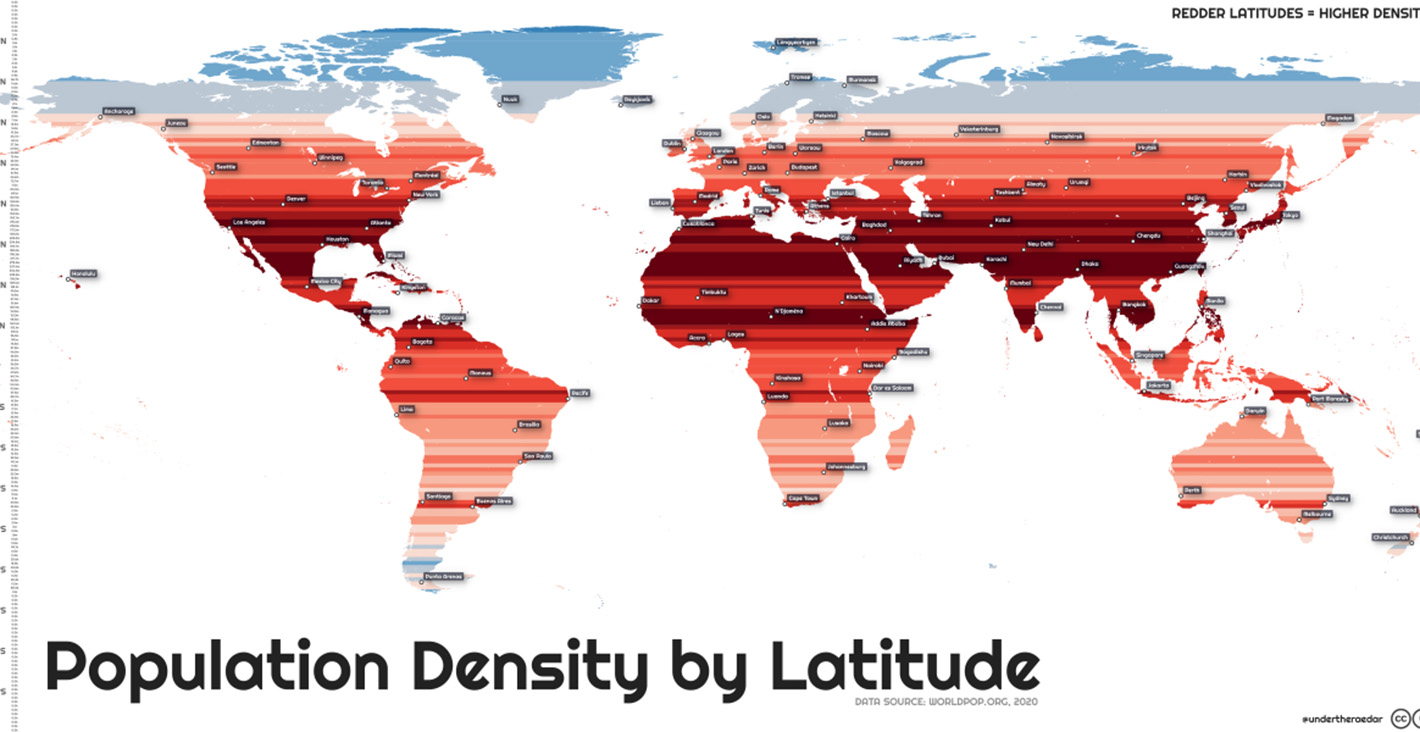
Furthermore, it is generally countries that are closest to Equator which have the highest population densities. Those living north of the Equator, especially between the 25th and 26th parallels, live in the most densely populated areas on earth (going from East to West, these latitudes run through southern China, Bangladesh, northern India, Pakistan, Egypt and Mexico).

World map showing population density by latitude, with redder horizontal bands indicating higher population density. Most intense red appears in latitudes across southern Asia, central Africa, and parts of Europe and the Americas.Source: Visual Capitalist

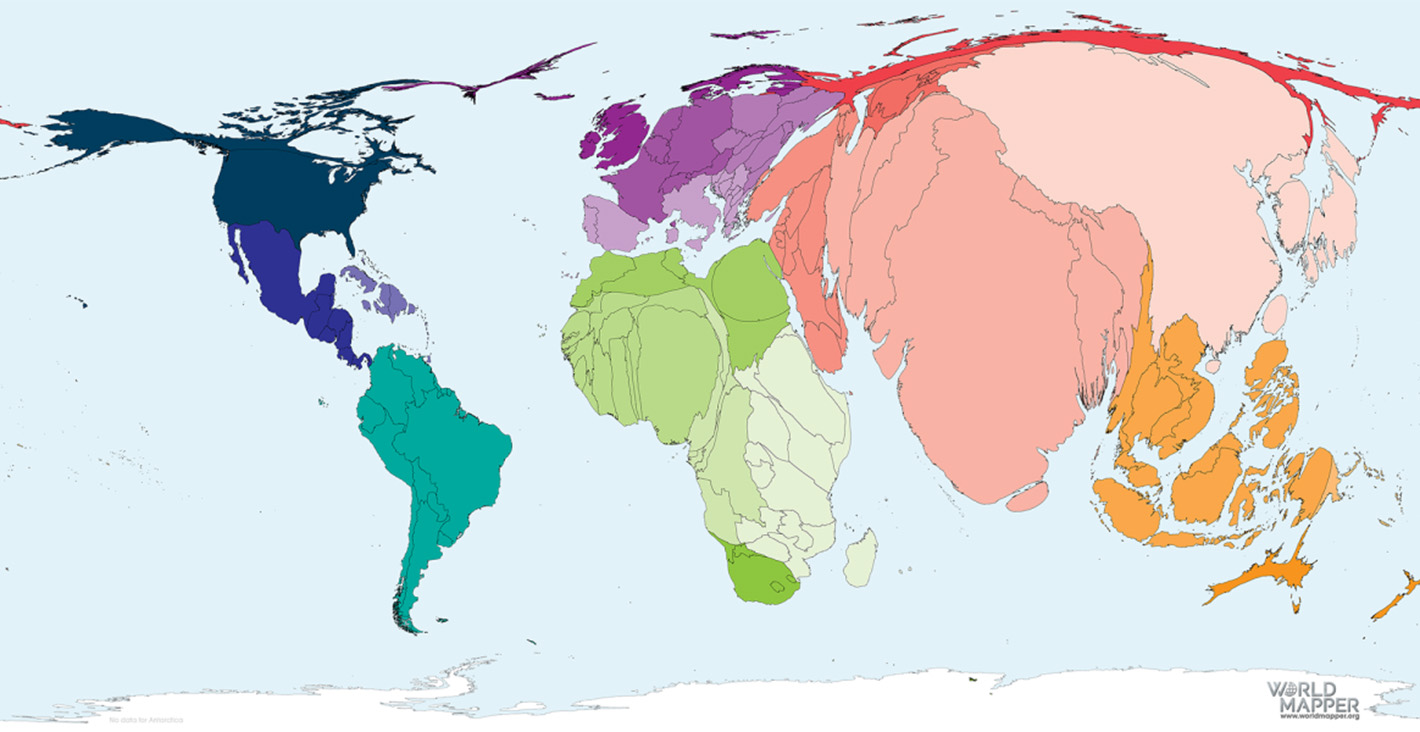
This means that the countries and regions where most people live are the same countries whose areas are most squeezed by the Mercator and other conformal map projections. The visualization that shows this most clearly is a cartogram—in which the areas of countries are scaled by the sizes of their populations rather than their land areas. In this ‘map’, Asian countries−in particular, India, China and Indonesia−plus the entire continent of Africa− loom large, while Russia, Europe, plus Northern and Southern America are much smaller than on the usual Mercator projection.

A distorted world map showing countries resized according to their population size, exaggerating the size of Asia and shrinking areas like Australia and Canada.Source: worldmapper.org

So, if I ever have the chance to visit the White House again, the world map that I would like to see on the walls of the ‘Situation Room’  and the Oval Office would be a cartogram, in which the size of countries was scaled according to the size of their population.  This might help focus US policy makers’ eyes, together with those of their visiting dignitaries, on the countries where most people in the world actually live−along with the huge disparities of living standards that exist between countries. But I am not expecting my invitation to the White House to arrive any time soon! 

About the author

Bob Baulch is a professor of economics at RMIT University Vietnam. He has worked in 30 countries in Africa, Asia, Europe, North America and the Pacific, and belongs to no political party. He also received no funding for preparing this article.

* There is another intriguing cartogram of the world scaled by countries proven oil reserves. I don’t think this is what the current US administration is looking at, but the figures underlying must influence them!

26 March 2026

Share

26 March 2026

Share

Related News

aboriginal flag float-starttorres strait flag float-start

Acknowledgement of Country

RMIT University acknowledges the people of the Woi wurrung and Boon wurrung language groups of the eastern Kulin Nation on whose unceded lands we conduct the business of the University. RMIT University respectfully acknowledges their Ancestors and Elders, past and present. RMIT also acknowledges the Traditional Custodians and their Ancestors of the lands and waters across Australia where we conduct our business - Artwork 'Sentient' by Hollie Johnson, Gunaikurnai and Monero Ngarigo.

More information