
Diamond power could be a medical implant’s best friend

Diamond power could be a medical implant’s best friend

RMIT researchers have created an experimental 3D-printed diamond–titanium device that generates electricity from flowing liquid and receives wireless power through tissue making it possible to remotely sense changes in flow.

The innovation could one day lead to longer-lasting implants such as smart stents, drug-release systems and prosthetics that never need a battery replacement and are precisely tailored to a patient. It would involve no active electronics in the implant.

The team says the research is early but promising, as there are no known devices that can gather energy from both fluid movement and wireless signals, which is enabled by the mix of semiconductive diamonds into a metallic material.

Smarter, safer implants

Senior Lead Researcher Dr Arman Ahnood, from RMIT’s School of Engineering, said the advance paved the way for safer devices.

“Our goal was to overcome one of the biggest limits in implant technology – the battery,” he said.

“They take up space and eventually fail, which often means another operation. With this approach, implants could run continuously with little or no onboard battery.”

He said the innovation could also have applications outside the biomedical sector.

“The ability to wirelessly receive power and harvest energy from liquid flow could be valuable in many other industries where sensors are needed in hard-to-access places using some of the most inert material systems,” he said.

“Our device can remotely detect changes in liquid flow in lab tests without the need for any active electronics in the implantable portion, which offers potential for future implants that could warn of progression of disease before it becomes dangerous.”

Ahnood said the innovation combined lightweight, strong and electrically conductive titanium with many tiny diamond particles.

“The diamonds transform titanium from a passive, structural implant material into an active, multifunctional platform – one that can scavenge energy, sense flow and receive wireless power while remaining biocompatible and strong,” he said.

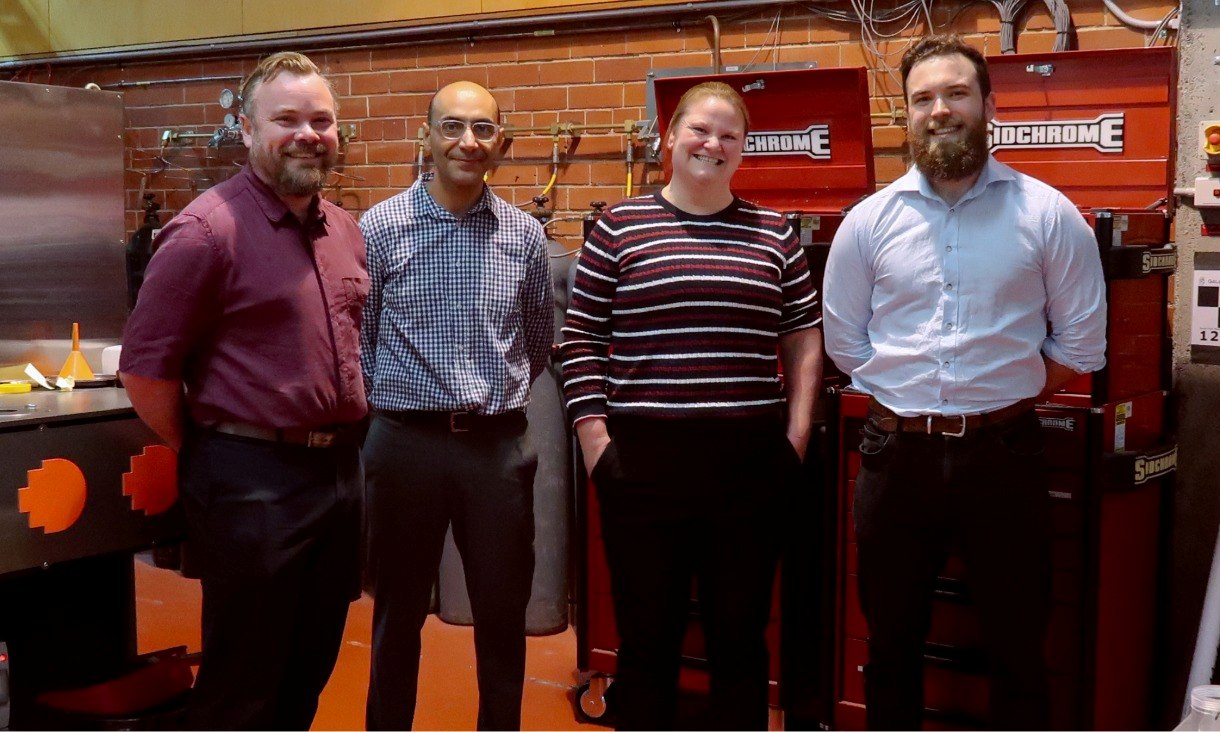
Four researchers stand in front of red tool cabinets in a workshop space at RMIT's Centre for Additive Manufacturing. The RMIT research team behind the diamond–titanium implantable device at RMIT's Centre for Additive Manufacturing: (left to right) Dr Peter Sherrell, Dr Arman Ahnood, Professor Kate Fox and PhD researcher Joshua Zarins. Credit: Shu Shu Zheng, RMIT University

Power from liquid flow

The team tested the device using saline solutions in the lab rather than blood. They say the same principles could apply inside the body, where blood moving across the surface of an implant could generate energy.

Dr Peter Sherrell, from RMIT’s School of Science, said the effect was key for low-energy medical devices.

“When liquid flowed across the surface in our lab tests, it produced a small but steady electrical signal. This is completely new – most implant materials are either insulating or conducting – this the combination of both in a single material that lets us see and use this electricity,” he said.

“On its own this wouldn’t be enough to run most devices but combined with wireless charging it could power simple implants.”

Printing stronger, tailored devices

Professor Kate Fox, from the School of Engineering, said the team had also shown the device could be printed into complex, patient-tailored shapes, using a 3D printer at RMIT's Centre for Additive Manufacturing.

“Diamond with titanium gave us a structure that was not only lightweight and durable but also electrically active,” Fox said.

“It shows we can design implants that do their mechanical job and also provide sensing or power functions.”

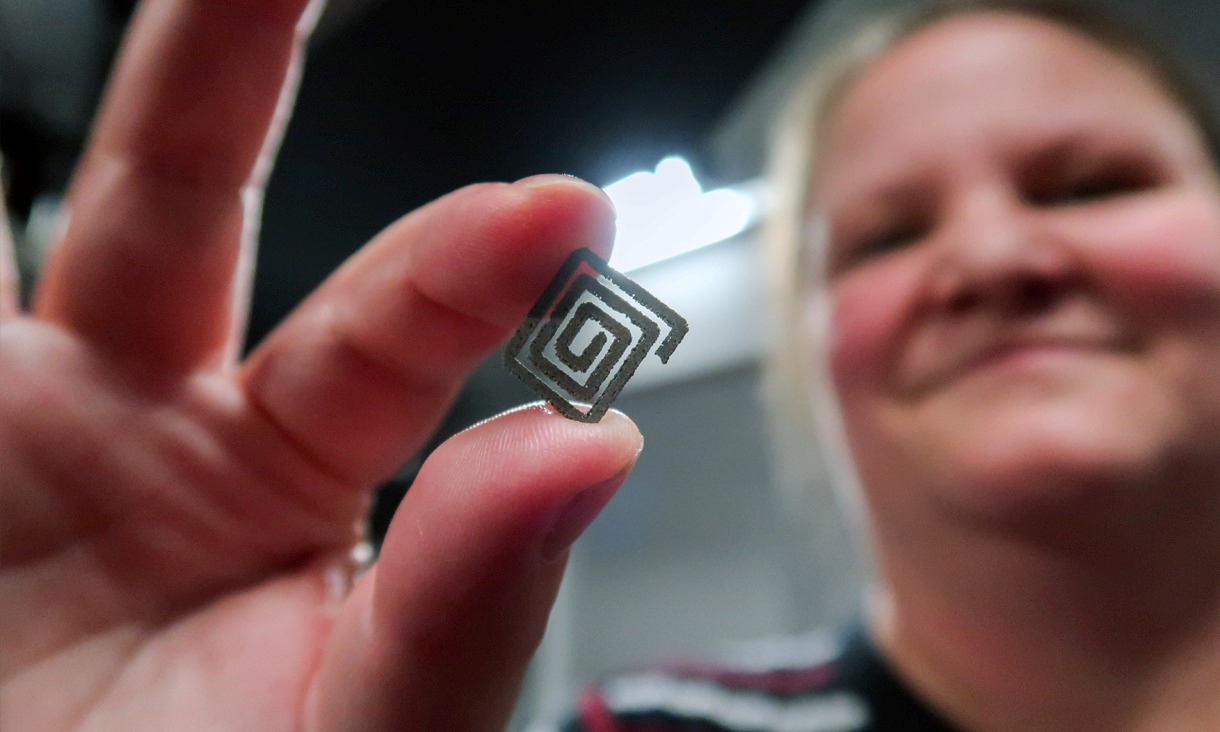
A woman holds a small square spiral-shaped diamond–titanium device between her fingers. Professor Kate Fox from RMIT’s School of Engineering holds a spiral-shaped prototype of the diamond–titanium implantable device. Credit: Shu Shu Zheng, RMIT University

Next steps

The researchers say the innovation needs to undergo further testing and they are seeking partners across biomedical and other sectors to help develop the technology into real-world applications. Organisations that want to partner with RMIT researchers can contact research.partnerships@rmit.edu.au

The research article, ‘Additively manufactured diamond for energy scavenging and wireless power transfer in implantable devices’, is published in the peer-reviewed journal Advanced Functional Materials (DOI: 10.1002/adfm.202508766).


Story: Will Wright

Share

  • STEM
  • Industry
  • Research
  • Engineering
  • Science and technology

Related News

aboriginal flag float-start torres strait flag float-start

Acknowledgement of Country

RMIT University acknowledges the people of the Woi wurrung and Boon wurrung language groups of the eastern Kulin Nation on whose unceded lands we conduct the business of the University. RMIT University respectfully acknowledges their Ancestors and Elders, past and present. RMIT also acknowledges the Traditional Custodians and their Ancestors of the lands and waters across Australia where we conduct our business - Artwork 'Sentient' by Hollie Johnson, Gunaikurnai and Monero Ngarigo.

More information