This was especially evident in the Energy and Real Estate sectors, which underperformed compared to others in environmental metrics.
Improved Sector Variation
“There was a lot of sector variation in the top 10 companies with the highest disclosure levels, with sectors including Consumer Staples, Financials, Industrials, Consumer Discretionary, Communication Services, Energy and Health Care represented at the top of the board.”
SPDI Ratings are calculated using 32 standards across governance, economic, social and environmental domains, as set out by the internationally recognised Global Reporting Index (GRI).
Sectors assessed in the new index include consumer discretionary and staples, energy, financial services, healthcare, IT, real estate and more.
The findings reveal a general improvement in transparency and disclosure practices among the top ASX-listed companies, although significant variability persists across industries.
Evolving the Index: AI and Sector Specific Models
Lau noted that there were several factors influencing industry variability, prompting efforts to refine the index for better contextual relevance. “These differences likely stem from variations in procurement practices and the relevance of specific GRI indicators,” he said.
“To address these disparities, this report explores the feasibility of sector-specific indices to avoid a one-size-fits-all approach.”
“Additionally, to enhance efficiency and accuracy in data collection, the potential for integrating artificial intelligence (AI) tools into the data gathering and analysis process will be investigated.”
“These advancements aim to position the SPDI as a benchmark for promoting sustainability reporting in Australia and beyond.”
Internationalising the Index
The team behind the SPDI have collaborated with other universities across the Asia-Pacific region to expand the scope and depth of the index.
In addition to RMIT Vietnam, four leading institutions: University Teknologi MARA (UiTM) in Malaysia, Ningbo University in China, Chulalongkorn University in Thailand and BINUS University in Indonesia have joined RMIT’s initiative.
These universities have compiled or are currently compiling the SPDI ratings for the top-listed companies in their respective countries.
By leveraging regional expertise and expanding its reach, the SPDI initiative strengthens its role as a catalyst for progress in enhancing transparency and accountability in sustainable procurement,” said Lau.
“This collaboration is poised to amplify the SPDI’s impact, fostering greater adoption of sustainable procurement practices across ASEAN countries.”
“These collective efforts and ongoing partnerships ensure the SPDI continues to serve as a pivotal tool in driving meaningful change and advancing global sustainability goals.”
Story: Finn Devlin and Claudia Lavery

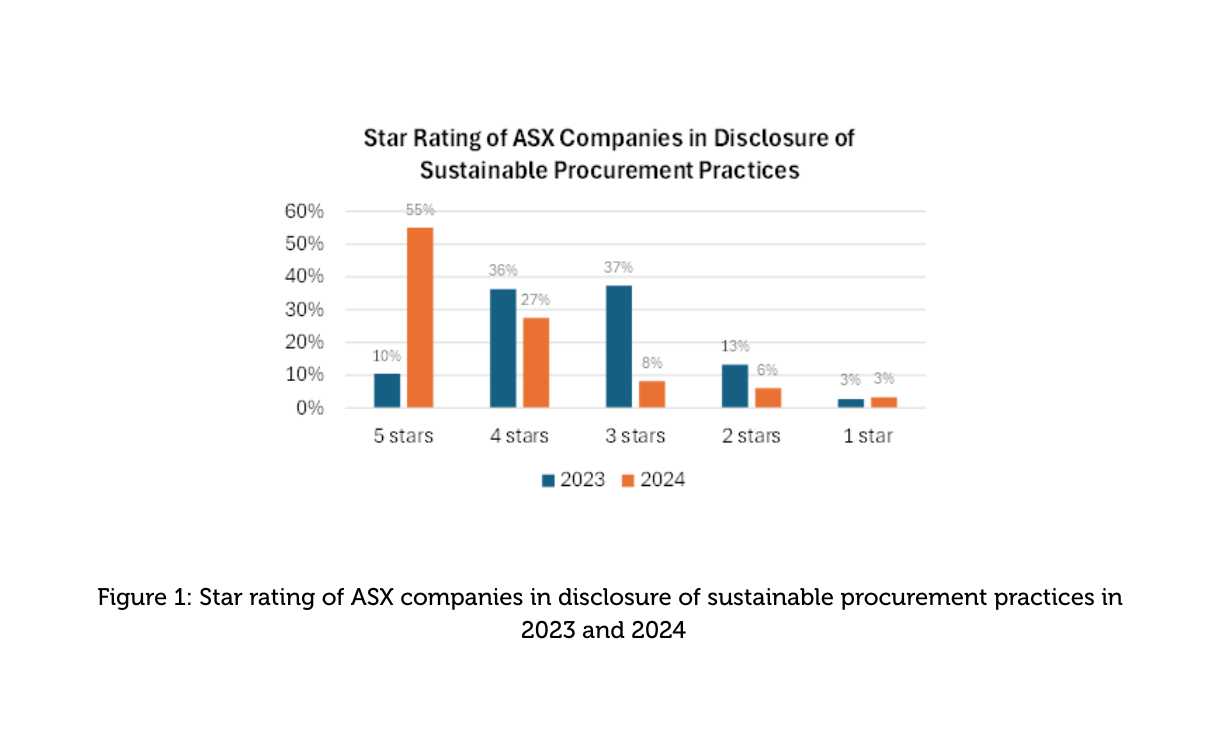
.jpg "Level of disclosure of ASX companies in 2023 and 2024")
.jpg "Figure 3: Comparison of the SPDI across four domains by industry in 2023 and 2024")