The program is focused on accessible learning and two-way knowledge exchange, building participants’ confidence and industry capability, with resources shared to support ongoing development and a more inclusive Australian fashion industry.
Alice Payne, Dean School of Fashion and Textiles at RMIT, said the partnership aligned with RMIT’s commitment to supporting emerging creative talent and cultural innovation.
“We saw this partnership with DAAF as an opportunity to share, learn from, and support First Nations practitioners who are already shaping the future of the industry,” she said.
“We are passionate about not only supporting the First Nations fashion and textiles sector, but actively challenging and transforming structures that have marginalised First Nations designers, makers and communities.
“This includes improving access to education, opportunities, resources and industry networks that allow Indigenous creators to establish and sustain practices on their own terms.
“Our approach dismantles systemic barriers, recognises Indigenous knowledge, and ensures First Nations voices guide decisions about First Nations people.”
Lauren Rogers, Senior Program Producer, Indigenous Fashion Projects at DAAF said the organisation was pleased to welcome RMIT into the Pathways Program this year.
“Partnerships like this are most valuable when they create space for genuine two-way learning, while recognising the knowledge, creativity and ambition that First Nations designers already bring to the table,” she said.
“We're excited to see this shared learning support each designer to grow their enterprise in ways that feel right for them.”
Built through co-design and two-way learning
The workshops are being shaped through ongoing conversations with Indigenous Fashion projects and the First Nations designers allowing the content and delivery to respond to the needs and priorities of the cohort.
Rashmita Bardalai, Lecturer in the School of Fashion and Textiles at RMIT University, said involving First Nations communities in shared decision-making from the beginning, rather than asking them to participate in pre-designed programs can help universities move towards genuine co-design and partnership with First Nations communities and organisations.
“For this partnership, co-design is about working with DAAF and the designers to ensure the workshops respond to their actual business needs, rather than assuming what those needs are,” she said.
“A genuine and successful partnership would be that the designers feel the workshops have supported their own goals, strengthened their confidence and respected the cultural foundations of their work.”
An opportunity to transform the sector
The Pathways Program fosters visibility, impact and intergenerational opportunity for First Nations-led fashion enterprises.
In the past, industry support for the program over the years has included David Jones and Australian Fashion Week, connecting participants with leading fashion industry professionals.
Tarun Panwar, Associate Dean Enterprise in the School of Fashion and Textiles at RMIT University, said the partnership represented an opportunity to elevate First Nations leadership, cultural authority and Indigenous design methodologies, with revolutionary outcomes for the sector.
“If First Nations leadership, cultural authority and Indigenous design methodologies were genuinely centred and fully supported, the Australian fashion sector would be structurally transformed in ten years’ time,” he said.
“First Nations-led enterprises would shape governance, investment and market strategy, with Indigenous Cultural and Intellectual Property protections embedded in contracts, collaborations and education as standard practice.
“In this context, Indigenous design methodologies would operate as a primary framework for fashion enterprise: orienting business decisions around cultural authority, reciprocity and accountability to Country, and setting the benchmark for ethical, globally distinctive Australian fashion.”
You can find out more about the DAAF Pathways Program here: https://www.ifp.org.au/programs/pathways/
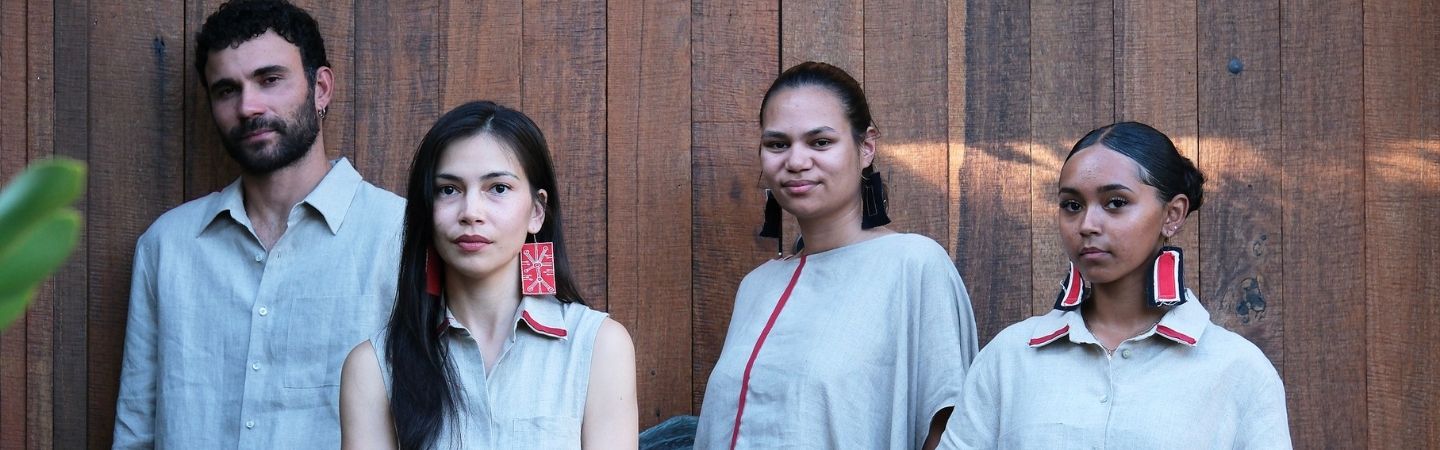
Banner image: LuluJaru Designs by Cissy Gore-Birch (photo by Marley Morgan)
Story: Finn Devlin