RMIT launches MRFF Community of Practice to drive health and medical impact

RMIT launches MRFF Community of Practice to drive health and medical impact

The RMIT Medical Research Future Fund (MRFF) Community of Practice (CoP) aims to strengthen the University’s capacity to deliver health and medical research that translates into meaningful outcomes for patients, communities and the health system.

The cross‑disciplinary CoP will equip researchers with the skills, connections and institutional support needed to design, develop and deliver MRFF‑funded, mission‑aligned research that is driven by trusted partnerships and involves consumers with lived experience. 

Open to researchers at any career stage and from all disciplines, the CoP aims to connect people working in, or aspiring to work in, MRFF priority areas and to build capability in collaborative, impactful research.

The CoP was launched at a symposium that featured a range of panel discussions, fireside chats and keynote addresses, where participants heard from leaders about the current MRFF landscape - its strategy, principles and priorities - as well as how to write a successful application and the importance of collaboration, partnership and consumer engagement in achieving MRFF success. 

Speaking to participants, RMIT University Deputy Vice-Chancellor, Research and Innovation, Distinguished Professor Calum Drummond AO, emphasised that achieving health impacts requires more than excellent ideas.

“To deliver better health outcomes, researchers need support structures that help turn strong concepts into programs that are collaborative, translational and grounded in real-world need.

“Events like this are about much more than sharing information,” Professor Drummond said, “they help us bring together researchers, professional staff, consumers and partners around a shared vision for healthier communities, and they signal that RMIT is serious about doing the kind of research that changes lives.”

30 March 2026

Share

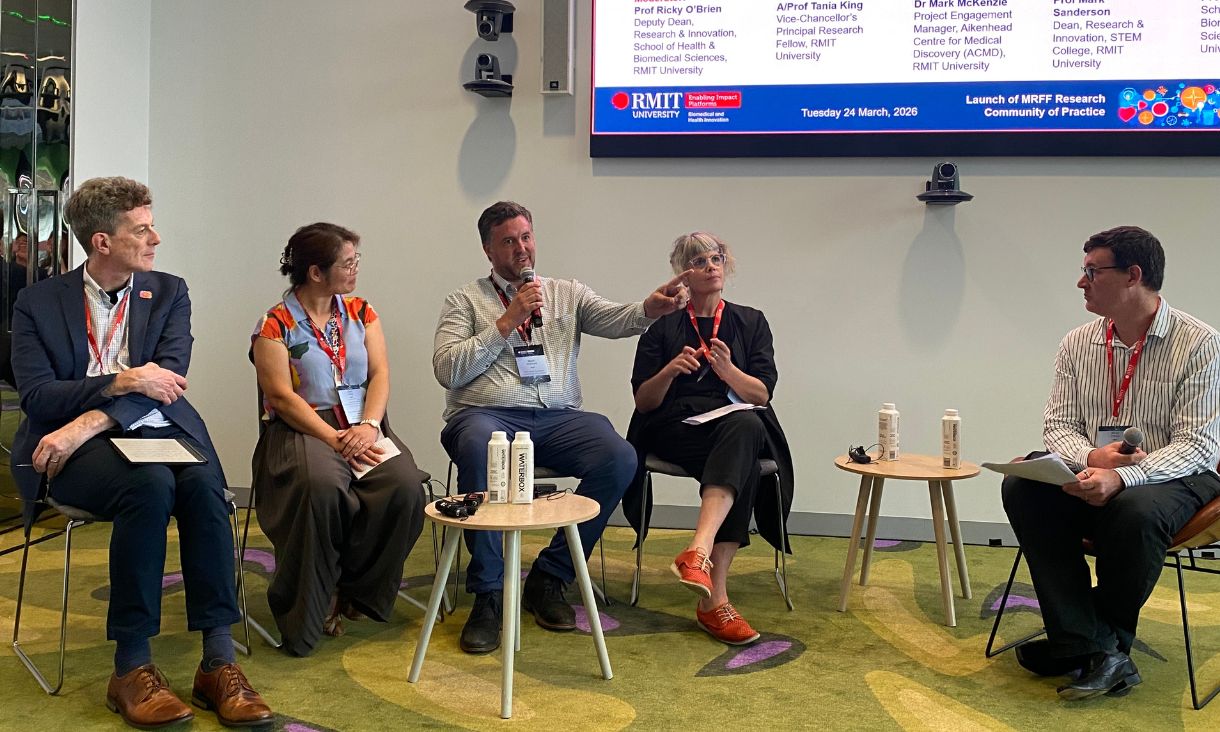
Five people engaged in panel discussionThe launch symposium featured a range of panel discussions, fireside chats and keynote addresses.

A fireside chat between RMIT University Distinguished Professor Magdalena Plebanski and Dr Sarvesh Soni from the Department of Health, Disability and Ageing, offered insights into medical research priorities through the lens of national policy. 

Dr Soni discussed the evolving focus areas of the MRFF, the importance of consumer‑centred research, and how RMIT can position itself to deliver real benefits to patients and communities through MRFF‑supported projects. 

In a panel discussion facilitated by RMIT Deputy Vice-Chancellor, STEM College, Professor Catherine Itsiopoulos, partnerships were framed not just as formal agreements, but as long‑term relationships built on trust, active listening and mutual understanding between researchers, communities, industry, government and philanthropy.

RMIT’s new Chief Advancement Officer, Jo Watts, emphasised the growing role of philanthropy in supporting health and medical research at RMIT, explaining how her team is helping researchers cultivate and steward philanthropic partnerships aligned with MRFF‑funded work. 

The focus then turned to practical skills with a presentation from Tim Haydon, CEO of WriteMedia, whereparticipants heard about common pitfalls in MRFF applications - from misaligned program objectives to insufficient detail on implementation, translation, and consumer involvement. 

Tim emphasised the need to read the grant opportunity guidelines closely, clearly address each assessment criterion, and ensure proposals articulated both scientific excellence and tangible benefit for patients and communities.

The symposium’s final panel discussion showcased the breadth and depth of MRFF‑relevant research across RMIT, spanning different disciplines, methodologies and partnership models.

Panelists reflected on their own journeys with MRFF‑related work, sharing lessons on designing projects with end‑users involved from the start, how to navigate complex collaborations, and sustaining partnerships beyond the life of a single grant.

The conversation highlighted that impactful MRFF research requires not only high-quality science and innovation, but also deliberately building relationships with health services, community organisations, consumers, and funders. 

Overall, the symposium offered attendees a clearer picture of how the MRFF Community of Practice will foster a more connected internal network, support capability development, and create more opportunities for collaboration across RMIT and beyond. 

This event was just the first in a program of ongoing CoP activities designed to help RMIT researchers turn health and medical research ideas into tangible benefits for patients, communities and the broader health system.


Story: Georgie Patterson 
30 March 2026

Share

Related News

aboriginal flag float-starttorres strait flag float-start

Acknowledgement of Country

RMIT University acknowledges the people of the Woi wurrung and Boon wurrung language groups of the eastern Kulin Nation on whose unceded lands we conduct the business of the University. RMIT University respectfully acknowledges their Ancestors and Elders, past and present. RMIT also acknowledges the Traditional Custodians and their Ancestors of the lands and waters across Australia where we conduct our business - Artwork 'Sentient' by Hollie Johnson, Gunaikurnai and Monero Ngarigo.

More information