As temperatures rise, inequality deepens

As temperatures rise, inequality deepens

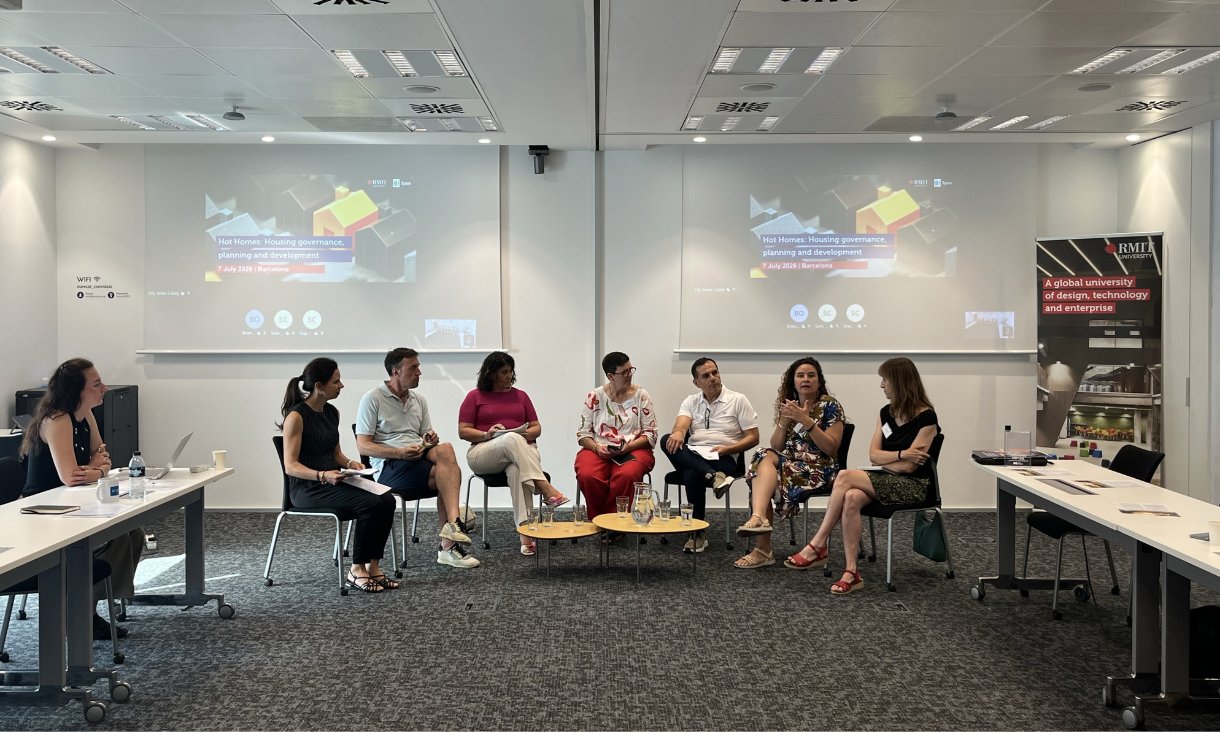
RMIT Europe in collaboration with Urban Land Institute (ULI) Spain has brought together experts for a roundtable discussion exploring the growing tension between extreme heat and housing.

A roundtable in Barcelona has brought together representatives from ULI, Barcelona City Council Energy Agency, the Department of Architectural Technology at the Polytechnic University of Catalonia, Urban Input, EFFIC, Alliance Against Energy Poverty and RMIT Europe.   

Climate change is exposing deep inequalities in housing, energy access and infrastructure, with vulnerable communities at greatest risk of experiencing the consequences of extreme heat.

As global temperatures rise, the consequences are not equally distributed.  

People living in poorly insulated homes, low-income households and renters are often more exposed to heat and less able to adapt.

This is also the case in Barcelona, where many homes across the city lack adequate thermal insulation.  

A large proportion of the city’s housing, particularly in older districts, predates building regulations introduced in the late 1970s. 

Poor insulation and low energy efficiency therefore remain significant challenges. 

During the roundtable, Professor Libby Porter, Director of RMIT's Centre for Urban Research, highlighted how the underlying systems and structures produce these kinds of problems.

“Perhaps these are more important than the technical solutions,” she said.

This also raises an important question: who is responsible for insulating homes?

In Australia, climate adaptation is complicated by fragmented governance and limited coordination between local, state and federal governments.  

Responsibility for funding infrastructure and adaptation measures is not always clearly defined, making it difficult to determine who should make decisions or pay for essential improvements.

Governments also have a responsibility in providing public spaces where people can seek relief from heat. 

Barcelona’s climate refuges offer one example. 

These spaces are mapped so residents can identify the available refuges during periods of high temperatures.  

However, access to these cooling spaces is not equal. 

Transport, mobility, work and caring responsibilities can all affect a person’s ability to make use of these spaces.

Share

Hot Homes eventExperts from academia, industry and the urban development sector came together to discuss housing inequality, extreme heat and climate adaptation.

The growing cost of staying cool

Rising energy prices are adding further pressure to households experiencing extreme heat.

As energy costs are driven by demand rather than affordability, some households may avoid using air conditioning or delay investing in insulation and other improvements.

The combination of everyday expenses, rising energy costs and more frequent heatwaves can leave people with difficult choices. 

Migrant families, women, children and people living in rental properties are among those more likely to be affected.

Heat exposure is also closely connected to housing conditions and the power relationships between landlords and renters, particularly in social housing.

“Data shows that if you’re poorer, you are in a more heat-exposed built environment,” said Porter, a researcher in urbanisation and the ways it can create dispossession and displacement.

From solutions to action

During the roundtable, panellists agreed that engineering solutions to improve the energy efficiency and thermal performance of existing buildings already exist. 

The challenge is to implement them at the required scale.

Isabel Tejero Fernandez​, Director of Energy Consulting at EFFIC, said that plenty of solutions are available. 

“We know what to do; the point is how to put all those solutions in place,” she said.  

Large-scale renovation will require significant investment, stronger regulation and financial incentives. 

It will also require a skilled workforce of technicians, engineers, architects and construction professionals. 

At the moment, the sector is not prepared for the scale of work required.

Sophie Chick, Vice President of the Urban Land Institute, emphasised the importance of collaboration between government, industry, communities and residents. 

“We have a really, really complicated housing system," she said. 

"It’s fragmented, it’s stuck, and we can’t meet those affordability and climate change challenges effectively."

As extreme heat becomes an increasing public health risk, it may also become an agent of change, creating greater urgency for systemic action and helping deliver housing that is both affordable and climate resilient. 


Story: Thirza Bakker
Share

  • DSC Research
  • Property & Construction
  • Society
  • DSC
  • Research
  • Environment
  • RMIT Europe

Related News

aboriginal flag float-starttorres strait flag float-start

Acknowledgement of Country

RMIT University acknowledges the people of the Woi wurrung and Boon wurrung language groups of the eastern Kulin Nation on whose unceded lands we conduct the business of the University. RMIT University respectfully acknowledges their Ancestors and Elders, past and present. RMIT also acknowledges the Traditional Custodians and their Ancestors of the lands and waters across Australia where we conduct our business - Artwork 'Sentient' by Hollie Johnson, Gunaikurnai and Monero Ngarigo.

More information