Alumni Expert Series: international artist Lisa Roet

For Lisa Roet, what began as a passion for painting during her time at RMIT evolved into a global contemporary art career that spans continents.

Choosing RMIT’s Bachelor of Fine Arts, majoring in painting, set the foundation for Lisa Roet’s career as an internationally recognised artist. 

While trained as a painter, Lisa’s practice expands far beyond the canvas, leading her into a world of diverse mediums, large-scale installations and impactful storytelling.  


Turning passion into a career

For Lisa, art has always been a way to ask questions – particularly about science, nature and humanity’s role within them.   

“My work is really about my desire to be a scientist,” she said. 

Although she studied painting, each of Lisa’s projects begins with a subject or issue she wants to address.  

From video and performance to jewellery and large inflatable sculptures, Lisa lets the ideas lead the materials. 

This process has enabled her to develop a distinctive artistic voice shaped by curiosity.  

“I work with a lot of different mediums – everything except painting,” she said. 

Alumni Expert Series: international artist Lisa Roet

For Lisa Roet, what began as a passion for painting during her time at RMIT evolved into a global contemporary art career that spans continents.

The Great Ape 

A central theme in Lisa’s work is her fascination with primates. 

Her practice often explores the evolutionary relationship between humans and apes.  

This focus on primates forms the core dialogue of her work and reflects her broader interest in humanity’s connection to nature. 

“It’s our relationship to nature that’s important in the essence of my practice,” she said.  

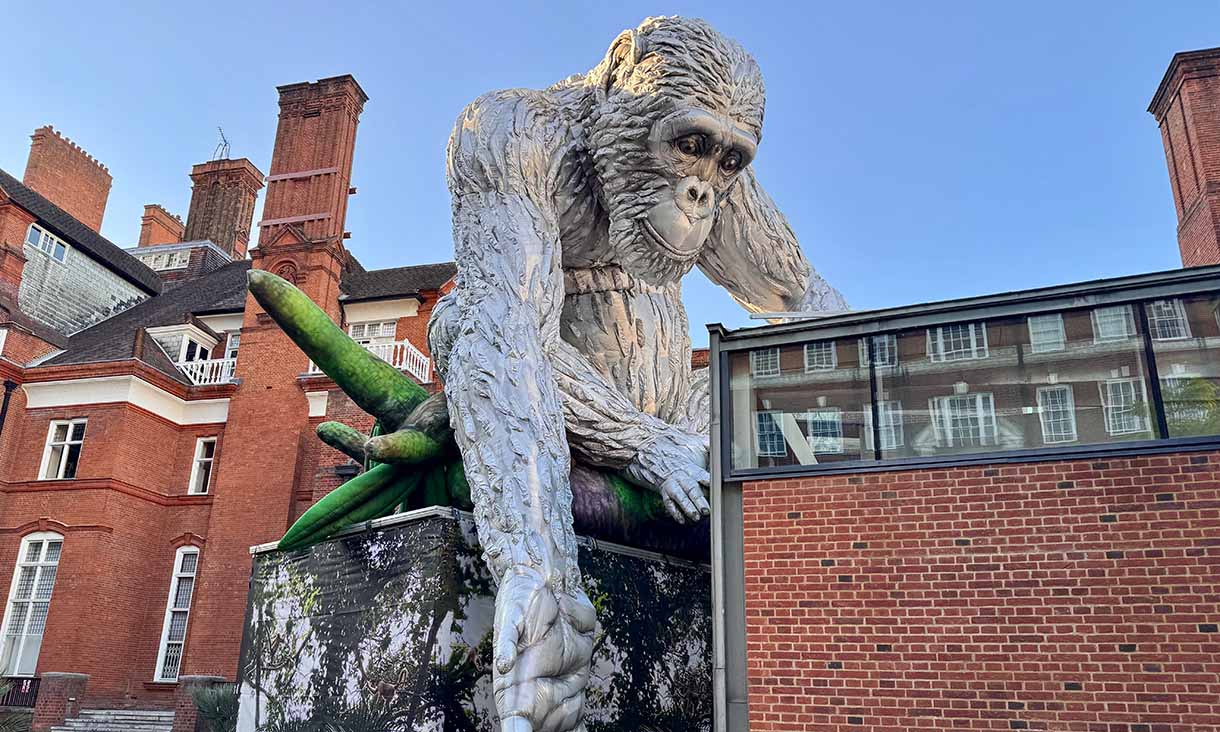
One of Lisa’s most recent pieces Great Ape  is a monumental inflatable chimpanzee with an outstretched hand – a symbolic gesture of reconciliation between humans and the natural world.

Through this work, she hopes to spark reflection and inspire a sense of affinity and collective responsibility toward preserving the planet. 

“I hope people take it as a gesture of alliance and togetherness in thinking forward to preserving our planet,” she said. 

Sustainable practice for a sustainable future 

For Lisa, sustainability is an essential pillar of her artistic approach. 

Material choices are an ethical and integral part of shaping a more sustainable creative industry and she encourages emerging artists to think critically about the materials they choose.  

In her own practice, Lisa has used fabric made from recycled plastic bottles, demonstrating how creative decisions can contribute to a more responsible and ethical industry. 

Her sustainability efforts invite audiences to reflect on humanity’s relationship with nature and the shared responsibility we have in shaping a more sustainable future.  


Stay true to your passion

Beyond sustainability, Lisa’s message to early-career artists is to follow a genuine creative direction rather than chasing trends.  

She believes that authenticity is key to developing original work and establishing a unique point of difference within the art industry.

“Follow your passion – your true passion, rather than continually following the next curatorial bent. 

That is the best way forward for unique art creation and a way of having a point of difference,” she said.
You may also be interested in...

aboriginal flag float-start torres strait flag float-start

Acknowledgement of Country

RMIT University acknowledges the people of the Woi wurrung and Boon wurrung language groups of the eastern Kulin Nation on whose unceded lands we conduct the business of the University. RMIT University respectfully acknowledges their Ancestors and Elders, past and present. RMIT also acknowledges the Traditional Custodians and their Ancestors of the lands and waters across Australia where we conduct our business - Artwork 'Sentient' by Hollie Johnson, Gunaikurnai and Monero Ngarigo.

Learn more about our commitment to Indigenous cultures