
How a regenerative future will help rebuild the environment and rethink work processes

Regenerative Futures, the keynote topic of the RMIT Alumni Breakfast, are all about renewing social, economic and environmental systems.

Until recent times, the benchmark of sustainability has been in conserving energy and protecting resources. But there’s a new frame of thinking that’s redefining how we view sustainability, and it stems from the idea of regeneration.

Regeneration is defined by the Oxford Dictionary as “the process of making an area or institution develop and grow strong again”.

Regeneration is one of the main principles of the circular economy, which aims to avoid waste and pollution by keeping materials functioning through reuse, maintenance and recycling. This reduces our reliance on natural resources while also cutting carbon emissions and preventing biodiversity loss.

RMIT alum and professional speaker Dr Dianne McGrath gave a keynote at the Alumni Breakfast partnered with the RMIT Regenerative Futures Institute focusing on what a regenerative future could look like if businesses got involved.

Alumni Breakfast: Regenerative Futures invited alumni business leaders to learn how a regenerative future aims to add to, rather than take from, the environment and communities. Dianne challenged the guests to think about what this could mean for them, through the lens of her rare experiences. We captured the highlights of her presentation.

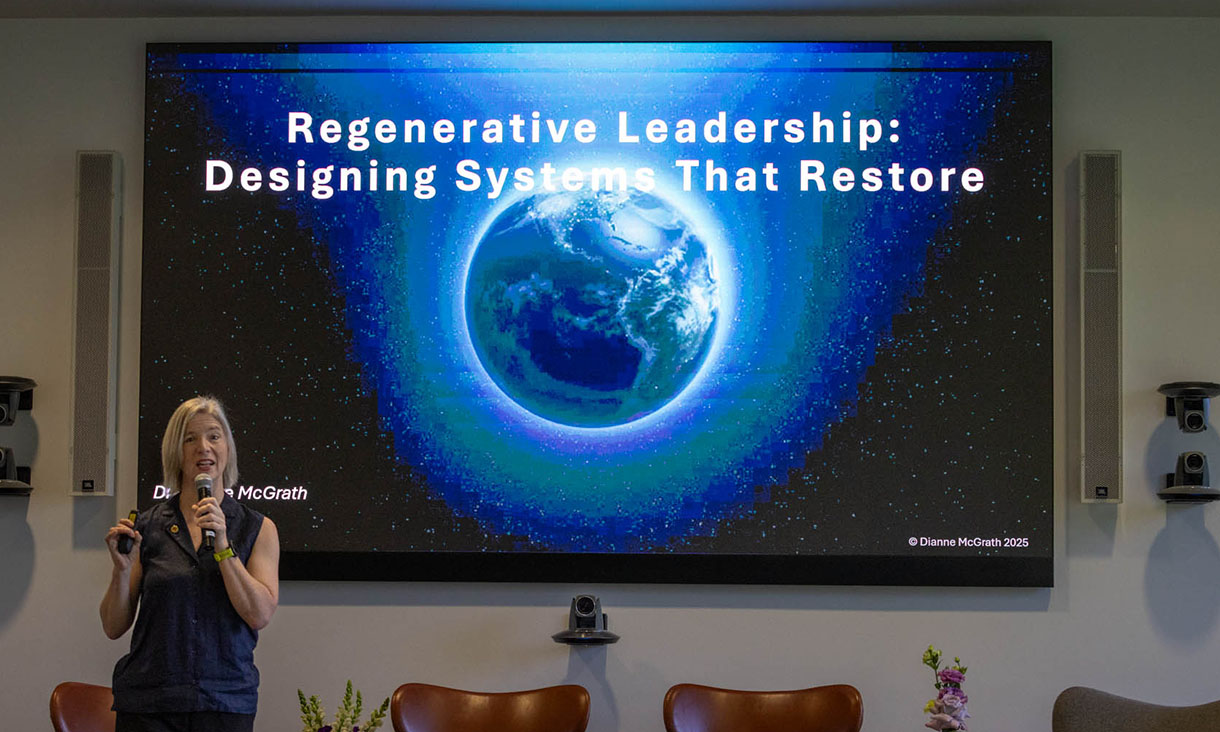
A presenter stands in front of a large screen that displays an image of Earth. The slide reads 'Regenerative Leadership: Designing Systems That Restore.'

Replacing extraction with contribution

Dianne has a unique perspective of regenerative thinking. She was so passionate about making life habitable wherever she travelled that she signed up for a one-way journey to Mars in 2013.

The Mars One project was initiated by a Dutch company that invited people from around the world to live on another planet. More than 200,000 applied and Dianne was one of seven Australians to make the final 100 candidates.

“My curiosity was [saying], ‘How do we do this? How can we possibly survive another planet?’” she said.

We can't extract anything from this planet because there's nothing to extract. We have to contribute first, we have to build closed loop systems that will survive entirely within a closed environment. I thought, ‘How exciting is that?’

Although Dianne made the final cut, the Mars One project was cancelled in 2021.

But not all was lost. The theory of replacing extraction with contribution, or giving instead of taking, became one of three key shifts of regenerative leadership that Dianne has continued to follow and pass on to others.

“The idea that we can move away from the extractive mindset to one of contributing got me thinking about being efficient with our resources,” she said.

“How do we start to move towards building more renewable and resilient communities? Because that's going to be much more important for us in the long run for our planet, but also great for businesses.”

Moving beyond efficiency to resilience

Dianne’s passion for challenge and adventure saw her circumnavigate the world in 11 months as part of the Clipper Round the World Yacht race between September 2023 and July 2024.

The experience made a lasting impression on Dianne, who along with her crew, was forced to push their resourcefulness to the extreme.

“It was a very closed loop environment: a tiny boat, we had only had a certain amount of food and we had to create our own water on board,” she said.

“In that time, my mindset was not about dealing with what we had at the moment, but actually the lesson was more about how can we prepare for what's to come.”

She likens this experience of resilience to preparing the sails for high winds. The crew could either use a full main sail or put in a reef to shorten the sail. The boat sailed quickly in both circumstances, but the shorter sail were more adaptable to extreme weather conditions and avoid risk to the crew and the yacht.

“Being able to be adaptable means you can be resilient and respond to whatever else is going to happen,” she said.

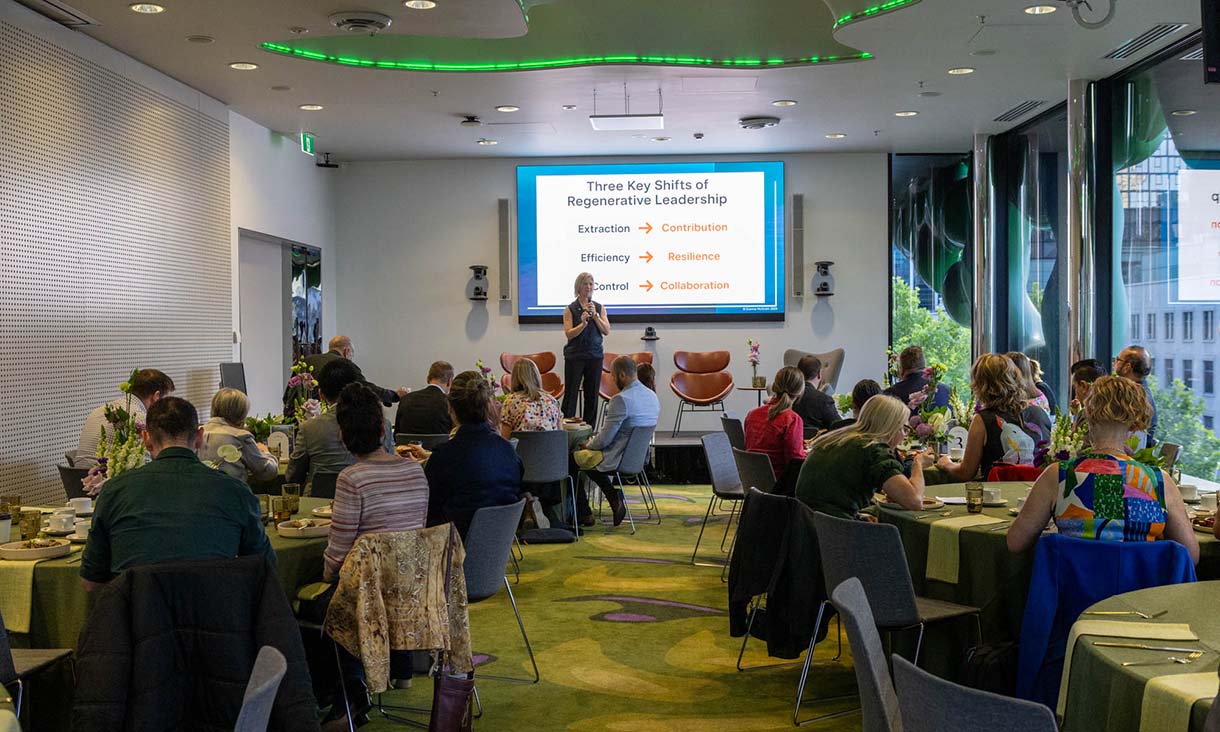
A speaker stands at the front of a conference room addressing an audience seated at round tables. Attendees are listening to a presentation. The room is well-lit, decorated with green accents and floral centrepieces.
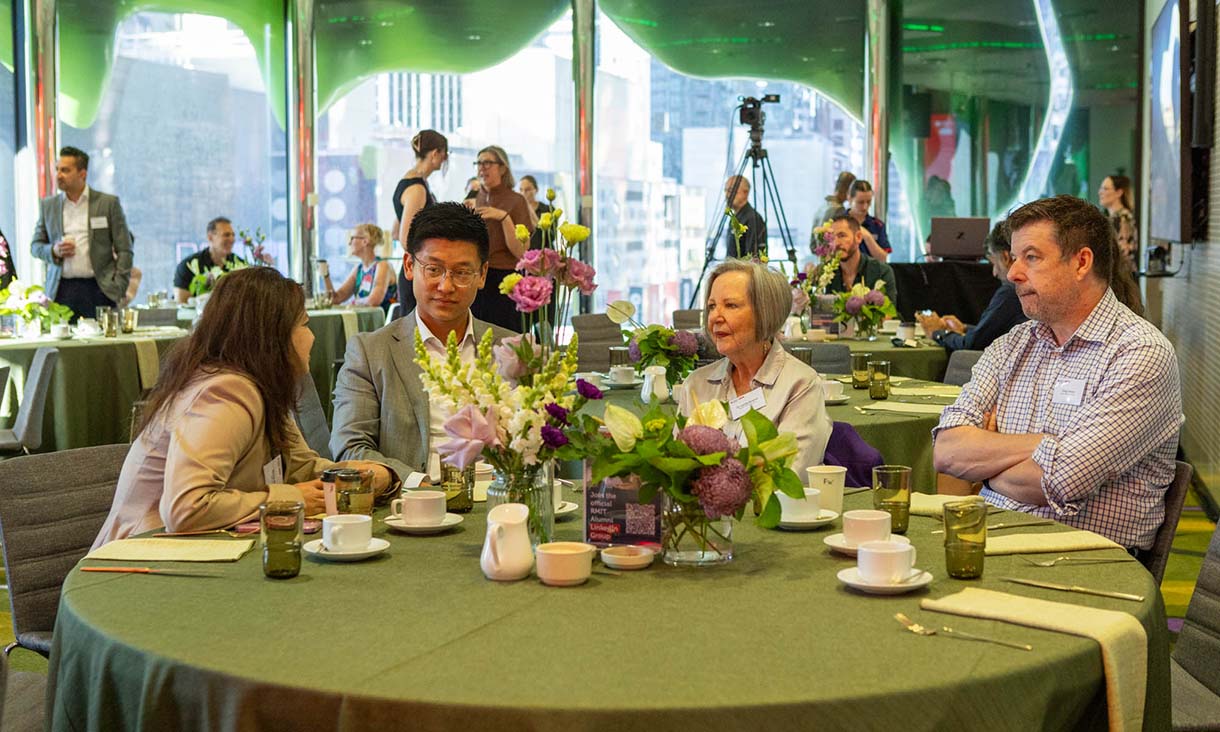
Small groups of people sit around round tables in a contemporary meeting space, engaging in conversation. The tables are set with cups, glasses and floral arrangements.

Giving up control for collaboration

Any circular business model relies heavily on collaboration. Involving a wide group of contributors who bring a diversity of backgrounds, ideas and experience makes for an effective and successful solution.

Many organisations work in silos without realising it and in doing so, squander the opportunity to cross-pollinate their collective knowledge and skills. The Alumni Breakfast: Regenerative Future event aimed to inspire attendees to challenge silos and implement regenerative ideas into their industries.

When assessing projects and how they are approached, Dianne advised businesses to take a holistic view and aim for a regenerative perspective.

“When you're making a decision in your business or in what you are looking to do – [ask yourself if] this decision adds life? How does it add to what you're doing? What value does it add?” she said.

“Think about that when we're making these decisions. When your teams are bringing ideas to you, is this immediate or is this going to help me later? And then that final one, who else? Who else should be a part of this discussion? Can someone help me and can I help someone else?”

Interested in joining future RMIT alumni events? Keep your details up to date to ensure you don’t miss out.

Story: Kate Jones

You may also be interested in...

aboriginal flag float-start torres strait flag float-start

Acknowledgement of Country

RMIT University acknowledges the people of the Woi wurrung and Boon wurrung language groups of the eastern Kulin Nation on whose unceded lands we conduct the business of the University. RMIT University respectfully acknowledges their Ancestors and Elders, past and present. RMIT also acknowledges the Traditional Custodians and their Ancestors of the lands and waters across Australia where we conduct our business - Artwork 'Sentient' by Hollie Johnson, Gunaikurnai and Monero Ngarigo.

Learn more about our commitment to Indigenous cultures