Taking ‘climate action’ for World Environment Day

Taking ‘climate action’ for World Environment Day

The Library highlights how every part of the University ecosystem can drive meaningful change, inspire climate conscious behaviours and help build a resilient future.

World Environment Day is observed each year on 5 June. In alignment with this year’s theme of climate action, the Library has strengthened its commitment to sustainability through a combination of governance, education, operational change and regenerative practice.

These include:

  • establishment of a Library Regenerative and Sustainable Practices Working Group
  • ongoing delivery of Learning Lab and open educational resources, aligned with the Sustainable Development Goals
  • waste‑reduction and reuse initiatives across Library sites
  • a growing focus on digital sustainability.

Library Regenerative and Sustainable Practices Working Group

The Library is committed to embedding the principles of ‘reduce, reuse, recycle’ at the core of its operations. Guided by the Library Regenerative and Sustainable Practices Working Group, we continue to examine how our spaces, services and decision‑making processes can minimise environmental impact and generate positive, long‑term outcomes.

Through this work, the Library actively supports RMIT’s Circular Economy Plan and advances the University’s strategic objective of “eliminating waste and encouraging reuse”.

Some initiatives include:

  • The installation of battery recycling stations at Brunswick, Bundoora, Carlton and Swanston library campuses, supporting the recovery of valuable materials, and preventing toxic waste and fire risks associated with landfill disposal.
  • Introducing compost caddies in staff rooms across all Library locations to reduce organic waste, with additional coffee‑ground collection points at Carlton and Swanston.
  • Expanding the Library’s once-used paper initiative with new drop-off points at Bundoora (Buildings 202 and 210) and Swanston (Building 28).

Digital sustainability and the Learning Lab redesign

The Learning Lab migration and redesign in 2025 focused on doing more with less, particularly:

  • retiring legacy content
  • reducing data‑heavy assets
  • improving efficiency of existing platforms rather than procuring new systems.

This reframed digital maintenance as a sustainability and regeneration activity, not just a technical one.

Extending the life of physical collections and materials

The Library has initiated several projects to improve the sustainability of our physical items, collections and merchandise:

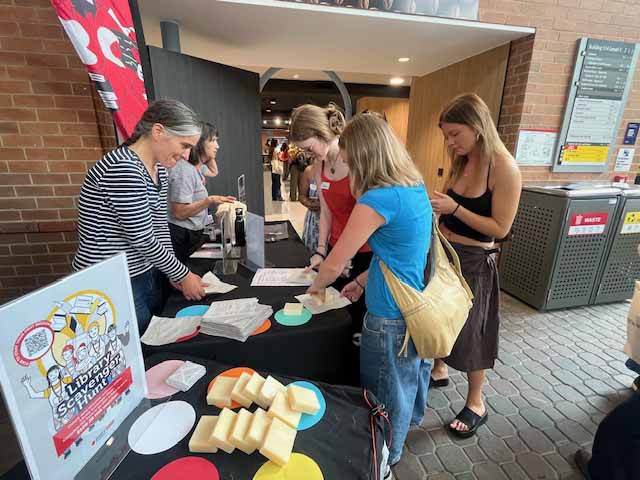
  • Surplus or redundant physical items (e.g. books, binders, puzzles) were redirected for creative activities and reuse by students – such as an activity where soap giveaways at Orientation were wrapped in the pages of weeded Library books – preventing disposal and extending life.
  • We engaged with new local and sustainable suppliers for Library merchandise and promotional items, demonstrating circular‑economy thinking rather than single‑use marketing.
  • The digital‑first service model continues to progress, reducing travel, printing and physical handling.
Decorative.Students at Orientation in Brunswick wrap soaps in pages of weeded Library books.

Open education and RMIT Open Press: expanding global access

Through strategic investment in open education and the development of highimpact open publications, the University advances its commitments to equitable access, sustainable production, digital transformation and community learning.

Open educational resources (OER) extend learning opportunities beyond enrolled students, providing flexible access to knowledge for community members, industry partners and international learners. RMIT’s Open Press titles make a significant contribution to increasing global access to highquality, openly licensed learning and research resources – reinforcing the University’s leadership in open, inclusive and sustainable education.

RMIT educators continue to incorporate the use of OER in their course curriculum. Total views across our OER ecosystem in 2025 reached 1,618,557, combining Learning Lab (438,131), Pressbooks (267,109) and our other managed OERs (913,237).

Looking ahead

The Library will continue to prioritise regenerating value from existing collections, infrastructure and services, repurposing learning materials, reusing physical assets and optimising digital platforms. This demonstrates a shift from a “doing less harm” approach toward practices that actively extend value, reduce waste and support longterm sustainability.

04 June 2026

Other news from the Library

aboriginal flag float-starttorres strait flag float-start

Acknowledgement of Country

RMIT University acknowledges the people of the Woi wurrung and Boon wurrung language groups of the eastern Kulin Nation on whose unceded lands we conduct the business of the University. RMIT University respectfully acknowledges their Ancestors and Elders, past and present. RMIT also acknowledges the Traditional Custodians and their Ancestors of the lands and waters across Australia where we conduct our business - Artwork 'Sentient' by Hollie Johnson, Gunaikurnai and Monero Ngarigo.

Learn more about our commitment to Indigenous cultures