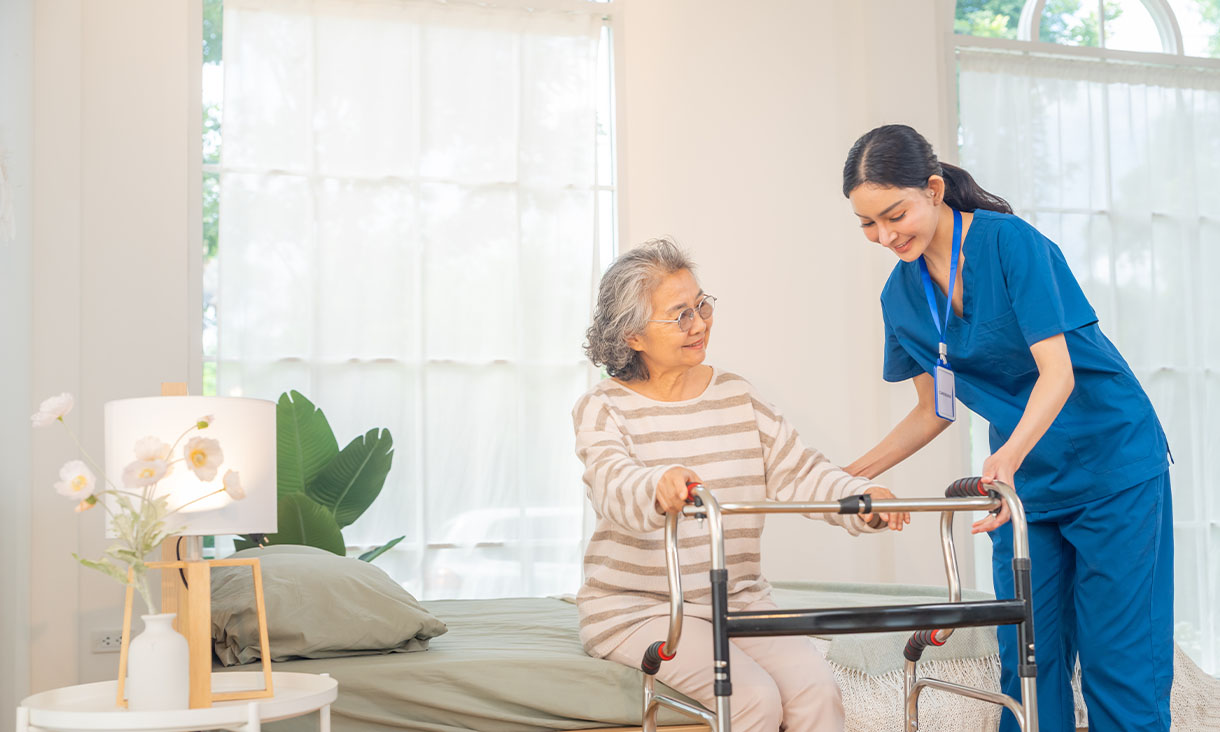

How AI can support older adults without taking over care

How AI can support older adults without taking over care

AI can help older adults live more safely and independently. A useful system must also protect dignity, keep people accountable for consequential decisions and strengthen the relationships that make care human.

Consider an older person living with dementia who is in pain but cannot explain it. AI can help a caregiver notice facial movements associated with pain. Sensors can also detect a change in mobility or routine that may warrant a phone call or visit. Used carefully, these tools can make needs visible earlier.

Ageing, however, is not simply a technical problem, and care is not a sequence of tasks to automate. Older adults may depend on others for some forms of support while remaining fully capable of expressing preferences, setting boundaries and deciding how they want to live. Technology that ignores this can reduce risk on paper while leaving a person feeling watched, managed or more alone.

This is why the debate about AI and ageing should focus as much on accountability as capability. Who decides what a system does? What information can it collect? When may it intervene? Who carries responsibility when a decision affects health, safety or autonomy? And how will we know whether life has actually improved?

To help answer these questions, I propose the CARE framework for human-centred AI and longevity.

CARE stands for Co-design, Augment, Retain and Evaluate.

Together, these four commitments provide a practical test for organisations designing, buying or governing AI for older adults and their caregivers.

Co-design begins with older adults and caregivers

Co-design means that older adults and caregivers help shape the purpose and rules of a system before it reaches a home, hospital or aged-care service. They should have a genuine say in what the AI does, what data it collects, who can see that data, when intervention is appropriate and when the system should remain silent.

This matters because usage data cannot tell us which needs have gone unheard. A product team may see that people have stopped using a feature. A conversation may reveal that the feature feels intrusive, confusing or infantilising. Dignity, autonomy, control and privacy therefore belong in the design brief from the beginning.

Caregivers also need a seat at the table. Family members, clinicians and community caregivers may experience the same system differently. Co-design makes these differences visible early, when the design can still change.

Augmentation should lead people back to people

AI should expand an older person's capabilities and support the people around them. It should not quietly become a substitute for human care or companionship. A useful test is whether the technology helps someone act with more independence and whether it creates a clearer path to human contact when contact is needed.

Social robots show both the potential and the limits. A Singapore University of Social Sciences study of the LOVOT social robot found that older adults living alone reported positive experiences and felt comfortable interacting with the robot at home. LOVOT could learn routines and respond to emotions. These findings are encouraging, but they do not make a robot equivalent to a relationship. Its role should be to complement family, volunteer and community support.

Singapore's SHINESeniors project offers another model. Unobtrusive home sensors track patterns such as movement, rest and medication. When behaviour changes, the system alerts a community caregiver, who decides what human response is appropriate. Technology serves as a safety net while the caregiver network provides the care.

Human responsibility must match the level of risk

As AI systems become more capable of acting on their own, human oversight must remain meaningful. A person who routinely approves an AI recommendation without examining it does not provide much protection. Responsibility needs to be built into the workflow, with enough time, authority and information for a person to disagree.

A practical approach is to match AI autonomy to the seriousness and reversibility of the decision. Low-risk actions can happen automatically. Examples include enlarging text, reading a message aloud or sending an appointment reminder. For moderate-risk matters, AI can recommend an action, but a person should confirm it. A missed medication alert or a proposed change to a care plan belongs in this category. High-risk decisions should remain with a qualified human. Diagnosis, treatment, safeguarding, capacity, end-of-life decisions and withdrawal of care all require professional judgement and clear accountability.

Singapore's Model AI Governance Framework for Agentic AI, first published in January 2026, takes a similar risk-based approach. It asks organisations to set boundaries before deployment and keep humans accountable for outcomes. This is especially important in care settings, where a wrong decision may be difficult or impossible to reverse.

PainChek® shows how AI and human judgement can work together. The app analyses facial movements that may indicate pain in a person with dementia who cannot communicate verbally. A caregiver records other observed behaviours, and the system calculates a pain score to inform assessment and treatment. The AI makes pain easier to recognise, while caregivers and health professionals remain responsible for what happens next.

Evaluation should ask whether daily life improved

Digital systems are often evaluated through measures that are easy to collect: chatbot conversations, app log-ins, alerts sent or minutes of engagement. These numbers describe activity. They say little about whether an older adult feels safer, more respected or less isolated.

A human-centred evaluation would examine perceived agency and dignity, caregiver confidence and burden, meaningful human contact, participation in family and community life, and access across languages, incomes and levels of digital ability. It would also ask whether unmet needs have decreased. These outcomes take more effort to measure. They may require repeated assessment over time and direct conversations with older adults and caregivers. That effort is necessary because the purpose of the technology is to improve life, not merely increase use.

Australia's Smarter Safer Homes trial points in this direction. The CSIRO-developed platform used ambient sensors and AI to identify changes in daily routines. Family members and care providers could review the patterns and decide whether to check in. The trial involved 195 participants, and CSIRO reported benefits for social care-related quality of life as well as participants' sense of safety and comfort. The important outcome was not the number of signals produced. It was whether those signals supported safer independence at home.

Australia and Singapore can learn from each other

The examples from Australia and Singapore suggest complementary strengths. Australian initiatives such as PainChek and Smarter Safer Homes foreground clinical use, evidence and measurable outcomes. Singapore's experience shows how AI can sit within coordinated networks of hospitals, community organisations, volunteers and family caregivers.

There is a useful opportunity for mutual learning. Researchers and care organisations could test how the same human-centred principles work across different cultures, languages, care systems and levels of digital access. The goal should not be to export one universal product. Each implementation needs local co-design, even when the underlying commitments remain the same.

Four questions to ask before using AI in ageing and care

  1. Who helped define the problem and decide what the system may do?
  2. Does the technology build capability and human connection?
  3. Is human responsibility clear and proportionate to the risk?
  4. Are we measuring dignity, agency, caregiver burden and participation rather than activity alone?

AI can play a valuable role in longevity and care. It can reveal pain, notice a change in routine and help coordinate support. Its value depends on the human arrangements around it. Older adults must retain a voice, caregivers need clear authority, consequential decisions need accountable professionals, and evaluation must show whether daily life improved. That is the standard the CARE framework is designed to set.

About the Author

Dr Mingjun Yang is a Senior Lecturer at School of Management, RMIT University. Her teaching and research interests include leadership, organisational behaviour, AI in management, group diversity, and innovation.

She has a particular interest in multilevel linear and curvilinear modelling within the field of management.

28 September 2026

Share

28 September 2026

Share

Related News

aboriginal flag float-starttorres strait flag float-start

Acknowledgement of Country

RMIT University acknowledges the people of the Woi wurrung and Boon wurrung language groups of the eastern Kulin Nation on whose unceded lands we conduct the business of the University. RMIT University respectfully acknowledges their Ancestors and Elders, past and present. RMIT also acknowledges the Traditional Custodians and their Ancestors of the lands and waters across Australia where we conduct our business - Artwork 'Sentient' by Hollie Johnson, Gunaikurnai and Monero Ngarigo.

More information