
Does property law hold the key to creating effective climate change mitigation and adaptation responses?

Does property law hold the key to creating effective climate change mitigation and adaptation responses?

Climate change affects everything, and everything happens on land. It does not matter if you are talking about an emissions unit or the loss of land from sea level rise, property and the rules that govern it are engaged by the climate crisis.

Lawmakers have tended to overlook property law implications when designing regulatory responses to climate change that risks weakening policy effectiveness while creating the illusion of progress. Assumptions about property, particularly its perceived absoluteness or rigidity, can also create barriers to designing tools that will have the desired outcomes.

Property is a social and flexible institution capable of serving multiple ends. The presumptions held by the law of property however are not unchangeable. When properly recognised and accounted for in system design, property law can facilitate rather than hinder climate responses. Property law and the rules that govern land must be central to thinking about the design of effective climate responses.

Newly released book, Property Law and Climate Change: Inextricably Linked, reveals a critical oversight in global climate action – the failure to integrate property law into climate policy and regulatory frameworks for both the reduction of greenhouse gas emissions, and for measures to support the adaptation and resilience of land against climate impacts.

The book explores the challenges and opportunities that property law poses for climate change over two parts.

  • Part One discusses property-based mitigation schemes, including emissions trading and carbon sequestration schemes and identifies property law issues that arise with such schemes, including whether and if so what property interests in land are created.
  • Part Two discusses property-based adaption mechanisms, including in planning law and the regulation of the sale of land. The limits of property law are illustrated by exploring policy responses that seek to strategically manage the retreat of people and things away from locations at risk of significant climate harm.

The book calls for the development of climate mitigation and adaptation tools in ways that are cognisant of, and grounded in, property law.

Overlooking property law or failing to engage with it based on presumptions about how it operates, will inevitably obstruct effective responses to climate change and delay the urgent, wide-ranging work required to build tools for a world undergoing rapid and profound transformation. The book provides a foundation for further interdisciplinary research on managed retreat.

About the authors

Dr Vanessa Johnston is a Senior Lecturer at RMIT’s School of Law. Her research critically examines how law and policy shape climate resilience, particularly in property ownership, land use, and transport systems. Her recent work explores the inextricable connection between property law and climate change mitigation responses and adaptation pathways such as managed retreat.

Dr Ben France-Hudson is an Associate Professor at the University of Otago, New Zealand. His research focuses on the law and theory of private property, with a particular focus on natural resources, land law and the anticipated effects of climate change.

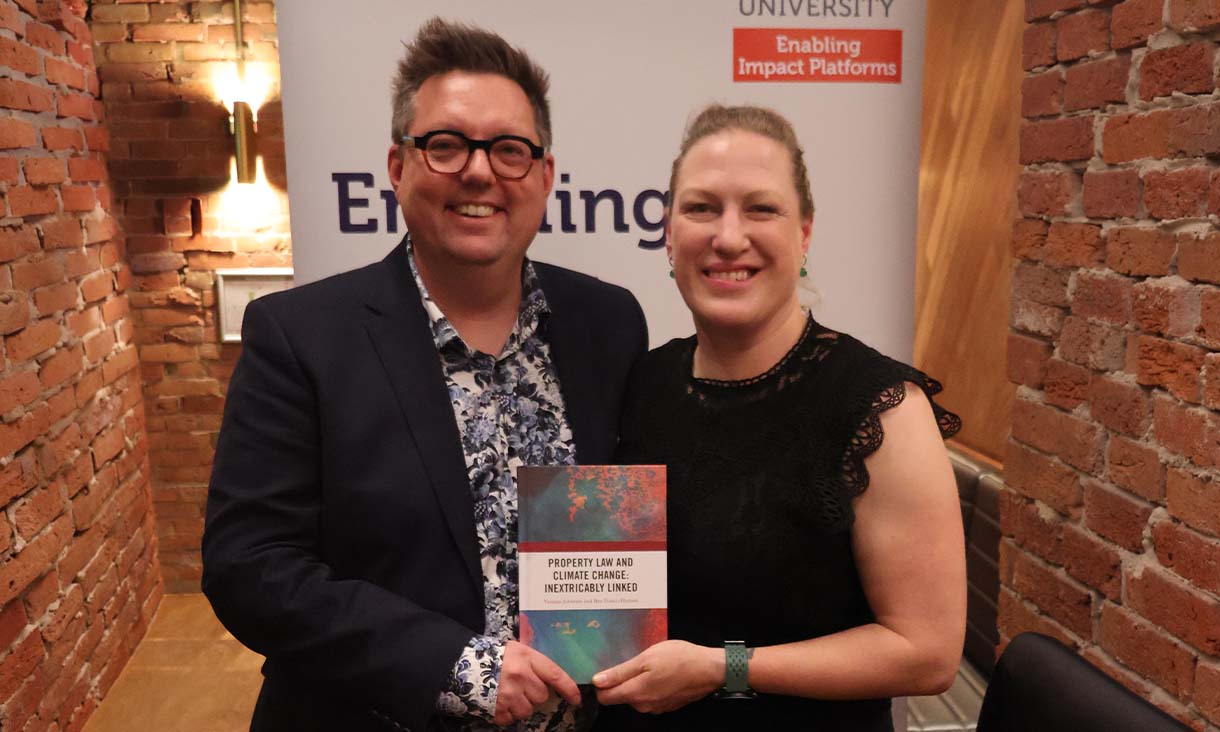
A man and woman stand together, holding their book in front of a brick wallVanessa and Ben at the official launch of their co-authored book.
07 August 2026

Share

07 August 2026

Share

Related News

aboriginal flag float-starttorres strait flag float-start

Acknowledgement of Country

RMIT University acknowledges the people of the Woi wurrung and Boon wurrung language groups of the eastern Kulin Nation on whose unceded lands we conduct the business of the University. RMIT University respectfully acknowledges their Ancestors and Elders, past and present. RMIT also acknowledges the Traditional Custodians and their Ancestors of the lands and waters across Australia where we conduct our business - Artwork 'Sentient' by Hollie Johnson, Gunaikurnai and Monero Ngarigo.

More information