Are we still discovering new ways to improve the human experience?

Are we still discovering new ways to improve the human experience?

Why does innovation matter? At the most fundamental level, because as humans we are constantly searching for ways to improve our experience of life. What exactly this means is difficult and perhaps impossible to define.

We value safety, health, freedom, time, knowledge, social connection, opportunity, pleasure, dignity, hope, and countless other things. The list could go on almost indefinitely, and neither millennia of philosophical thought nor developments in psychology have brought us particularly close to a complete account of what ultimately makes human life better.

What matters for our purposes is that value ultimately comes from the human experience. Money, products, technologies, physical resources, and institutions do not have value in and of themselves. They have value because of what they allow us to do, achieve, experience or become. At the same time, the resources available to us are finite, with time perhaps being the clearest example. Much of human progress can therefore be understood as the search for better ways of using the limited resources available to us to create greater value.

It is this search that we are referring to when we speak of innovation. Through creativity and new ways of using what is already available to us, we make finite resources capable of producing forms of value that did not previously exist. Earth and clay become bricks that provide shelter, security and, eventually, some of humanity’s greatest structures. Silicon, derived from silica abundant in ordinary sand, becomes the basis of microchips that have transformed how we communicate, work, learn and understand the world.

Innovations differ in how far they expand possibilities

Some Innovations improve the ways we use resources within an existing technological paradigm; others reveal entirely new ways of using the world around us.

Learning to turn earth and clay into useful materials opened an enormous new paradigm. From it came bricks, pottery, tiles, drainage systems, kilns, sculpture and increasingly sophisticated forms of construction, each allowing us to derive new forms of value from resources that had always been around us. But innovation within any existing paradigm ultimately faces limits. No matter how masterful we became in the use of clay, and no matter how sophisticated the structures, tools or works of art we produced from it, further advances in our use of clay could never give us radio, flight, antibiotics or computation.

Reaching those possibilities required entirely new ways of understanding and using the world around us. At times, this meant learning to make use of things we had not even known existed. For virtually all of human history, much of the electromagnetic spectrum surrounded us without our knowing that it was there, let alone appreciating what it might allow us to do. Once we learned to understand and manipulate it, an entirely new range of possibilities opened up. Voices could travel across continents, music could be broadcast through the air, objects could be located by radar, the human body could be imaged, spacecraft could communicate with Earth, and billions of people could connect wirelessly. New paradigms matter because they open entirely new ways of improving human life, allowing us to create forms of value that may have been unimaginable within the world we already understood.

That distinction is easy to lose sight of when we try to measure innovation. Research and Development (R&D) expenditure – the number of researchers, scholarly papers or patents – may tell us something about the scale of innovative activity, but much less about whether that activity is extending existing possibilities or opening genuinely new ones. It may be tempting to assume that, because paradigm-shifting discoveries can create enormous value, people will naturally seek them out and that greater investment in innovation will make such breakthroughs more likely. History suggests otherwise. Paradigm-shifting ideas have often faced significant obstacles to their development and adoption. As human beings, we naturally seek some degree of certainty and stability in an otherwise uncertain world, while cultures, institutions and broader social structures tend to form around existing paradigms.

These structures shape how people live, what they do and how economic activity is organised. New paradigms can therefore be deeply disruptive, displacing established practices, institutions and interests even when they ultimately create substantial value. It is unsurprising, then, that history provides many examples of such ideas being resisted rather than immediately embraced. The resistance to Copernican heliocentrism, culminating in Galileo Galilei’s condemnation by the Roman Inquisition in the 17th century, is one prominent example. An even more striking, although legendary, illustration comes from 1st-century Rome, where Emperor Tiberius was said to have ordered the execution of an inventor who presented him with flexible, supposedly unbreakable glass, fearing that the invention would undermine the value of precious metals and disrupt the existing economic order.

Beyond this natural resistance to ideas that challenge the prevailing order, there are other, more practical forces that can constrain the emergence of paradigm-shifting innovation. The scale and complexity of modern societies mean that most research is conducted by highly skilled experts within particular fields, whether scholars, engineers or other specialists. These experts naturally respond to the incentives and expectations placed upon them. Yet measures of performance can only be built around outcomes that are already sufficiently understood to be identified and evaluated. They will therefore tend, by construction, to sit within existing paradigms.

Consider, hypothetically, a world operating entirely within the paradigm of producing useful goods from clay. Those who developed stronger bricks, better kilns or more sophisticated pottery would readily be recognised as productive and innovative. Someone devoting years to studying invisible electromagnetic phenomena, with no obvious application or measurable output, could easily be regarded as an unsuccessful and unproductive time-waster. The incentives therefore tend to reward demonstrable progress within what is already understood rather than exploration far beyond the established path.

Finally, departures from established paradigms are, by definition, departures from what is known. They are therefore difficult to evaluate in advance, highly uncertain and often costly to pursue. Most attempts to move meaningfully beyond established ways of doing things will fail. Even when they succeed, those responsible for the initial breakthrough may capture only a small share of the value they create. Johannes Gutenberg, whose movable-type printing press transformed the economics of reproducing and disseminating information, struggled financially while developing his invention and ultimately lost control of much of his printing operation after being unable to repay his debts. Richard Trevithick, a pioneer of high-pressure steam and builder of the first steam locomotive to run successfully on rails, faced technical difficulties, struggled to convince others of the potential of his ideas, and ultimately died in poverty.

We therefore cannot assume that, simply because paradigm-shifting discoveries are essential to value creation and the improvement of human experience, they will naturally arise.

Where is the state of innovation now?

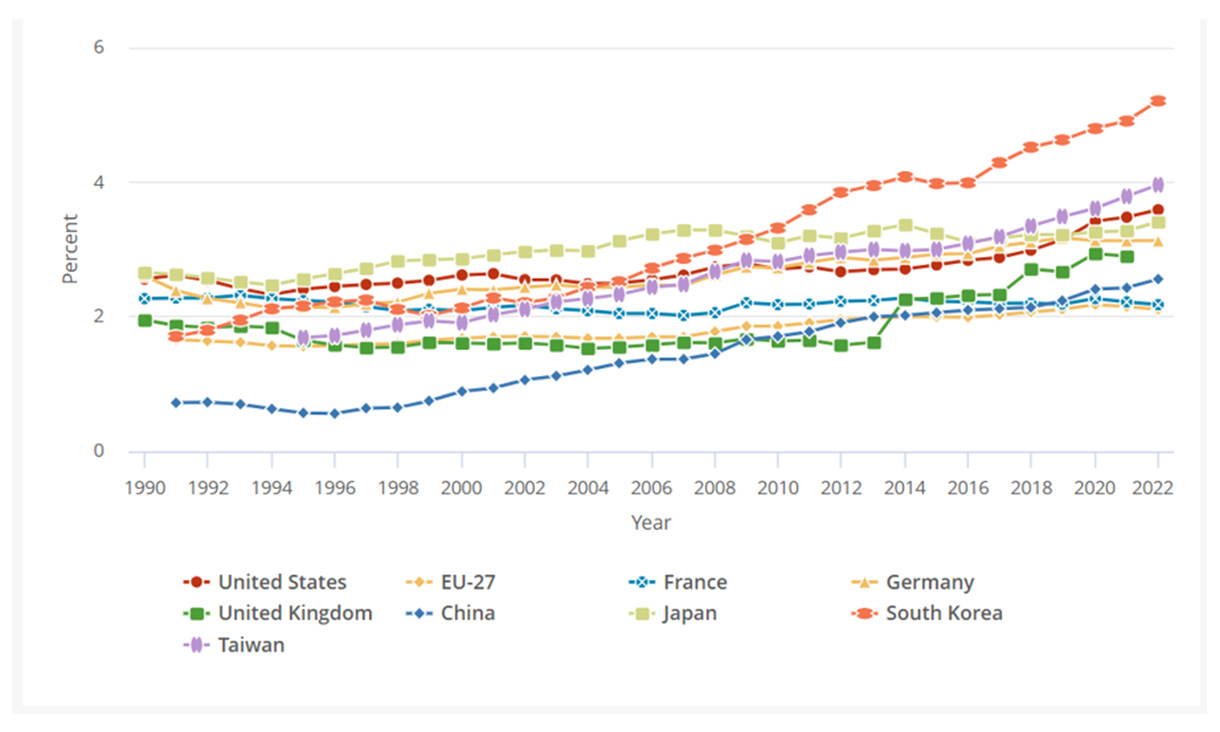
Data from the US National Science Foundation show that R&D expenditure as a share of GDP has been rising across the major global economies, while the number of academic papers and patent filings has also grown substantially over time. On the surface, these trends should give us confidence in our ability to address emerging challenges, adapt to a resource-constrained world, and continue creating value and improving the human experience.

Yet data previously generated by our Finance and Frontier Technology Innovation Cluster give a less reassuring picture. By measuring how far new inventions depart from the technological knowledge embodied in those that came before them, we find that the emergence of more radical innovations has plateaued and, by some measures, appears to be declining.

This evidence is important, but it does not fully capture the issue we are interested in here. A major breakthrough may open an entirely new technological space, after which much of the valuable innovation that follows may appear incremental simply because it develops within that new paradigm. To understand whether innovation is continuing to expand the boundaries of what is possible, we therefore need to examine the structure of technological knowledge itself. Building on our earlier patent-text analysis, together with Stamatios Tsigos we are taking a different approach, first identifying technological clusters using established clustering techniques and then examining how inventions are distributed within and across those clusters over time. We ask whether existing clusters are becoming more crowded, whether new and distinct clusters continue to emerge, and whether the technological distance between clusters is expanding or contracting.

A graph depicting R&D as a percentage of GDP across select countriesFigure 1. R&D as a percentage of GDP across select countries

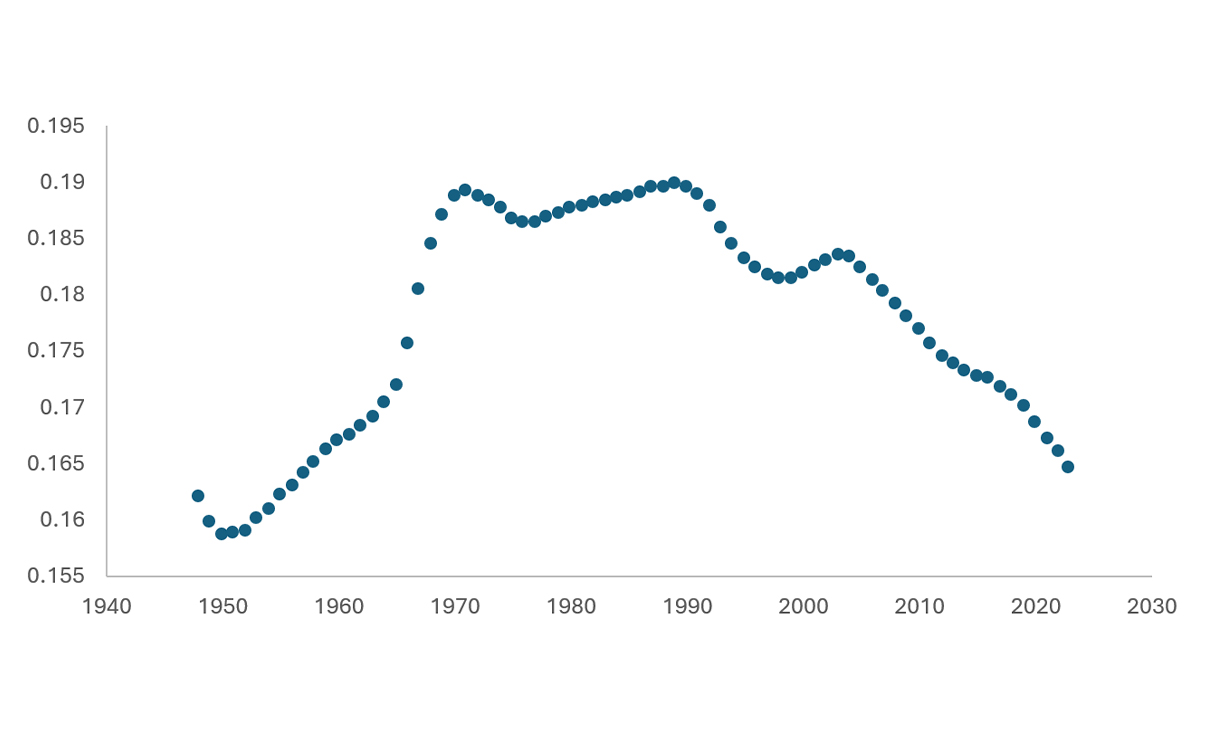
We first examine how distant inventions are from one another within established technological clusters. Intuitively, this tells us how crowded these technological spaces are becoming. Greater within-cluster distance means that inventions are spreading into more distant parts of the technological space, while declining distance means that inventive activity is becoming increasingly concentrated around what is already known. Since the number of inventions rises substantially over time, avoiding greater crowding requires the technological space itself to expand, either through the emergence of new paradigms, or through paradigms sufficiently broad to provide a longer runway for subsequent innovation.

Our results reveal that from the 1950s to the early 1970s, within-cluster distance increased sharply, suggesting that technological space was expanding faster than inventive activity was filling it. This period coincided with the emergence of major new technological paradigms, including semiconductor electronics and integrated circuits, modern computing, jet and space technologies, nuclear technology and, toward the end of the period, molecular biology.

From the 1970s to around the turn of the century, within-cluster distance was broadly stable. This is consistent with a period in which rising inventive activity was broadly matched by the opening and expansion of technological spaces, preventing innovation from becoming materially more crowded.

Since the early 2000s, however, within-cluster distance begins to decline sharply, suggesting that inventive activity is increasingly concentrating within already established technological spaces.

A graph depicting Intra-cluster distance between ideasFigure 2. Intra-cluster distance between ideas

This finding is consistent with evidence reported in a 2020 American Economic Review paper examining how much research effort is required to sustain technological progress. Across a range of technology fields, research effort has consistently risen substantially while research productivity has declined sharply. Semiconductors provide perhaps the clearest example. Maintaining Moore’s Law, the continuing increase in the density of transistors on computer chips, requires more than 18 times as many researchers as it did in the early 1970s.

This is exactly what we would expect as innovation pushes further into a mature technological paradigm, where additional progress remains possible, but increasingly large amounts of resources, time and effort are required to achieve it. This is why the continued emergence of new paradigms is so important. Without them, more and more of society’s scarce resources must be devoted simply to maintaining the same rate of progress within increasingly mature technologies. New paradigms allow us to escape these diminishing returns by opening new technological spaces in which entirely new avenues of value creation become possible.

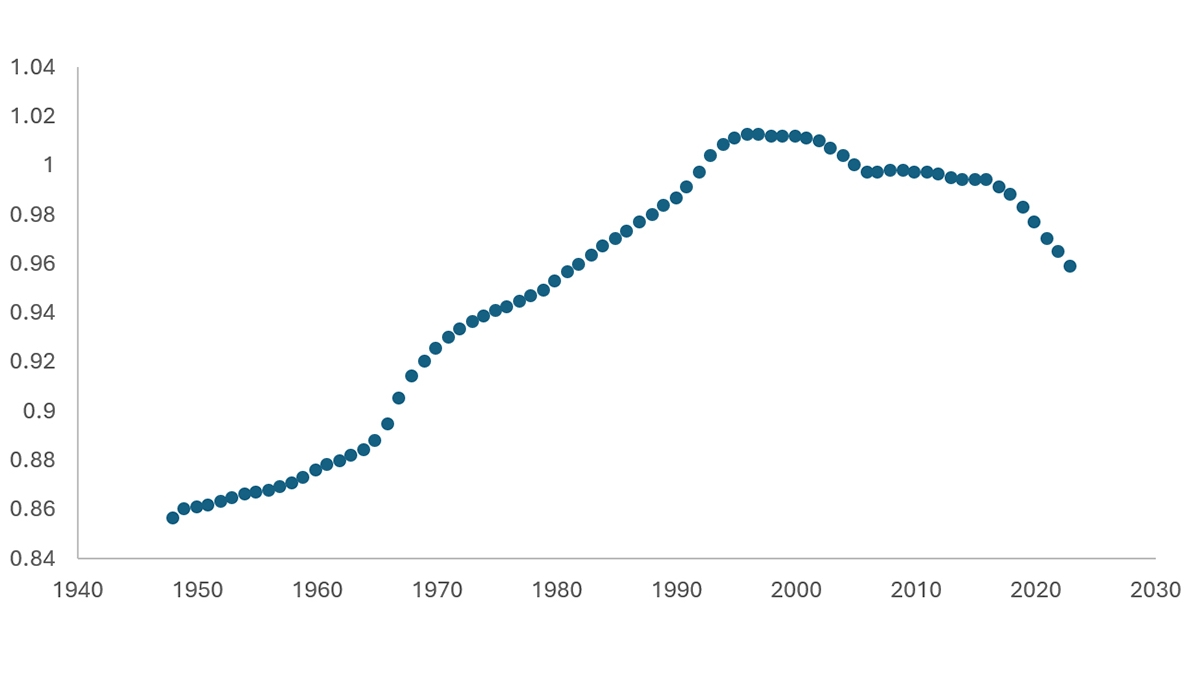
We next examine the distance between technological clusters. While our first measure tells us whether innovation is becoming more crowded within existing paradigms, this measure asks whether the technological landscape itself is continuing to expand. New paradigms that emerge far from existing areas of knowledge open genuinely new technological spaces, while those that emerge close to what we already know expand that frontier by less. Again, we find that from the 1950s to around the turn of the century, the distance between technological clusters increased, suggesting that the technological possibility space was expanding. Since the early 2000s, however, that trend has reversed. Technological clusters have become progressively closer to one another. Taken together with the increasing crowding we observe within clusters, the evidence suggests that innovation is becoming more concentrated both within established technological paradigms and around areas of knowledge that are themselves increasingly related.

A graph depicting inter-cluster distance Figure 3. Inter-cluster distance

The current excitement around artificial intelligence provides a useful way of thinking about what this may mean. Generative AI is clearly an important new technological paradigm and is already opening valuable possibilities that did not previously exist. Yet it has not emerged from an entirely new technological foundation. Its physical infrastructure depends on semiconductor-based computing, while many of its underlying mathematical ideas, including artificial neural networks, have histories stretching back many decades. In this sense, AI can simultaneously represent a major new paradigm while remaining relatively close to the broader computing and semiconductor paradigms that preceded it.

This distinction matters because technological progress is valuable only insofar as it improves the human experience. AI is exceptionally well suited to problems involving information, computation, prediction, communication and the automation of cognitive and routine tasks. But many important challenges facing human wellbeing, including loneliness, social disconnection, loss of meaning, fear and stress, do not arise primarily from limitations in our ability to process information or perform computation.

This is why the continued emergence of genuinely different paradigms matters. A society can become extraordinarily sophisticated within one technological possibility space while leaving other dimensions of human value largely untouched. At the same time, pushing further within an established paradigm may require increasingly large amounts of computation, energy, data, capital and specialised human skill. Modern AI provides a vivid example. Its importance is not in question, but it illustrates how technological progress can remain highly impressive even as innovation becomes increasingly concentrated within possibility spaces opened by earlier paradigms.

It is this emerging evidence, the plateauing of radical innovation, the increasing crowding of technological space, and the declining distance between technological paradigms, that makes the direction of innovation an issue we need to take seriously. We are committing more money, people, time and effort to innovation than ever before, yet it seems not to be translating proportionately into the opening of genuinely new technological possibilities. The concern is that an increasing share of our innovative effort may be directed towards extracting more value from possibility spaces opened by earlier paradigms, while genuinely new spaces are emerging less frequently. In a world facing finite resources, diminishing returns within established technologies, and an evolving set of challenges to the human experience, that distinction is very important.

Understanding why this is happening, and what might be done about it, requires a much broader conversation than one confined to researchers or the conventional innovation ecosystem. Our Finance and Frontier Technology Innovation Cluster will continue developing evidence on the forces shaping frontier and paradigm-shifting innovation, including the role played by capital markets and the way financial resources are allocated across competing ideas. But the forces determining the direction of innovation extend much further.

The incentives faced by researchers influence which questions are pursued. Organisations determine how much room people have to question established ways of doing things. Investors decide which uncertain ideas receive capital and how quickly those ideas are expected to generate returns. Governments shape research priorities and the institutional environment in which experimentation occurs. And ultimately, the risk and return preferences of households and society influence where capital flows and what forms of uncertainty we are willing to tolerate. Collectively, these decisions shape how much space we give to ideas that sit outside what is already known.

The challenge, therefore, is to understand whether the systems through which we allocate resources, evaluate ideas and reward success give genuinely unfamiliar possibilities enough opportunity to be explored. This does not mean abandoning accountability, lowering standards, or indiscriminately supporting unconventional ideas. Most such ideas will fail. It means recognising that a system designed entirely around outcomes that can already be understood, measured and justified may systematically favour progress within existing paradigms over the discovery of new ones. If the evidence presented here is pointing in the right direction, the central question is whether we are using our finite resources in ways that continue to expand the possibilities for creating human value.

That is the conversation our Cluster hopes to contribute to, and one that should involve researchers, businesses, investors, governments and the wider community.

About the Author

Professor Edward Podolski is a Professor of Finance at RMIT University’s School of Economics Finance and Marketing.

His research focuses on identifying organisational factors that enhance firm value, particularly through the lens of how shareholders guide and impact executive strategic decisions.

09 October 2026

Share

09 October 2026

Share

Related News

aboriginal flag float-starttorres strait flag float-start

Acknowledgement of Country

RMIT University acknowledges the people of the Woi wurrung and Boon wurrung language groups of the eastern Kulin Nation on whose unceded lands we conduct the business of the University. RMIT University respectfully acknowledges their Ancestors and Elders, past and present. RMIT also acknowledges the Traditional Custodians and their Ancestors of the lands and waters across Australia where we conduct our business - Artwork 'Sentient' by Hollie Johnson, Gunaikurnai and Monero Ngarigo.

More information