Australian of the Year brings stellar insights to inspire the next generation at RMIT

Australian of the Year brings stellar insights to inspire the next generation at RMIT

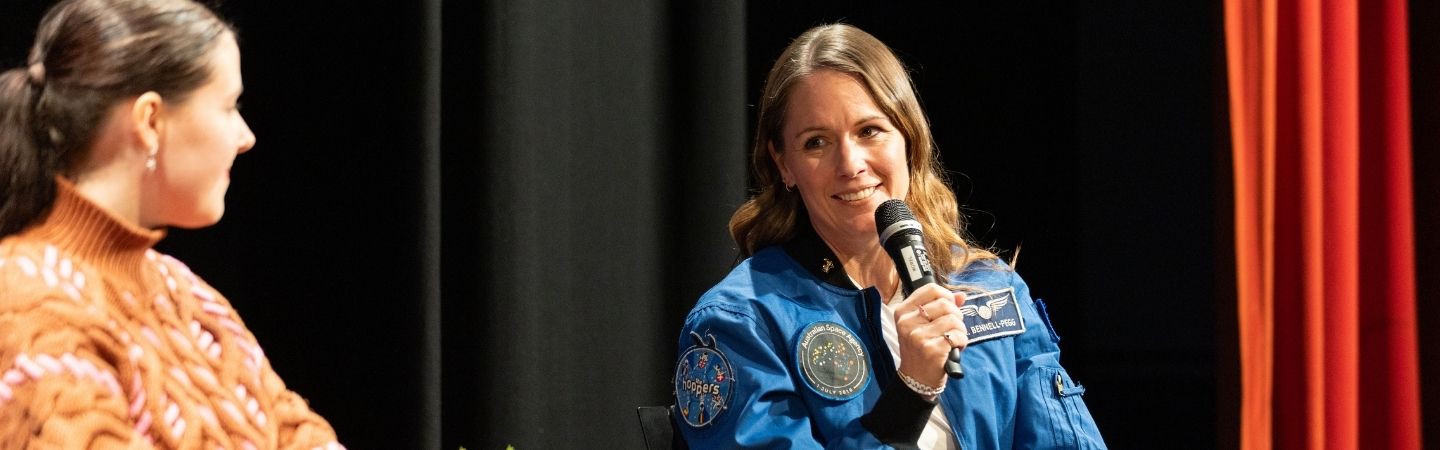
Katherine Bennell-Pegg, who is the first astronaut to officially represent Australia, visited RMIT for a tour and panel discussion taking students through her journey from physics student to space systems engineer and astronaut.

Bennell-Pegg spoke with students and staff who are leading key projects in space-related fields and tried her hand at RMIT’s cutting-edge technologies including the Nova360 helicopter simulator.

The visit included a tour of RMIT’s Virtual Experiences (VX) Lab, showcasing some of the University’s immersive research in space weather and food technology.

The astronaut, whose long list of accolades include being named Australian of the Year in 2026, was impressed by the quality of research and education on display, as well as the passionate minds behind it.

"I got to meet so many incredible students, researchers, and staff who are at the cutting edge of the cutting edge, with incredible capabilities for understanding the space environment and Australia’s needs in it,” Bennell-Pegg said. 

“Much of the future of space is being built here at RMIT,” she added, drawing attention to RMIT’s VR technologies, robots, food research, and fashion as examples of innovation that place the University at the forefront of Australia’s space industry.

In a special presentation and panel discussion with students, Bennell-Pegg emphasised the importance of investing in STEM research and education in Australia. 

"For Australia right now, we really do need a cultural shift in how we view science and research and technology at the individual level, that it's not just the kids that are top of the class, but also at the societal level, backing in our own research and our own ideas, rather than thinking things are out of reach for Australia.

“The door is there if we want to walk through it as a nation to go even further, and knowing that it's an investment, it's not a sunk cost. 

“Space is so critical for quality of life and our environment around the world.”

Professor Catherine Itsiopoulos, Deputy Vice-Chancellor of STEM College and Vice-President, said that it was an honour to host Bennell-Pegg and showcase the University’s unique contributions to the space sector.

“It was a pleasure to share with Katherine our strengths right across RMIT, and how our collaborative approach will help us advance what comes next for space and STEM,” Professor Itsiopoulos said.
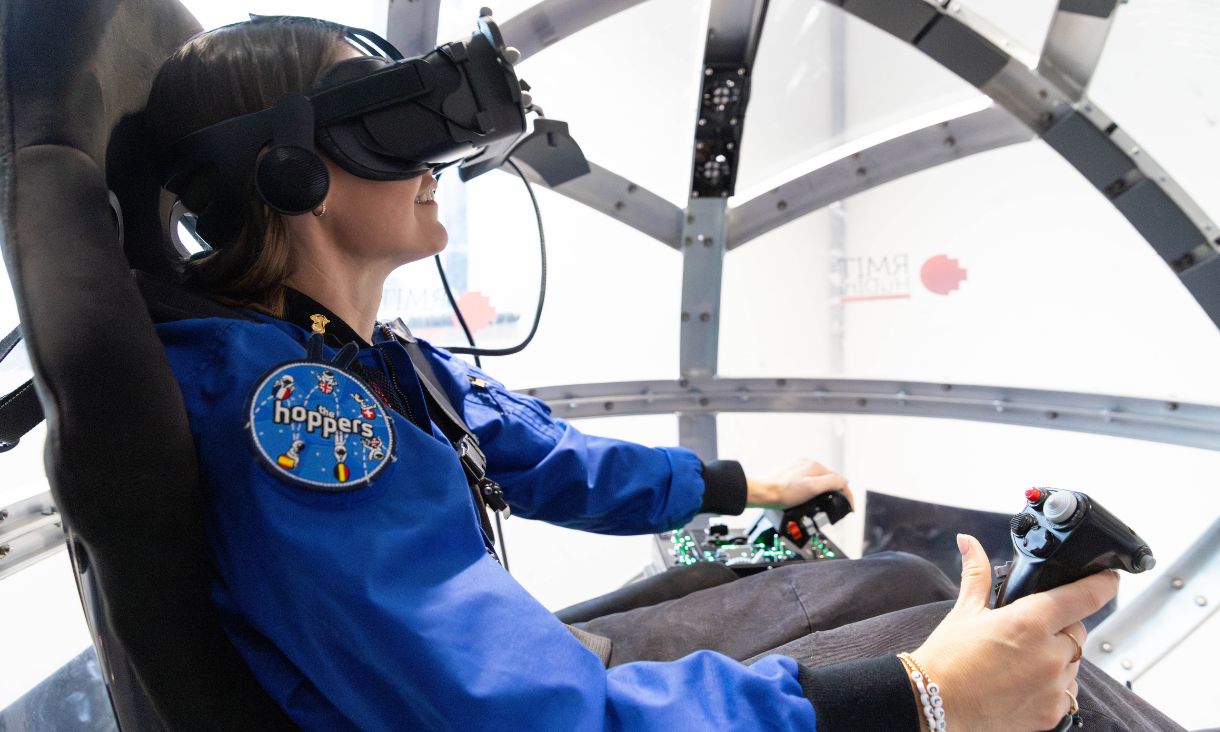
Katherine Bennell-Pegg using RMIT's Nova360 helicopter simulator.Katherine Bennell-Pegg using RMIT's Nova360 helicopter simulator.

Building a pipeline for women in STEM

Bennell-Pegg offered insights into her perspective as a female STEM leader, arguing that Australia needs to build a pipeline for young girls interested in STEM.

“Gender gaps are opening early and they are persisting. We’ve got the lowest-ever enrolment rates on record for girls and young women in physics and intermediate and higher maths,” she said.

“I've had the privilege to get out and about across Australia, and I can tell you – curiosity and talent have no gender and no postcode; they are absolutely everywhere in this country. Aspiration is not everywhere though, because opportunity isn't.” 

Increasing opportunity and breaking down barriers for women in STEM is a priority for RMIT.

Manager for Women in STEM in the College of Vocational Education, Nicole Fetchet, said that the University’s outreach programs elevate the profile of STEM careers.

“It's our job as a tertiary education provider to ensure these professions are visible, to showcase the STEM applications of the future, and remove the barriers to ensure STEM is accessible to people of all genders and from all walks of life,” Fetchet said.

“It’s also great to have visible role models like Katherine who can inspire the next generation.”

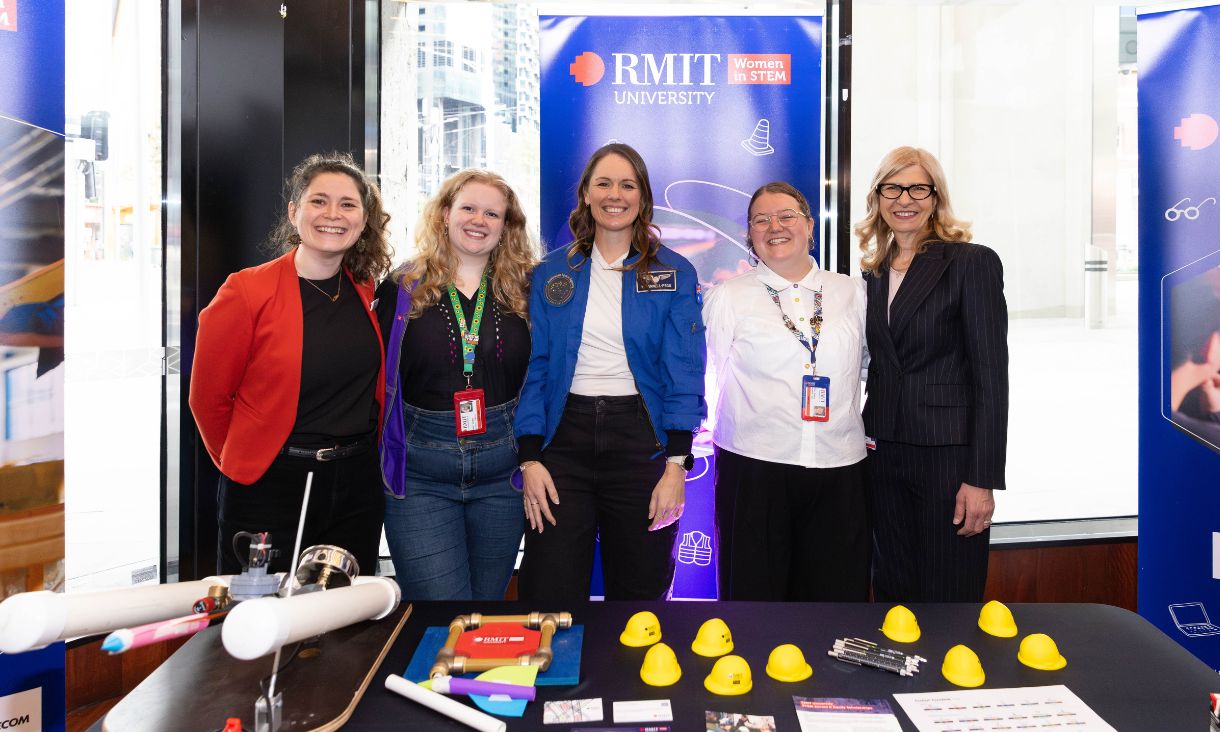
Katherine Bennell-Pegg and Professor Catherine Itsiopoulos with members of the Women in STEM and STEM Outreach teams.Katherine Bennell-Pegg (middle) and Professor Catherine Itsiopoulos (right) with members of RMIT's Women in STEM and STEM Outreach teams.

Showcasing cutting-edge space research

RMIT’s researchers showcased to Bennell-Pegg the innovative ways they are approaching space, which focus on collaboration across disciplines and sectors.

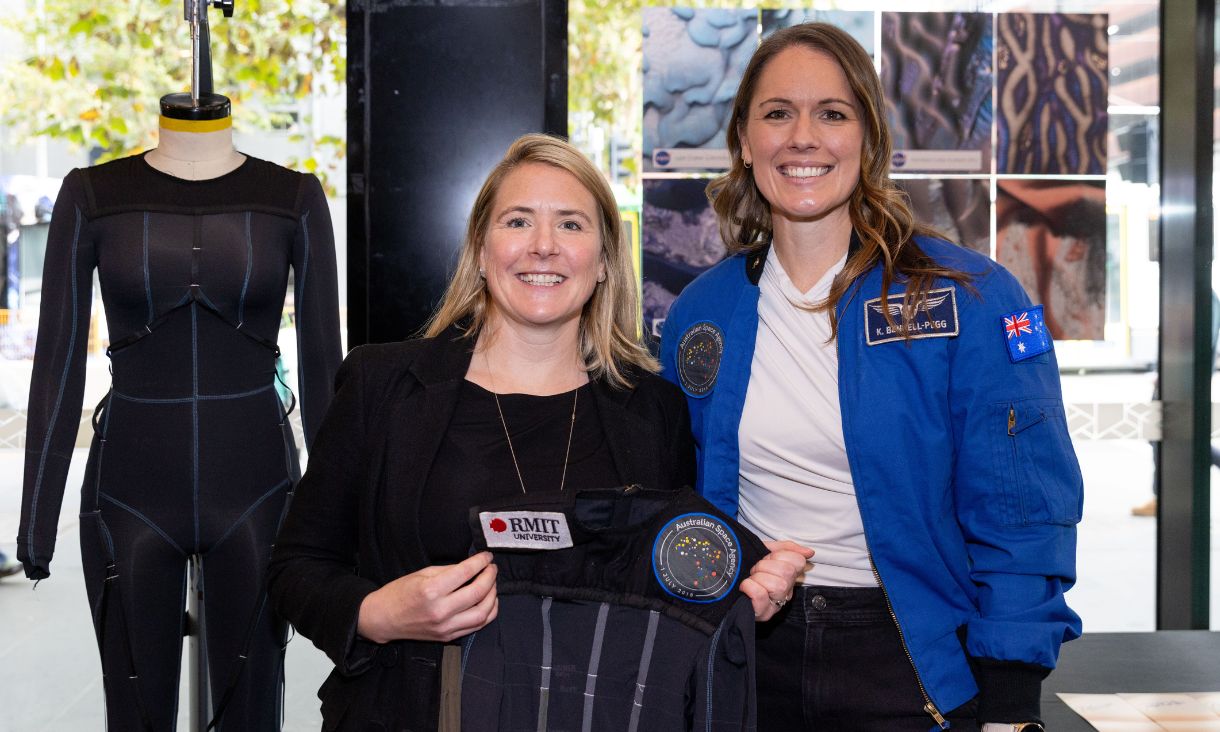
Ruth Bunford, Lecturer in the School of Fashion and Textiles, exhibited her project, a specialist compression garment for astronauts, which was developed in collaboration with industry partner Human Aerospace and funded by the Australian Space Agency.

The project brought together experts from fashion, engineering, textile technology, aerospace, and medicinal care, who worked as a team to design the garment, which is tailored for increased wearer mobility. 

“The exchange of knowledge between members of the research team... enabled us to find a collaborative way of working towards a common research goal that would not have been possible without input of the expertise from a broad range of disciplines,” Bunford said.

Bunford added that showcasing the project to Bennell-Pegg reinforced “why I do the work that I do”.

Ruth Bunford with Katherine Bennell-Pegg.Ruth Bunford with Katherine Bennell-Pegg.

Dr. Julia Low and PhD candidates Brooke Crawford and Grace Loke also presented their work, which is at the intersection between space science and food technology.

The research aims to better understand how astronauts experience food and meals in microgravity and isolated and confined environments, with the hope of creating more effective and enjoyable eating experiences for future space travellers. 

Crawford said that connecting with someone as experienced as Bennell-Pegg was a valuable opportunity.

“It was especially rewarding to receive feedback from someone with direct astronaut training experience and to hear that she sees value in our research,” Crawford said.

“Katherine’s encouragement to believe in ourselves and our work has shifted how I view my PhD and what is possible, reminding me that research focused on human experience and wellbeing has a meaningful role in the future of space exploration.”

Space education unlocks exciting pathways

Bennell-Pegg noted that the work being done at RMIT is laying out the groundwork for the future of Australia’s space industry.

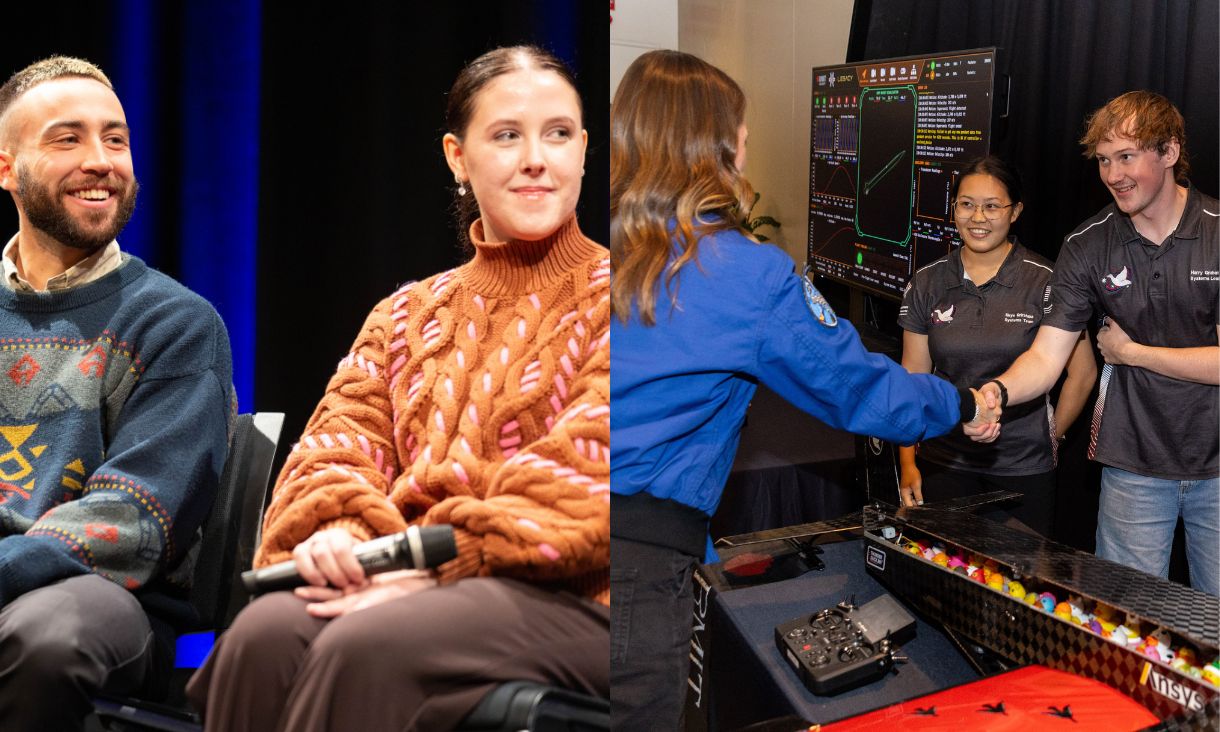
Ciara Ennis, a second-year student from RMIT’s Bachelor of Space Science who appeared in the panel discussion with Bennell-Pegg, said that her studies are preparing her for a career here at home.

“Students in programs like mine are learning skills specified for pathways into our industry at home. We no longer have to travel overseas for an education or career in the industry,” Ennis said. 

Two images spliced together. On the left, an image of students Nicholas and Ciara in a panel discussion. On the right, Katherine Bennell-Pegg greeting members of the RMIT's student-led rocket team HIVE.Left: Aerospace engineering student Nicholas Fay and space science student Ciara Ennis during panel discussion. Right: Katherine Bennell-Pegg greeting members of RMIT's UAS Research team.

RMIT has a range of diverse pathways for students interested in studying space.

The STEM College’s dedicated undergraduate degree, the Bachelor of Space Science, supports students to develop critical skills in space science and technology while benefiting from strong partnerships with local and international space companies and agencies.

In the School of Engineering, the Aerospace Engineering discipline gives students the opportunity to work with a range of industry partners and supports them to compete on a global stage via the RMIT High Velocity (HIVE) student team.

The Future Technologies cluster in the College of Vocational Education also delivers programs in aerospace engineering developed in collaboration with industry, ensuring graduates gain the technical knowledge, creativity, and problem-solving skills needed for the future workforce. 

Professor Itsiopoulos said that RMIT’s status as the largest dual-sector university in Australia uniquely positions it to offer practical, hands-on learning in the space sector.

“RMIT has a long history in applied learning. The University’s motto – a skilled hand, a cultivated mind – underpins our approach to the space sector and explains how what we teach, from aerospace engineering and physics to advanced manufacturing, geospatial science, data and AI, and communications, can be applied to this incredible field,” Professor Itsiopoulos said.

Watch Katherine Bennell-Pegg's presentation and panel discussion.


Story: Keely Tzoukos

Share

Related News

aboriginal flag float-starttorres strait flag float-start

Acknowledgement of Country

RMIT University acknowledges the people of the Woi wurrung and Boon wurrung language groups of the eastern Kulin Nation on whose unceded lands we conduct the business of the University. RMIT University respectfully acknowledges their Ancestors and Elders, past and present. RMIT also acknowledges the Traditional Custodians and their Ancestors of the lands and waters across Australia where we conduct our business - Artwork 'Sentient' by Hollie Johnson, Gunaikurnai and Monero Ngarigo.

More information