While historically the EU has been a strong supporter of the WTO, the world thirty years on from the latter’s inception is increasingly uncertain. Disruption to the rules-based order, global conflict, as well as unpredictable moves from powerful actors such as the United States, coalesce in multifaceted challenges to multilateralism, posing the following questions:
Is the decline of multilateralism and corresponding lessening power of the WTO overstated? How do entities such as the EU and the WTO navigate a world in which there may be lower trust in institutions?
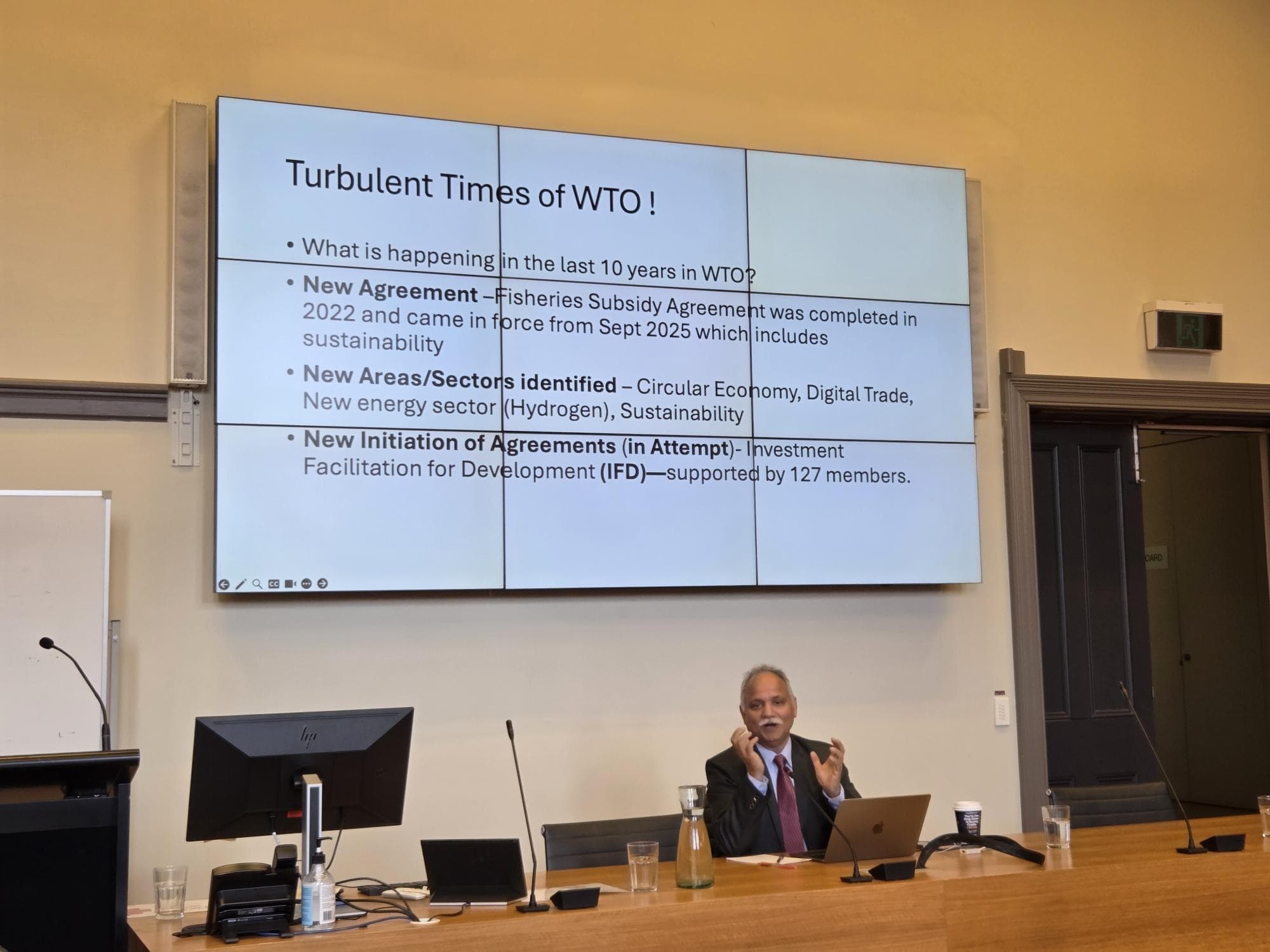
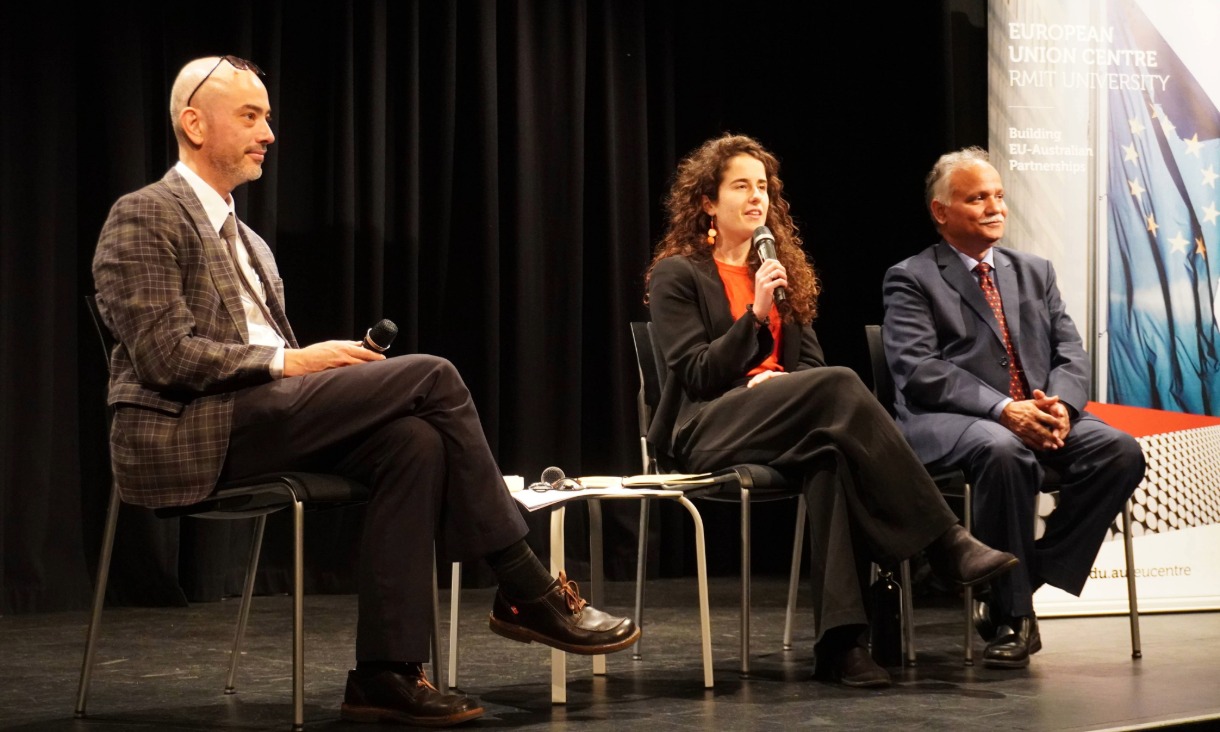
Emcee and Professor Emeritus Bruce Wilson – former director of the RMIT’s EU Centre of Excellence – invited lead panellist and expert in WTO law Associate Professor Rajesh Sharma to discuss the present and future for two hitherto giants of multilateralism – the EU and WTO. Dr Sharma was joined by European studies professor Bruno Mascitelli and Australian Institute of International Affairs (AIIA Victoria) board director Professor Gabriele Suder. The response was resounding as Dr Sharma declared: ‘The WTO is alive; it’s not dead’.
As a dispute resolution practitioner, he offered unique insight from behind the scenes of international trade negotiations and called for a positive view on multilateralism given successes such as the WTO’s Fisheries Subsidy Agreement identification of new trade areas, as well as cases settled by the Multiparty Interim Appeal Arbitration Agreement. These indicate that the WTO does have a working system and that it cannot be judged against US tariff wars. To allegations of an ailing rules-based order, he moreover offered a solution – the WTO turn away from previous US-centrism while the EU steps out of the shadows from its traditional role as ‘Robin to the US’ Batman’. In this role, Dr Sharma believes the EU could better influence negotiations in new areas of trade; create a positive trade environment; lead and coordinate reforms on dispute settlement; and restrain escalating tariff wars.
The WTO is alive; it’s not dead.
Professor Gabriele Suder built on Dr Sharma’s optimism and put forth a view that the WTO ‘is about promoting trade, labour standards and other values-based goals’, the dispute settlement functions being merely a means to these ends. And while acknowledging the slower pace of multilateral machinations, Professor Suder called for the audience to consider how ‘going slower creates more or different value’ in an otherwise fast-paced world.
Professor Bruno Mascitelli, meanwhile, sought to problematise the view that the EU would necessarily want to step into the vacuum left by a less predictable US on the world stage. He emphasised the factors that could contribute to the EU’s intransigence against playing the role of a multilateral hero – the Global Financial Crisis, COVID-19 pandemic, two Trump presidencies, as well as wider economic issues – to emphasise thatchange for the Union may be led more by geopolitical context than other factors.
Together, the three panellists drew a nuanced view of our ‘turbulent times’: one in which supporters of the rules-based order perhaps need not despair about an unpredictable US or the global rise of protectionism and isolationism. While caution and adaption are needed to handle contemporary challenges, it is key to not fall into assuming the world will follow in the US’ footsteps of distrust, or indeed that the US will completely walk the walk of Trump’s isolationist talk when it comes to its actions on the multilateral world stage. Neither was the view of the EU taking the lead wholly positive. Professor Suder called for the EU to ‘get its head around what leadership means’ in this new era following the vacuum left by Angela Merkel, while Dr Sharma emphasised that from the majority world’s perspective, ‘the EU has all the resources; it’s supposed to manage them well’.
Through this call for complexity and understanding, the EUATRAN Centre’s last seminar in its first year built upon learnings from its two previous seminars. On Tuesday 8 July, Seminar 1 on European Union Trade Policy: Evolving Priorities examined the progression of EU trade policy, from the establishment of the single market to its growing focus on strategic bilateralism and value-based trade in the last three decades. And Seminar 2 on Thursday 31 July explored Advancing Sustainable Development Goals (SDGs) through Institutions and Policy. A key theme that emerged from Seminar 2 was the essential role ofstrong institutional and policy structures in supporting transparency, coordination and long-term commitment to the SDGs.
Overall, the EUATRAN Centre’s first year of seminars have focused onthe history of EU trade policy, the importance of institutions and policy to support values-based initiatives such as the SDGs, and the future of multilateral trade specifically. Transitioning into the second year of the project, our focus will be on the application of these topics and other themes to the forthcoming free trade agreement between the EU and Australia.
Please stay tuned for our events in 2026.