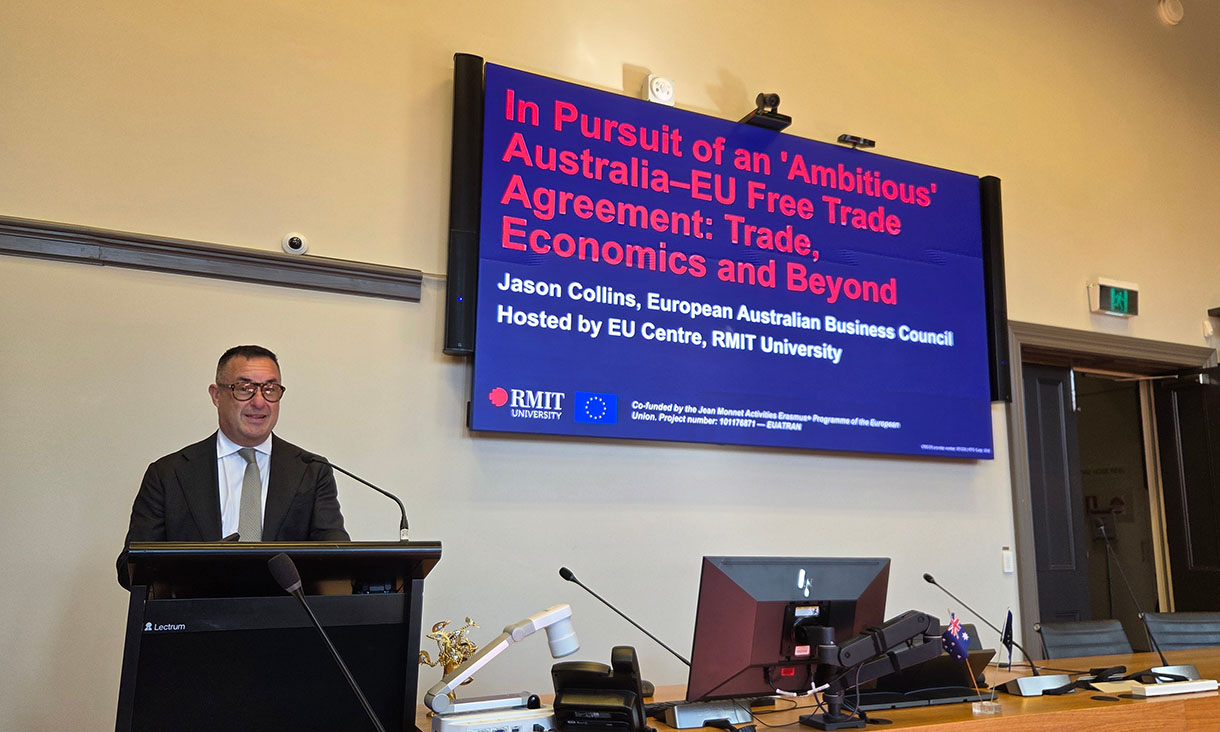
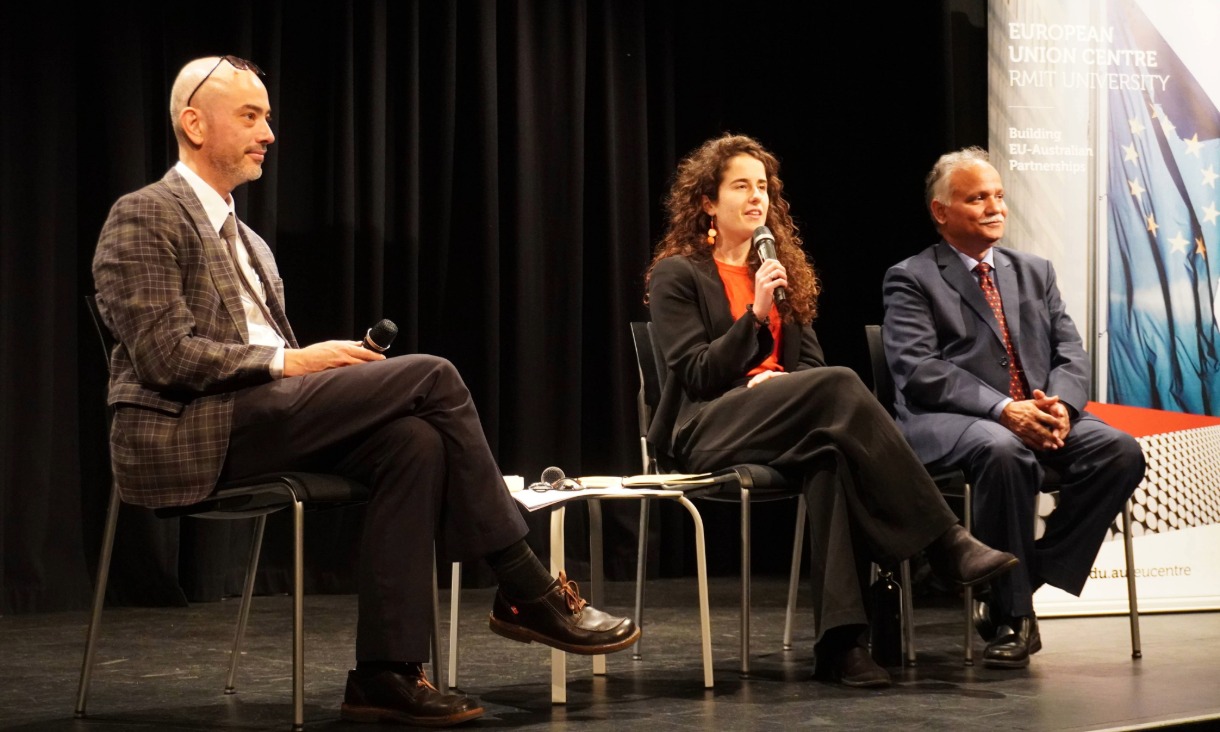
Europe Day falls on the 9th of May and commemorates the Schuman Declaration of 1950 which laid the foundations for the European Union (EU) as it is known today – a desire to prevent war and ensure peace and unity. Against this backdrop, the panel explored the role and the potential of recent EU trade agreements in mitigating contemporary instability. Professor Julian Lee, co-director of the EUATRAN Centre of Excellence and mediator of the panel, observed in his opening remarks that ‘where there are events and forces that create disorder’, there will often be ‘forces or processes that attempt to create stability again’. Quoting EU Commission President Ursula von der Leyen, he recognised not only the economic impacts and benefits of the recent EU–Australia trade agreement but more importantly its potential to help build ‘a global community committed to fair and free trade’. While seeking to not take a naive and unproblematic view of Europe or trade agreements, he acknowledged that actions occur within contexts, especially in today’s ‘compromised times’.
Associate Professor Rajesh Sharma meanwhile provided insightful analysis on the EU–India trade agreement’s implications for civil society and compared key differences in this agreement with the EU–Australia deal. He recognised global geopolitical shifts as driving the agreement, pointing to the fact that in the past negotiations had been slow due to differences in standards and political priorities in areas such as sustainability and labour mobility. He also contrasted how the two deals were publicly received: while the EU’s deal with Australia, another developed country, may be perceived as ‘natural’, India achieving a deal with EU brought more excitement in representation. In practice, however, Associate Professor Sharma questioned whether the EU really achieved market access to a massive population as Indian civil society lacks purchasing power even though the Indian government itself is a powerful buyer. Nonetheless, Dr Sharma argued the agreement helps the EU extend its influence in the Global South, especially when considered alongside the security and defence partnership signed on the same day.
Former EUATRAN Centre intern Jimena Laguna Pineda finally discussed the details of the EU–Mercosur trade agreement, its lengthy negotiation of 25 years and its predicted implications. She explained the technicality of implementation whereby due to controversy surrounding the agreement, the text has been divided into the commercial part on tariffs and trade, and the political part, including chapters such as climate change and labour rights. While the commercial part can come into force under what is called the EU’s ‘exclusive competence’, the political part requires ratification by all member states. She also discussed the divided attitudes of EU member states towards the agreement where the EU and Mercosur’s perceived or actual non-alignment of producing standards and cheaper agricultural products have provoked EU farmers’ fear of losing competitiveness in the domestic market. On the other hand, the agreement boosts EU exports and benefits those countries with industrial competitiveness such as Germany. Divisions within the EU have stalled ratification of the political part while the commercial part has come into force at the start of this month.
While each of the three trade agreements under discussion have different contents and have been received in very different ways, together, the three panelists also explored what they share: how each agreement transcends economic relations and shows how trade has been a vehicle for the EU in diversifying partnerships and renewing relations in response to global upheaval.
The EUATRAN Centre looks forward to welcoming you to more of our events in 2026. If you would like to be kept in the loop on our news and events, you can join our mailing list.