
Fashion education for the future: Equipping students with skills for future employment through interdisciplinary learning

Fashion education for the future: Equipping students with skills for future employment through interdisciplinary learning

The School of Fashion and Textiles is collaborating with finance, engineering and global urban sciences to expand fashion students' knowledge and help them build sustainable and successful careers in the fashion industry.
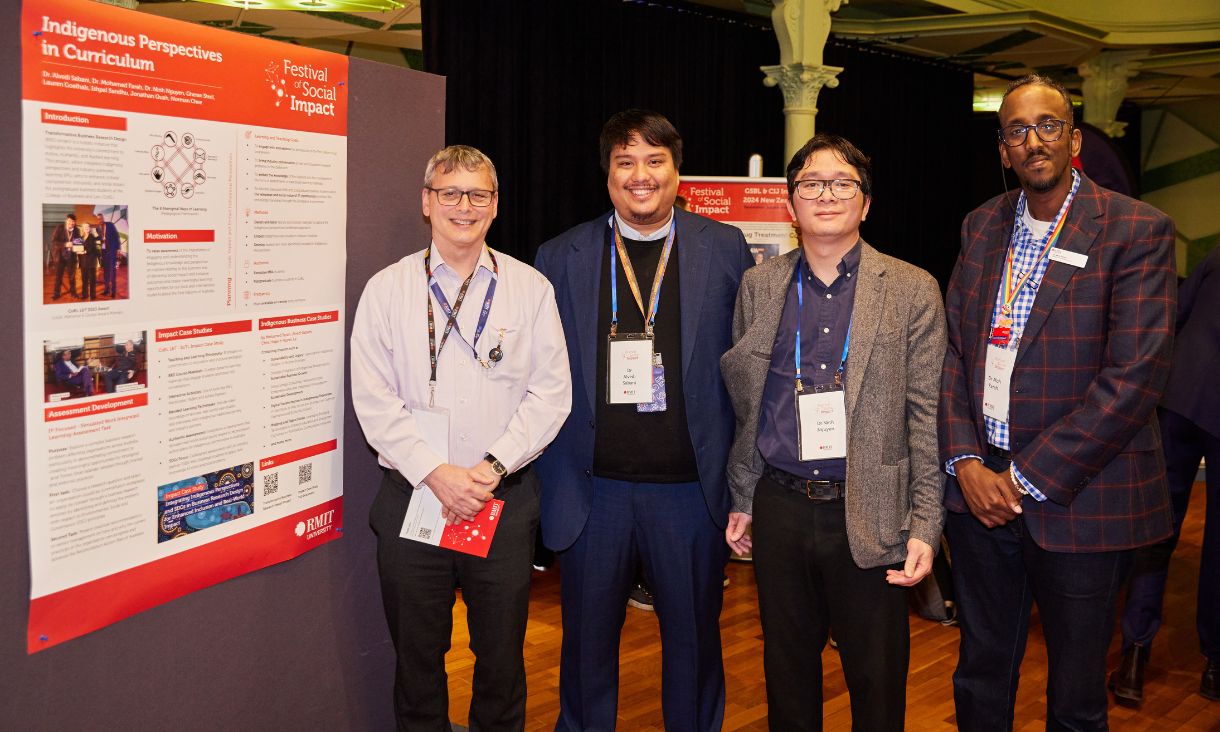
This story features presenters at this year's Learning and Teaching Festival at RMIT which brings together the best examples of learning and teaching across all of RMIT’s entities to explore the topic of innovation through collaboration. RMIT staff can register to attend the Festival via the link at the end of the story.

Entrepreneurship and business acumen for careers in creative industries

The fashion industry has often faced scathing criticism about overproduction and unsustainability, largely due to designers not having knowledge of business and economics.  

A collaboration was sparked at RMIT’s 2024 Learning and Teaching Festival, where Nirav Parikh, Senior Lecturer in Finance presented a gamified digital learning experience as part of a finance course, after which Associate Professor Tarun Panwar, Associate Dean of Enterprise in the School of Fashion and Textiles approached him and proposed repurposing it for a fashion context.  

Senior Learning Designer Pete Fernandes and Senior Learning and Teaching Specialist Dr Ying Zhou from the College of Business and Law also joined the team to support the initiative. 

The game they collaborated on will teach fashion enterprise students the basics of finance and sustainable finance and will provide students with an authentic and applied learning experience to get students professionally ready for the future challenges they may face. 

“There is a need for business acumen in fashion education because it keeps the whole fashion chain grounded, with a deeper understanding of costing and what the right kind of inventory should be being created,” said Tarun.  

Prior to the collaboration with Tarun, Nirav didn't have much knowledge about the fashion industry but was aware that many fashion professionals can find great opportunities to enhance their careers by gaining knowledge about business and finance. 

Students who understand creativity and commerce together have a much higher chance of employability and succeeding in the industry. 

“We hope to equip our students with the knowledge about how sustainable finance can protect the fashion industry, and the skills to ensure creative industries can play a role in protecting the planet,” said Tarun.  


Transformative problem-solving in humanitarian contexts

Interdisciplinary learning at its core encourages academics, educators and students to work outside of their area of expertise and open their minds to collaboration and innovation. 

Dr Kate Sala, Assistant Program Manager, Bachelor of Fashion and Textiles (Sustainable Innovation), in collaboration with colleagues Dr Rashmita Bardalai, Assistant Program Manager in Bachelor of Fashion Enterprise, and Dr Nick Brown, Senior Lecturer in Chemical and Environment Engineering brought about a collaboration between fashion, engineering and global urban sciences to create a simulated learning environment, the Agnapot Learning Environment (ALE). 

“The challenges our students will face in the future will rarely belong to a single discipline and this course helps them develop the skills to navigate complex, interdisciplinary projects,” said Kate.

The ALE is a digital fictional world where students are immersed in a humanitarian disaster response or long-term development context, based on real experiences and case studies. 

“They must think about different aspects of the new context they are faced with including climate, resources and transportation and have to consider if the items being produced are practical or feasible in this different environment,” said Kate.

“My favourite part of this course is seeing students realise that fashion and textiles can be applied far beyond garment design.”

It’s about developing meaningful, practical solutions that respond to real human needs in complex contexts.

“Students are forced to think in a setting where they don't necessarily know where a textile might be applied,” added Rashmita. 

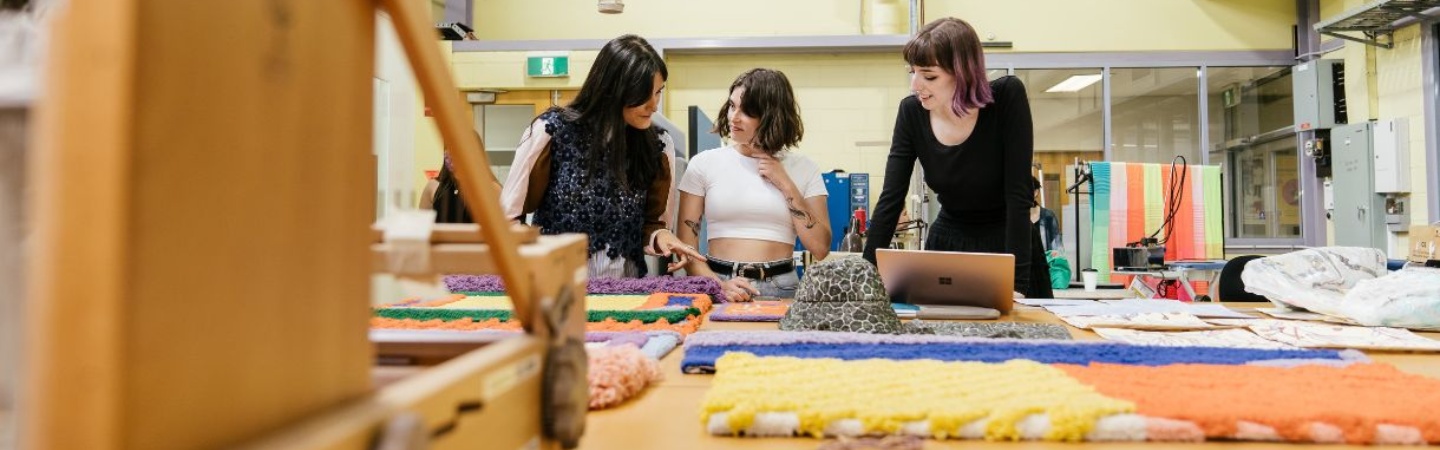
“Students must think outside of the box and apply fashion and textiles expertise in different ways.”

The team are aiming to change misconceptions about the humanitarian space whilst teaching the course. 

Students who have participated in this program provided feedback describing the transformative experience of being involved.  

“I didn't realise that textiles could be used as more than making clothes or makeshift shelters,” shared one student. 

“This course and projects opened my eyes to new design opportunities and understanding in using textiles.” 

Other students reflected on not initially seeing the benefit of the course but finding that their attitudes shifted dramatically.  

“I'm seeing processes and production and the way textiles can impact humanitarian crisis situations differently.”  

“Now I feel completely differently about the fashion and textiles industry.” 

Artificial Intelligence skills for a rapidly evolving industry

Artificial intelligence is a hot topic within the education space, and Dr Rashmita Bardalai is collaborating with Okkular, an e-commerce generative AI company, to equip Fashion Enterprise students with the knowledge and expertise to integrate emerging technologies in their work and careers.

The partnership with Okkular presented an opportunity for students to meaningfully engage in evolving classroom projects training AI algorithms from a fashion perspective in fashion merchandising, taxonomy, styling and other applications in the real-world context. 

“Our students are learning how to work in the background of the AI programs so that they have the knowledge to apply it to generate content that is original,” Rashmita said.

It's important for our students to understand how to use AI from a critical standpoint.

Rashmita also reflected on the concerns around the use of artificial intelligence in creative spaces and acknowledges the need for ethical considerations as part of a quickly evolving technological landscape.

She emphasised that it is important to learn to use it effectively and critically rather than not using it.  

“I think AI is a tool that we need to use within limitations and parameters,” said Rashmita.  

As part of the partnership each semester Okkular are open to internships with RMIT students, showcasing the opportunities AI present to the fashion industry and the ways in which technology and fashion can work together.  

Some students after completing the program have gravitated towards careers in the intersection between fashion technology and innovation and have even gone on to employment with Okkular themselves.  

Rashmita discussed the value of cross-collaboration between tech and fashion in education, emphasising the need for students to develop hybrid skills in the evolving workforce.

Technology and fashion can collaborate and learn from each other.
Learning and teaching fesitval logo on yellow background

Register for Learning and Teaching Festival 2025

Registrations for the 2025 Learning and Teaching Festival (13-16 October) are now open. View the full program and register for sessions on the Learning and Teaching Festival Sharepoint site.

29 September 2025

Share

Related news

29 September 2025

Share

aboriginal flag float-start torres strait flag float-start

Acknowledgement of Country

RMIT University acknowledges the people of the Woi wurrung and Boon wurrung language groups of the eastern Kulin Nation on whose unceded lands we conduct the business of the University. RMIT University respectfully acknowledges their Ancestors and Elders, past and present. RMIT also acknowledges the Traditional Custodians and their Ancestors of the lands and waters across Australia where we conduct our business - Artwork 'Sentient' by Hollie Johnson, Gunaikurnai and Monero Ngarigo.

More information