The LibrarySearch AI Research Assistant searches across the RMIT Library Collections.
This means you can find relevant, credible and academic sources not available when using other generative AI tools, such as ChatGPT. It is useful for quick introductory searches and can be used in addition to the main LibrarySearch tool.

Important
Features of the LibrarySearch AI Research Assistant
You can input a research question or topic in plain language rather than using keywords and Boolean operators (e.g. AND, OR). For example:
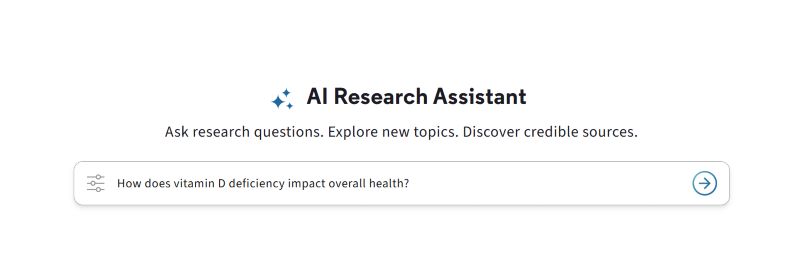
From your research question, the AI Research Assistant constructs a Boolean search statement with keywords and alternative terms. It then provides:
- an AI-generated summary response to your research question based on the ‘top five’ most relevant publications within the RMIT Library collection
- links to the ‘top five’ publications
- suggestions for additional research questions
- the option to view more results.
Other features include:
- Multilingual support: Ask questions in any language and receive results translated into your preferred language
- Search history: Previous search results are saved between sessions but can be deleted if no longer required.
About the 'top five' results
The AI research assistant uses only the abstracts or descriptions of the publications to create the summary response. It doesn’t include information from the Library’s print collection, and some databases are excluded. This means that some important information might be missed and the selected ‘top five’ articles might not be the most relevant sources for your research question. Use the summary and the selected publications as a starting point only.
Links to full text
The AI Research Assistant will not create imaginary sources (unlike some other AI tools). However, sometimes the full text link may link to the homepage of a journal rather than the specific article, or it might link to publications that do not have the full text available in the Library collection.
The 'view more results' feature
This takes you to the traditional LibrarySearch interface, where you can view the Boolean search statement created by the AI Research Assistant tool and use additional filters (for example: date range, peer reviewed and subject.)
For example:

RMIT LibrarySearch AI functions
Explore the new AI functions of RMIT’s LibrarySearch, including Natural Language Search and AI Research Assistant (2:51 mins).