Floating wetlands trial boosts Bass Coast farms

Floating wetlands trial boosts Bass Coast farms

An RMIT‑led trial on the Bass Coast is showing how floating wetlands could transform the health and productivity of Australia’s 1.8 million farm dams.

The partnership with Melbourne Water and Bass Coast Landcare Network is trialling the floating wetlands on a series of dams across the region.

Early results of the trial have shown improvements in water quality, biodiversity and emissions reduction. 

The floating wetlands act as natural filtration systems, where plants form underwater root matrices that attract a microbial community to help transfer nutrients, trap particles and cool the water. This chain reaction improves both the health and look of the farm dam. 

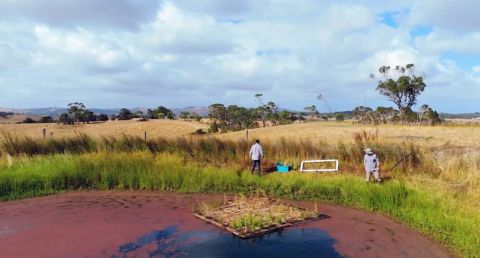
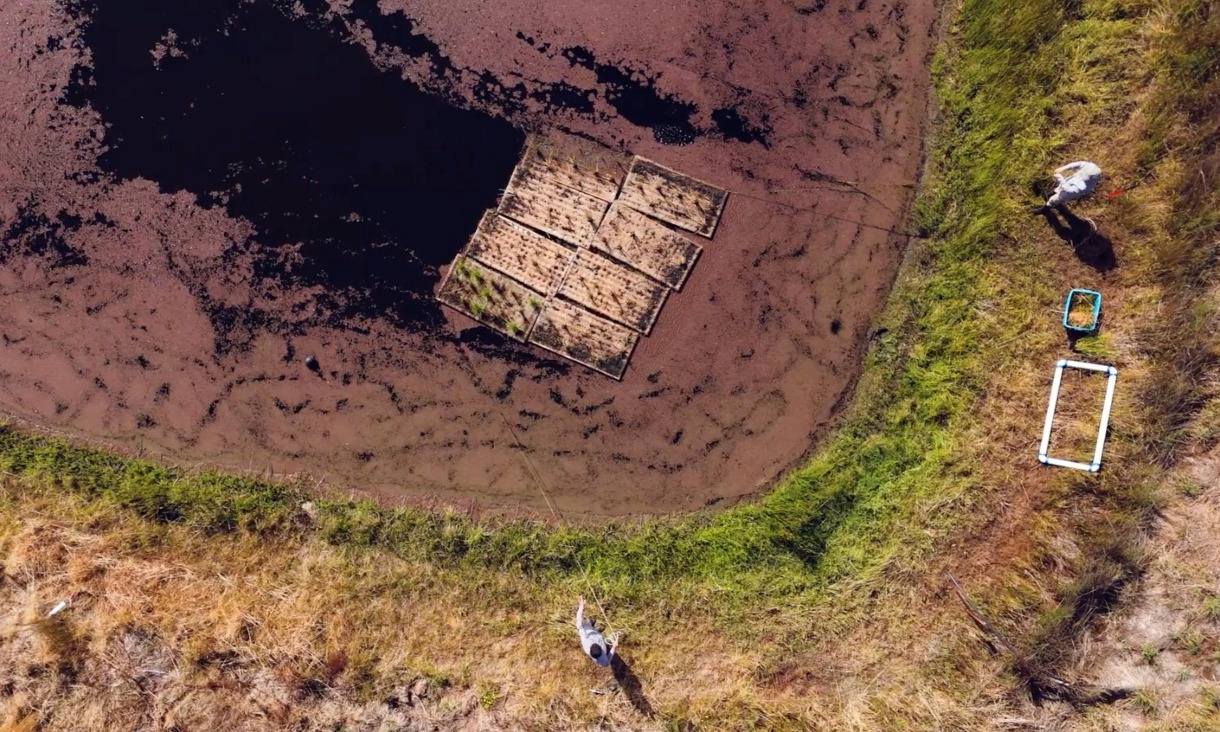
Image of a floating wetland.

Project lead, Dr Martino Malerba from RMIT'S School of Science, said the trial aimed to improve multiple elements of farm dams and farms more broadly. 

"We're aiming to enhance farm dams to act as biodiversity hotspots, as well supporting farmers and the farming industry, alongside the environmental benefits," he said. 

Despite Australia's farm dams storing 20 times more water than Sydney Harbour, many remain degraded, fenced off and under‑utilised. 

Camilla Graves, a local landowner on the Bass Coast who is trialling the system, said installing wetlands is an easy way to improve water quality and increase biodiversity around the dam precinct. 

"One of the problems with farm dams is the quality of the water," she said. 

"We're really excited to be trying out these floating wetlands to see if they can improve that water quality. One of the key benefits is that because the plants float independently of the shore, there’s unlikely to be interference from wallabies, foxes and other pest animals.” 

Joel Geoghegan, Sustainable Agriculture Team Lead at Bass Coast Landcare Network, said farm dams remain an area where farmers can realise more benefits for themselves and the wider Bass Coast community. 

"On the Bass Coast, agriculture dominates the landscape," he said. 

"Most properties and industries in the area rely on dams for stock water, but most of those dams haven't been protected properly, and we aren't yet realising the full benefits of what they can offer.

"The biggest benefit we're hoping to find is the reduction in on-farm dam emissions that these floating wetlands can help provide, and obviously there are other biodiversity benefits too." 

Researchers inspecting a floating wetland.Researchers inspecting a floating wetland.

Karen Thomas, Sustainable Agriculture Facilitator at Melbourne Water, said the combination of expertise in science, water and the local area meant the project team was able to deliver something that had multiple benefits across a range of areas in the farming industry.

"When we compliment the latest research with what we know is best practice, not only do we get product and productivity benefits to the farm and farmer, we also take an important step in addressing the environmental challenges of agriculture in Australia," she said. 

With successful trials completed, partners are now looking to expand the program.

Malerba said government support was now essential to scale the innovation. 

“The idea is to find ways to scale it up,” he said.

“We look forward to working with government to realise the policy and financial settings, so that farmers can adopt these new methods of managing their farm dams, and deliver both productivity and environmental benefits that Australians all share in.” 

Find out more about what RMIT's Centre for Nature Positive Solutions is doing to address the world’s most urgent environmental challenges.


Story: Finn Devlin

Share

  • Research
  • STEM
  • Environment
  • Sustainability

Related News

aboriginal flag float-starttorres strait flag float-start

Acknowledgement of Country

RMIT University acknowledges the people of the Woi wurrung and Boon wurrung language groups of the eastern Kulin Nation on whose unceded lands we conduct the business of the University. RMIT University respectfully acknowledges their Ancestors and Elders, past and present. RMIT also acknowledges the Traditional Custodians and their Ancestors of the lands and waters across Australia where we conduct our business - Artwork 'Sentient' by Hollie Johnson, Gunaikurnai and Monero Ngarigo.

More information