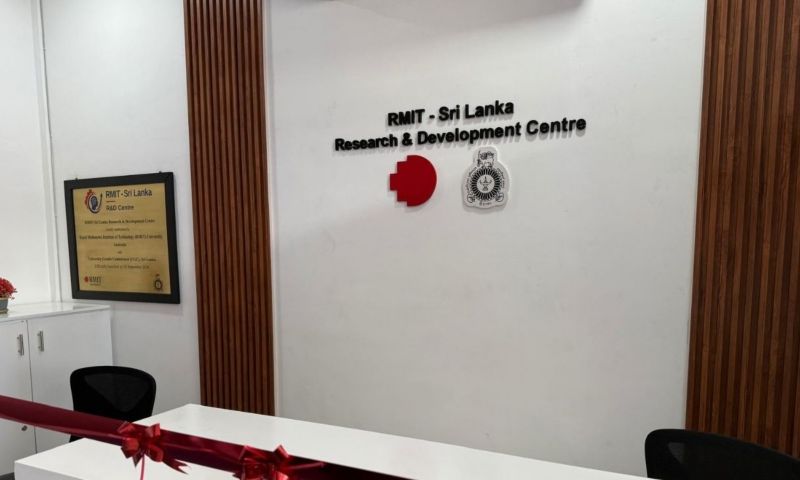
Professor Catherine Itsiopoulos, Deputy Vice-Chancellor STEM College at RMIT University said the Centre would build on the existing joint PhD programme, industry-led Masters by Research and coursework programmes, to improve connection and translation for shared benefit.
“We’re proud to initiate the RMIT-Sri Lanka Research and Development Centre, which will provide benefits across RMIT and Sri Lanka,” she said.
“The Centre connects diverse disciplines, cultures, education, and industry to develop globally connected researchers and practitioners delivering purposeful outcomes that address real-world needs in Australia, Sri Lanka, and beyond.”
Professor Sujeeva Setunge, ADVC R&I in STEM College at RMIT University, said the new Centre was established to strengthen research capability, industry collaboration, international research engagement, and innovation-led development.
“The Centre marks an important milestone in the longstanding partnership between RMIT University and Sri Lanka’s higher education sector,” she said.
“The Centre will offer an opportunity for Sri Lankan and Australian partners and community to collaborate in creating transformational impact aligned to RMIT’s vision for creating impact in the regions and communities we operate in.”
Itsiopoulos said the Centre will help to establish a multidisciplinary research ecosystem that connects STEM, Design, Business, and Social Sciences disciplines to address real-world challenges.
“The Centre supports multidisciplinary research and education across advanced materials, infrastructure resilience, artificial intelligence, sustainability, agriculture, health technologies, policy, and social innovation,” she said.
“By connecting academia, industry, and government, the Centre creates a globally connected platform for high-impact research and education pathways aligned with national priorities and global sustainability challenges."
Last week, an RMIT delegation travelled to Sri Lanka to officially launch the Centre alongside the Sri Lankan government. The delegation was led by Distinguished Professor Calum Drummond, Deputy Vice-Chancellor Research and Innovation at RMIT University.
The Centre’s official launch occurred at an industry and government forum attended by over 100 participants, including vice chancellors of the partner Universities, Australian High Commissioner for Sri Lanka his excellency Matthew Duckworth, academic staff, 26 government partners including cabinet ministers and 25 participants from industries supporting the HDR candidates.
Drummond said the establishment of the RMIT-Sri Lanka R&D Centre reflects the shared ambition of RMIT and Sri Lanka to advance impact-focused research founded on RMIT’s Futures framework.
“The Centre will ensure that the pathways to impact are identified early in our joint research projects to enable translation of knowledge into practice, by connecting complementary expertise and strengthening collaboration among universities, industry and government, Outcomes will address shared priorities and contribute to innovation, prosperity, and improved quality of life,” he said.
The launch also included the signing of an agreement between RMIT and National Water supply and Drainage Board to train employees of the organisation through an RMIT masters by research program, while 35 new RMIT candidates received their scholarship awards during the event.
A long-standing presence in Sri Lanka
The Centre builds on almost a decade of RMIT’s presence in Sri Lanka, partnering with the tertiary sector and government.
In 2018, RMIT established a cotutelle PhD program between the University and four Sri Lankan counterpart tertiary organisations, allowing students to study locally while gaining access to RMIT’s expertise. The program progressed well with recruitment of high-quality candidates, timely completions and publications and new outcomes.
In 2023, the University’s commitments in Sri Lanka were strengthened, with a partnership established with the University Grants Commission - the peak body of Sri Lankan Universities - to train junior academics of Sri Lankan universities through an RMIT-Sri Lanka Joint PhD program.
This program has now seen over 25 PhD completions, with 33 current candidates and 40 candidates selected and progressing enrolments at RMIT.
Story: Finn Devlin