Negotiations for a free trade agreement (FTA) between Australia and the European Union (EU) began in July 2018, with both sides expressing hopes for an 'ambitious and comprehensive' deal. Throughout negotiations, ‘ambition’ was first used to describe market access liberalisation efforts and was later extended to also describe geographical indication protection, services and investment offers, as well as trade and climate.
Today, the future of the FTA is tied up in expectations of ambition, as the Coalition has threatened to back out of supporting the deal over what they deem as shortcomings on Australia's agricultural market access, and over-ambitious climate commitments.
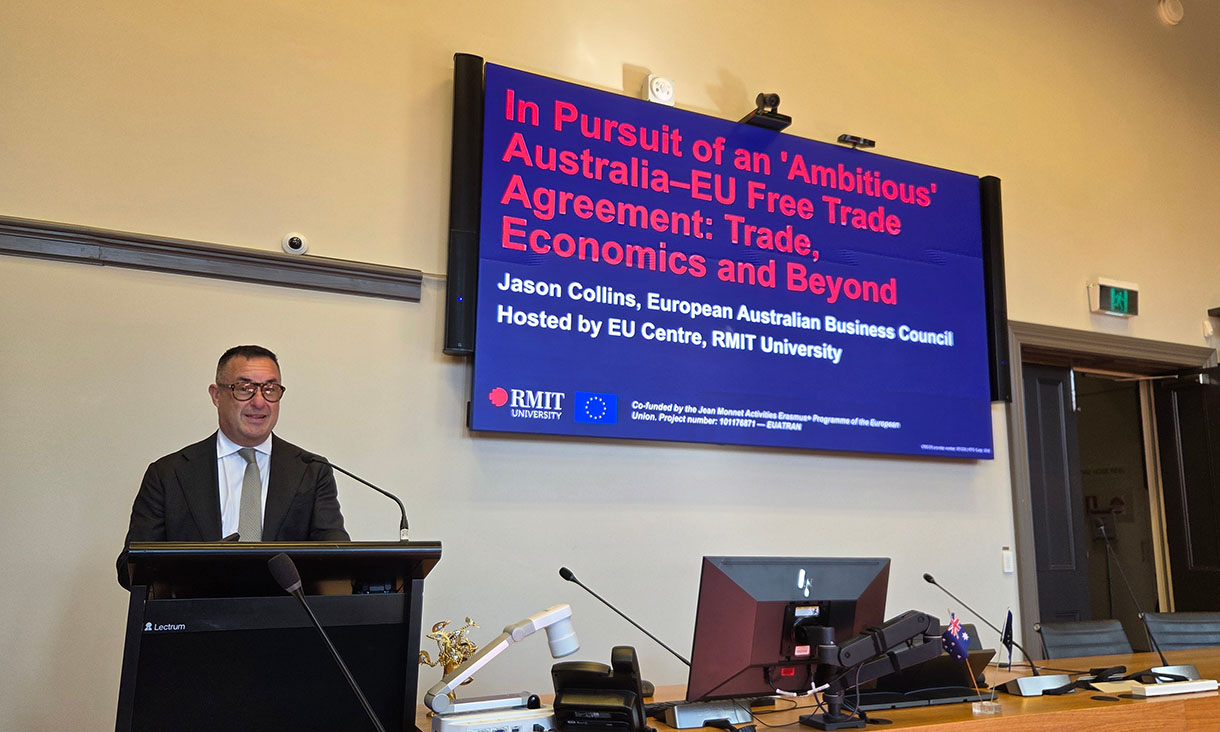
EUATRAN welcomed Jason Collins to speak on this, addressing an audience of government, business, academics and students. Collins has served as the Chief Executive Officer of the European Australian Business Council since 2007 and provided insight into the EU–Australia FTA from his background leading the Council’s business advocacy, engagement programmes, and institutional relations with government agencies, chambers, industry groups and other stakeholders.
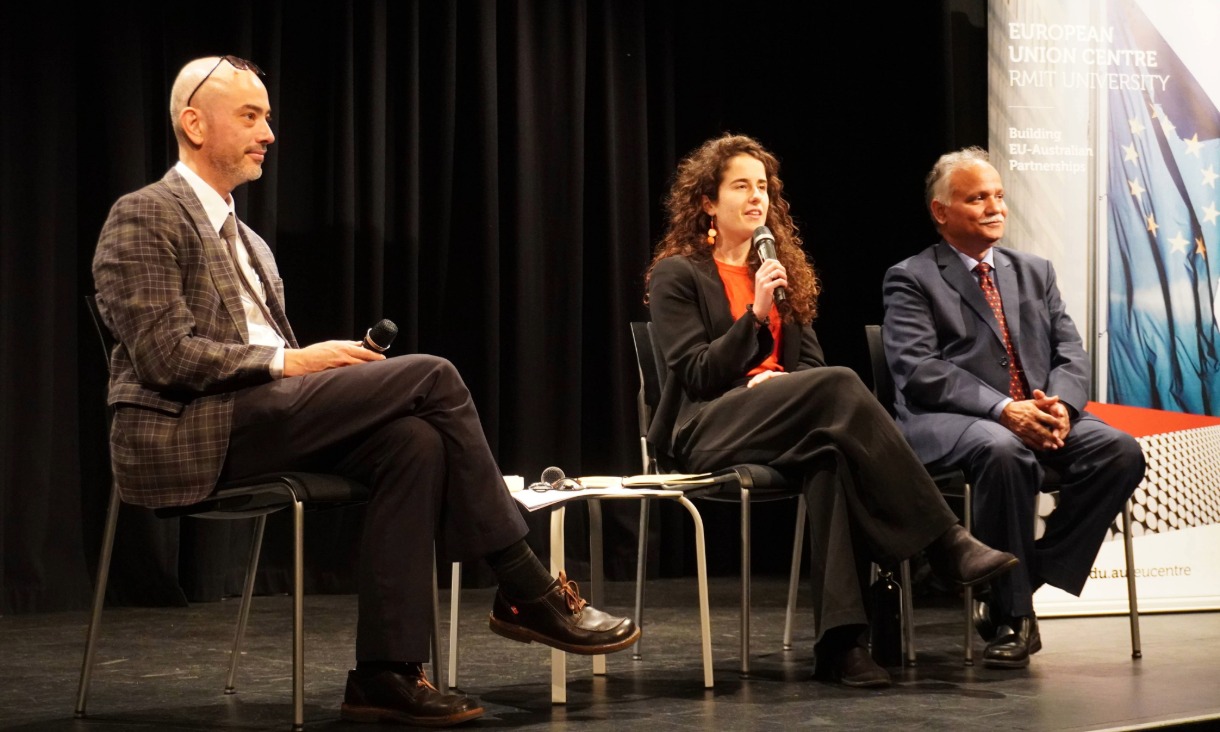
EUATRAN’s Research and Project Officer Nikkola Mikocki-Bleeker introduced the event with some words of context of the growing role of trade in global politics. She/they highlighted that the EU’s recent burst of trade agreement-signing, including the FTA with Australia in March of this year, reflects the trading bloc’s efforts in creating peace and stability in increasingly uncertain geopolitical world and economy, yet that FTAs are also tools of ambition that move beyond this instrumentalist framing.
Speaking to this, Collins began his address by painting a picture of a Europe confronted with complex global challenges which are shaping its priorities and partnerships, including those with Australia.
Following a recent business delegation from Australia across Europe, including to Brussels, Berlin, Helsinki and London, Collins observed Europe is increasingly thinking in geopolitical terms. From dealing with Russian aggression at its borders, a ‘completely unsustainable’ trade deficit and dependency on China, as well as unpredictable political moves from the United States (US), the EU’s outlook is being fundamentally reshaped. Vulnerabilities are exposed in dependencies on Russian energy, reliance on Chinese manufacturing and critical minerals, and security and technology risks in the Union’s relations with the US. Thus, ‘strategic autonomy’ and ‘strategic sovereignty’ are emerging as key frames across Europe. An active debate surrounds how Europe can strengthen its economy and deepen partnerships as it potentially moves beyond a ‘made in Europe’ approach to a ‘made with Europe’ approach, Collins noted.
The EU–Australia FTA plays directly into this, in what Collins described as a ‘very exciting time’ for bilateral relations, with the trade deal offering ‘transformational’ opportunities on both sides. Strategically, by opening up trade with Australia, Europe can decrease dependencies on China, particularly in critical minerals. For Australia, Europe represents our ‘most important economic partnership overall’, Collins argues, as the FTA offers Australia access to the EU’s market of 450 million consumers in new ways. Collins underscored Australian agricultural exports to the EU as‘absolutely critical’, while also highlighting opportunities across a range of sectors including investments and professional mobility.
Collins announced that within the business sector ‘we are enormously optimistic’ for the future of the EU–Australia FTA, with confidence that it will pass through government as a hugely beneficial deal for both sides. Despite conflicting ambitions, Collins expressed how other trade deals with the EU have ‘more than lived up to expectations’, pointing to the New Zealand–EU FTA which has surged Kiwi exports to the EU by $3 billion in just two years.
What we must watch out for, Collins warned, are the ‘populist politics’ that tear down these ambitious trade agreements for not meeting their expectations, while losing sight of the bigger picture.
Following Collin’s address, the floor opened to a Q&A, as audience members inquired about what the FTA means for Australian businesses, small and medium-sized enterprises (SMEs), and changing geopolitical dynamics.
Collins emphasised that while the FTA builds crucial confidence for businesses, particularly when dealing with the strong institutions and legal systems of the EU, FTAs are ‘only as good as the paper they are written on’ and businesses must ‘do their homework’ to prepare for and take advantage of the deal. A focus now lies on how to mobilise businesses and provide information, particularly for SMEs, to understand how to navigate the FTA.
Finally, Collins recognised that Europe is‘very, very unsettled’, explaining their rapid movement on FTAs and partnerships as a response to economic insecurity and changes out of their control. Recent agreements have been reached with India and the Phillipines, with progress towards an FTA with Malaysia and the possibility floated of an ‘associate membership’ with Canada, as the EU strengthens its alliances worldwide.
Ultimately, Collin’s address highlighted that the EU–Australia FTA promises transformational growth for both Australia and the EU, while fostering deep alliances amongst complex challenges and global upheaval. As we await ratification of the agreement on both sides, it remains to be seen if these ambitious promises will be fulfilled.
The EUATRAN Centre looks forward to welcoming you to more of our events in 2026. If you would like to get in touch or receive updates from the EUATRAN Centre, please email eucentre@rmit.edu.au.