Not Applicable
Commonwealth Supported Places
RMIT's Bachelor of Medical Radiation (Nuclear Medicine – Industry Practice) offers a blend of remote learning and hands-on training, with students embedded and financially supported by public and private Australian partner organisations.
This innovative offering allows you to balance your studies with work and personal commitments, while simultaneously contributing to the much-needed growth of your local Nuclear Medicine workforce.
It provides the opportunity for you to remain in your home state once you have completed your degree, and continue to build your career while working within your community.
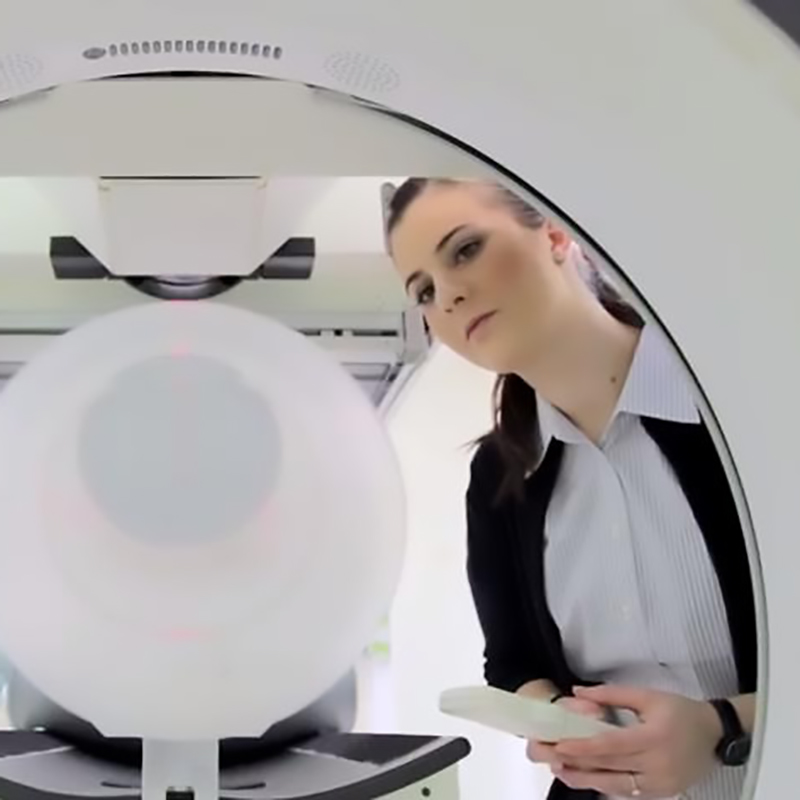
Nuclear medicine assists in the diagnosis and treatment of disease by using very small amounts of radioactive materials to produce medical images, that show how the body is functioning. Common nuclear medicine applications include cardiac stress tests to analyse heart function, bone scans for orthopaedic injuries, and lung scans for blood clots.
Nuclear Medicine Scientists are vital for operating specialised equipment such as Positron Emission Tomography (PET) scanners. Without this essential workforce, the diagnosis and continued management of conditions like cancer, cardiovascular disease, and brain disorders would be very difficult.
- Liza-Jane McBride, Chief Allied Health Officer at Queensland Health
When you are enrolled in this degree through employment in the private sector, you will be able to complete your study requirements whilst being paid to undertake your placement requirements for 2 days a week during the university semesters. Some private providers may also offer you a scholarship.
When you are enrolled in this degree through earning a position with a public health provider, you will receive a scholarship. You will also complete your study requirements whilst undertaking your placement requirements 2 days a week during the university semester.
Enjoy the security of paid placement hours, either through a scholarship or employment, during your studies in the private or public health sector, while attending RMIT classes remotely.
Undertake placement and meet study requirements while living in your home state, as you work towards a career as a nuclear medicine technologist and contribute towards addressing a critical workforce shortage.
With a well-established reputation as a leader in nuclear medicine training, RMIT will provide your teaching and learning remotely whilst you undertake your clinical placement requirements within an industry leading nuclear medicine provider.
RMIT already delivers a world-class nuclear medicine degree in Victoria. Through our exceptional partnerships and collaboration with our industry partners, we are now able to offer nuclear medicine to Australian residents to address pressing skills shortages.
- Mark Scalzo, Senior Industry Fellow, Nuclear Medicine at RMIT University
We are excited to be partnering with the following health organisations for this offering:
Queensland Health is proud to partner with RMIT University to deliver an embedded student program in nuclear medicine, allowing students to train and work locally, while creating a pipeline of skilled workers in Queensland.
- Liza-Jane McBride, Chief Allied Health Officer at Queensland Health
You will join classes and tutorials online for the duration of your study. You will also closely work with our health partners and be embedded in the Nuclear Medicine industry for the duration of your study.
In first year, you will travel to Melbourne for a one-week intensive at the end of both Semester 1 and Semester 2.
All clinical placements will be provided via our Australian health partners.
You will be expected to complete the degree in approximately 3.5 years, subject to satisfactory academic progress.
Choose a plan below to find out more about the subjects you will study and the course structure.
| Title | Location | Duration | Plan code |
|---|---|---|---|
| Bachelor of Medical Radiation (Nuclear Medicine - Industry Practice) | Queensland | Full-time 8 semesters (delivered in 3.5 years) | BP321NI |
Upon successful completion of this degree you will graduate as a qualified and industry experienced Nuclear Medicine Scientist/Technologist.
Australia is facing a critical nuclear medicine skills shortage and increasingly, nuclear medicine procedures are becoming part of a patient's care pathway. Demand has grown significantly in the past decade, and is expected to continue growing.
Nuclear Medicine Scientists/Technologists are vital for operating specialised equipment such as Positron Emission Tomography (PET) scanners. Without this essential workforce, the diagnosis and continued management of conditions like cancer, cardiovascular disease, and brain disorders would be very difficult.
“The planned establishment of new services in Queensland Health over the next five to ten years will increase demand for this workforce and we identified a strong need to develop a workforce pipeline to support delivering care closer to home.”
- Liza-Jane McBride, Chief Allied Health Officer at Queensland Health
The Bachelor of Medical Radiation (Nuclear Medicine – Industry Practice) is not yet accredited by the Medical Radiation Practice Accreditation Committee (MRPAC) or approved by the Medical Radiation Practice Board of Australia (MRPBA).
MRPAC will consider this degree for accreditation in 2026, in the second year of program delivery. This is in line with their accreditation procedures and timelines.
MRPAC is responsible for accrediting all medical radiation programs within Australia. Graduates who have successfully completed an MRPBA-approved program of study are eligible to apply with the Australian Health Practitioner Regulation Agency's (Ahpra), Medical Radiation Practice Board of Australia (MRPBA) for general registration as a medical radiation practitioner in Australia, subject to meeting the MRPBA's registration standards.
Successful completion of an Australian Year 12 senior secondary certificate of education or equivalent qualification.
For information on international qualifications and corresponding entry requirements that are equivalent to Australian academic entry requirements, see country equivalents.
You must have applied for and been offered a position as a Nuclear Medicine Technologist – Embedded Education student, in an accredited Australian Nuclear Medicine clinical department approved by RMIT University.
A minimum IELTS (Academic module) overall score of 7.0, with no band below 7.0; or equivalent. For equivalents to English entry requirements, see the English equivalents web page.
Students who are successful in obtaining a place in the program must meet a number of Immunisation and Compliance requirements upon commencement of their studies in the program.
Please note: A full course of immunisations can take up to 7 months to complete, you should contact your medical practitioner prior to entering the program to commence immunisations. It is a requirement that you will have commenced all immunisations and will continue to progress this until completion of the vaccination courses by the deadlines set by the university.
* a ‘partially compliant’ allowance of 2 vaccinations will be considered. If partially compliant, continued employment/continuation with placement will be contingent on students completing the vaccination schedule within the timeframe specified in the Australian Immunisation Handbook.
Nationally Coordinated Criminal History Check*: Students must present evidence of a successful Nationally Coordinated Criminal History Check prior to undertaking the clinical components of this program (Annual requirement for the duration of your Program). Nationally Coordinated Criminal History Checks are conducted via fit2work. An account with fit2work will be created using the student’s name and the RMIT issued student email address, once studies in the program have commenced. Further information will be provided once enrolment has been completed.
Students will also be expected to complete:
Details on how to access and action these will be provided following enrolment into the degree.
Prior to undertaking clinical placement, you may be required to gain student registration with the Australian Health Practitioner Regulation Agency (Ahpra).
*All relevant screening and compliance check fees are the responsibility of the student.
The following information outlines the tasks you will be required to undertake during professional experience placement and on-campus learning activities.
The non-academic abilities listed are provided for your information only and are not entry requirements.
By understanding the types of activities you'll participate in, you can:
If there are any activities outlined which may be difficult for you to undertake, there is a range of adjustments to your study conditions available to enable and support you to demonstrate these abilities.
Please contact the Equitable Learning Services (ELS) team to discuss any adjustments you may require. To receive learning adjustments, you need to register with ELS.
If you are living with disability, long-term illness and/or a mental health condition, we can support you by making adjustments to activities in your program so that you can participate fully in your studies.
The University considers the wellbeing and safety of all students, staff and the community to be a priority in academic and professional experience placement settings.
You must be an Australian citizen and be able to clear a National Police Certificate (you will be asked to complete this as a part of the application process).
Entry to this earn-and-learn model is only through employment with one of our participating partner employers. Please note that you will still need to meet the entry requirements above.
Step 1: Contact the above listed health partners and follow their application process for the embedded student model. Some partner organisations advertising positions for this model may not yet be listed on this page. Please continue to complete the application process with both RMIT and the partner organisation.
Step 2: Undergo the partner's selection process to obtain a place in the embedded student model program.
Step 3. Apply directly to RMIT with the required documentation listed below.
Once you have secured your employment in the program with a health partner organisation, you will need to provide the following documentation with your application to RMIT:
All students who are successful in obtaining a place in this program will receive a Commonwealth Supported Place.
For complete fee information please see the main Bachelor of Medical Radiation page.
Use our Frequently Asked Questions to learn about the application process and its equity access schemes, find out how to accept or defer your offer or request a leave of absence, discover information about your fees, refunds and scholarships, and explore the various student support and advocacy services, as well as how to find out more about your preferred program, and more.
RMIT University acknowledges the people of the Woi wurrung and Boon wurrung language groups of the eastern Kulin Nation on whose unceded lands we conduct the business of the University. RMIT University respectfully acknowledges their Ancestors and Elders, past and present. RMIT also acknowledges the Traditional Custodians and their Ancestors of the lands and waters across Australia where we conduct our business - Artwork 'Sentient' by Hollie Johnson, Gunaikurnai and Monero Ngarigo.
More information