RMIT, AstraZeneca and IDAEA-CSIC join forces to investigate nature-based solutions to treat wastewater

RMIT, AstraZeneca and IDAEA-CSIC join forces to investigate nature-based solutions to treat wastewater

The research collaboration will generate knowledge to inform more sustainable water management practices through nature-based solutions.

A new partnership between RMIT, AstraZeneca and the Institute of Environmental Assessment and Water Research (IDAEA-CSIC) has been formalised during the visit of an RMIT delegation to the AstraZeneca headquarters in Barcelona. 

The agreement strengthens scientific cooperation between Spain and Australia, two countries seeking innovative solutions to water management in light of challenges presented by climate change. 

The partnership unites RMIT’s experience in developing nature-based solutions for water management, IDAEA-CSIC’s expertise in water quality and ecosystems, and AstraZeneca’s commitment to responsible resource management and environmental sustainability. 

The project marks the beginning of a collaboration between the three organisations aimed at advancing sustainability-focused research and innovation.

As part of the Australia-Spain Network for Innovation and Research Excellence (AuSpire), Dr Kai Wilschnack, MSCA Postdoctoral Fellow at RMIT Europe, will investigate nature-based solutions to reduce chemical and biological contaminants under the co-supervision of Professor Vincent Pettigrove from RMIT's School of Science. 

The research will take place at AstraZeneca’s Rubí wastewater treatment plant, with IDAEA-CSIC providing specialist laboratory capabilities and scientific expertise.

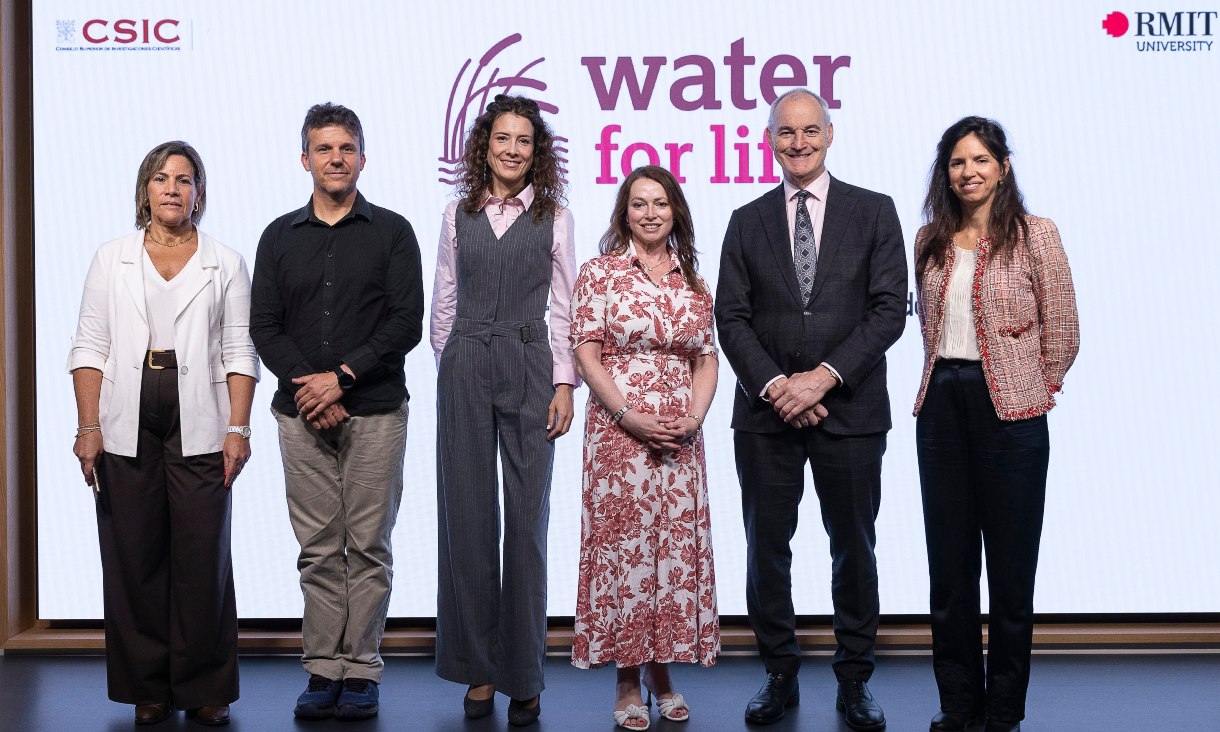
(L-R) Director, IDAEA-CSIC, Dr Ethel Eljarra; Director and Research Scientist, Centre for Advanced Studies of Blanes (CEAB-CSIC), Dr Marc Rius Viladomiu; Sustainability and SHE (Safety, Health and Environment) Lead, AstraZeneca, Alba Ancochea; Her Excellency Rosemary Morris-Castico, Australian Ambassador to Spain; RMIT Vice-Chancellor and President, Professor Alec Cameron; RMIT Europe CEO, Dr Marta Fernandez.

During the meeting in Barcelona, RMIT Vice-Chancellor and President, Professor Alec Cameron, emphasised the partnership with AstraZeneca and IDAEA-CSIC as an example of RMIT's dedication to industry-engaged research and sustainability-focused innovation while training the next generation of research leaders.

“Our presence in Europe makes collaborations like this possible and allows us to build enduring relationships to advance research and innovation for sustainable futures," he said. 

“The most important challenges facing society cannot be solved in isolation and we’re proud to strengthen our relationship with AstraZeneca and CSIC today.”

Her Excellency Rosemary Morris-Castico, Australian Ambassador to Spain, reflected upon Spain and Australia's similar challenges and how they can be tackled despite geographic distances.  

“By bringing together Australian and Spanish expertise, this project is generating knowledge that can help us better understand how nature-based solutions can support environmental restoration and water management,” she said.  

“What makes this partnership particularly valuable is its focus on delivering practical outcomes and developing solutions that could benefit other regions facing similar challenges.”

Dr Marc Rius Viladomiu, Director and Research Scientist, Centre for Advanced Studies of Blanes (CEAB-CSIC), added that the research collaboration comes at a crucial time for water conservation.

"The current climate situation on our planet makes it important to seek solutions based on scientific knowledge at an international level," he said. 

With the potential to improve water quality, biodiversity and habitat restoration, the new research partnership will play a key role in building more resilient water environments in Spain and Australia. 

AuSpire is an ambitious, interdisciplinary research initiative offering postdoctoral fellowships grounded in the concept of Planetary Wellbeing, co-funded by the European Union and coordinated by RMIT Europe.

Co-funded by the European Union under the Marie Sklodowska-Curie Grant Agreement No 101177949 (AuSpire). Views and opinions expressed are however those of the author(s) only and do not necessarily reflect those of the European Union or the Research Executive Agency. Neither the European Union nor the Research Executive Agency can be held responsible for them.

Co-funded by the European Union

Share

  • STEM
  • Sustainability
  • Research
  • Environment
  • Science and technology
  • RMIT Europe

Related News

aboriginal flag float-starttorres strait flag float-start

Acknowledgement of Country

RMIT University acknowledges the people of the Woi wurrung and Boon wurrung language groups of the eastern Kulin Nation on whose unceded lands we conduct the business of the University. RMIT University respectfully acknowledges their Ancestors and Elders, past and present. RMIT also acknowledges the Traditional Custodians and their Ancestors of the lands and waters across Australia where we conduct our business - Artwork 'Sentient' by Hollie Johnson, Gunaikurnai and Monero Ngarigo.

More information