Can the process be the evidence

Can the process be the evidence

The Education/Generative AI debate has reached a groundswell of debate about the struggle to secure assessment. TEQSA's latest resource, Assuring Quality Learning in a Gen AI-Integrated Future, marks a shift in a debate.

Blog by: Dale Leszczynski, Head of AI Education with thoughtful collaboration by Professor Shona Leitch, ADVCE, Nada Principal Advisor Educational Practice, and Toni Jones Lead Educational AI.


Whilst the early effort went into protecting the artefact — the essay, the report, the submission — through secure conditions, detection tools and redesigned tasks. That work was (and continues to be) necessary. It bought time, in some environments forced overdue conversations about assessment design, and produced much of the evidence the sector now draws on. It also stands on an assumption, that the artefact alone is evidence of learning.

But as learning has shifted, with content abundant, instruction available everywhere, credentials multiplying outside the academy, the university's most tangible remaining claim has been integrity and verification: we stand behind a qualification and certify that the graduate can do what it says. Defending the artefact has been a defence of that claim, and a legitimate one. TEQSA's June 2026 document takes the next step in that same debate. It suggests the artefact, on its own, may no longer carry the evidentiary weight and that assuring learning means exploring the journey a student takes to arrive at the artefact.

Drawing on a treasure trove of learning sciences research, and framed through the language of "adaptive capabilities," the document suggests product-based assessment is becoming an unreliable basis for learning assurance as generative AI and associated technologies grow more ubiquitous and abundant. Not because students are cheating, but because a final artefact, on its own, may no longer tell you much about the cognitive work that produced it, or whether that work happened at all. What matters, the document argues, is evidence of the process: how a student planned, monitored, evaluated and adjusted their thinking over time.

Active, Authentic, Applied — and now, visible

RMIT's Triple A pedagogy — Active, Authentic, Applied — has always positioned learning as something students do, not something that gets done to them. Assessment in that model is not a checkpoint at the end of a course. It is intended to be woven through the experience, designed to surface how students are developing, not just what they have produced.

TEQSA's document calls this learning process evidence, and argues it should sit alongside, not replace, assessment products or artefacts. The idea has a long pedigree. The assessment for learning tradition has argued for decades that evidence of student progress gathered during learning, used to adapt teaching and learning in response, is central to good assessment practice. That gathering and interpreting that evidence is a core educator competency (Wolterinck et al., 2024). The guidance is quick to call out that this is not about abandoning rigour or removing the artefact from assessment. It is about shifting what counts as credible evidence of learning in a context where the artefact alone can no longer carry that weight. Gen AI has not invented the case for process evidence. It has made acting on it more urgent.

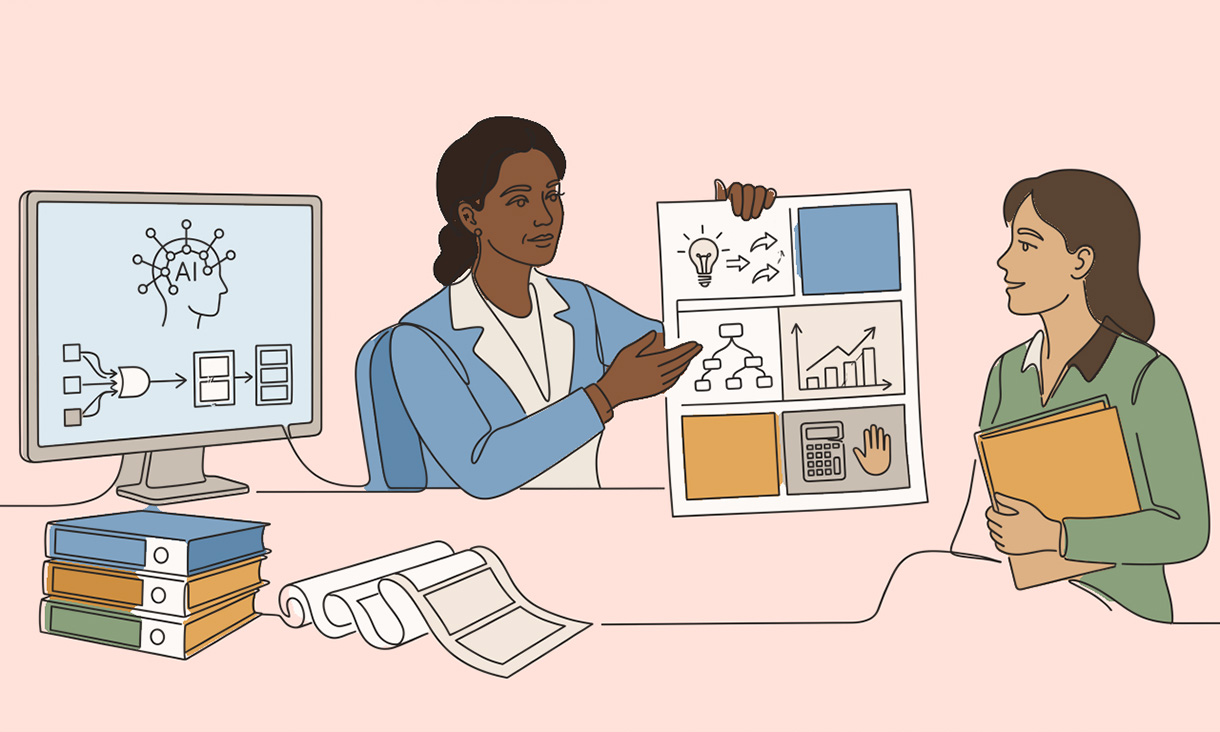
Diagram with transparent blocks titled: Feedback Loop, AI Interaction Trace, Reflective Checkpoint, Revision Sequence, Decision Point, Improved Draft, and Educator Judgement, representing stages in an AI-supported learning or assessment process.The image presents assessment as a transparent, traceable process rather than a single final submission. It highlights feedback loops, revision sequences, AI interaction records, decision points, improved drafts, reflective checkpoints, and educator judgement—showing how evidence from throughout the learning process can support a more informed and authentic assessment.

Generative AI Tools remove much of the friction in producing a final artefact, meaning design intention in an assessment (how that artefact comes to be) is more consequential make production of the artefact. AI tools that generate code, visual artefacts, written prose and other outputs demonstrate that students can now reach sophisticated outcomes while bypassing much of the cognitive effort traditionally associated with learning. A student may produce a polished result without deeply engaging with complex concepts, exploring alternatives or refining their understanding, yet arrive at an output very similar to that of a peer who has invested substantially more intellectual effort.

Interactions with generative AI tools can also provide evidence of that intellectual effort. Revision histories, decision points and reflective checkpoints can reveal how students work through challenges, respond to feedback and evolve their thinking over time. These traces offer insight not simply into what students produced, but into how their understanding developed.

None of this is straightforward to build or measure. TEQSA's document is careful on this point: learning process evidence offers partial windows into a student's regulatory activity, not a complete record of it, and it should not be treated as a foolproof method of assuring learning. The value of this kind of data is as supportive evidence, not definitive proof, another input educators can read alongside the artefact, not a replacement for professional judgement about what a student has learned. 

Knowing the role AI played

Moving away from "did AI write this?" to "what role did AI play in this student's learning, and how did the student navigate that?" And where the learning demands it, the question can and should flip: AI should not be used in this part of the student's learning at all, how did the student navigate that?

The first question (“Did AI write this?”) asks whether we can verify authorship. It has driven much of the sector's early response to AI in education, even though it is not answerable with certainty. The other two are more productive. They focus not on who produced the work, but on how learning has occurred. 

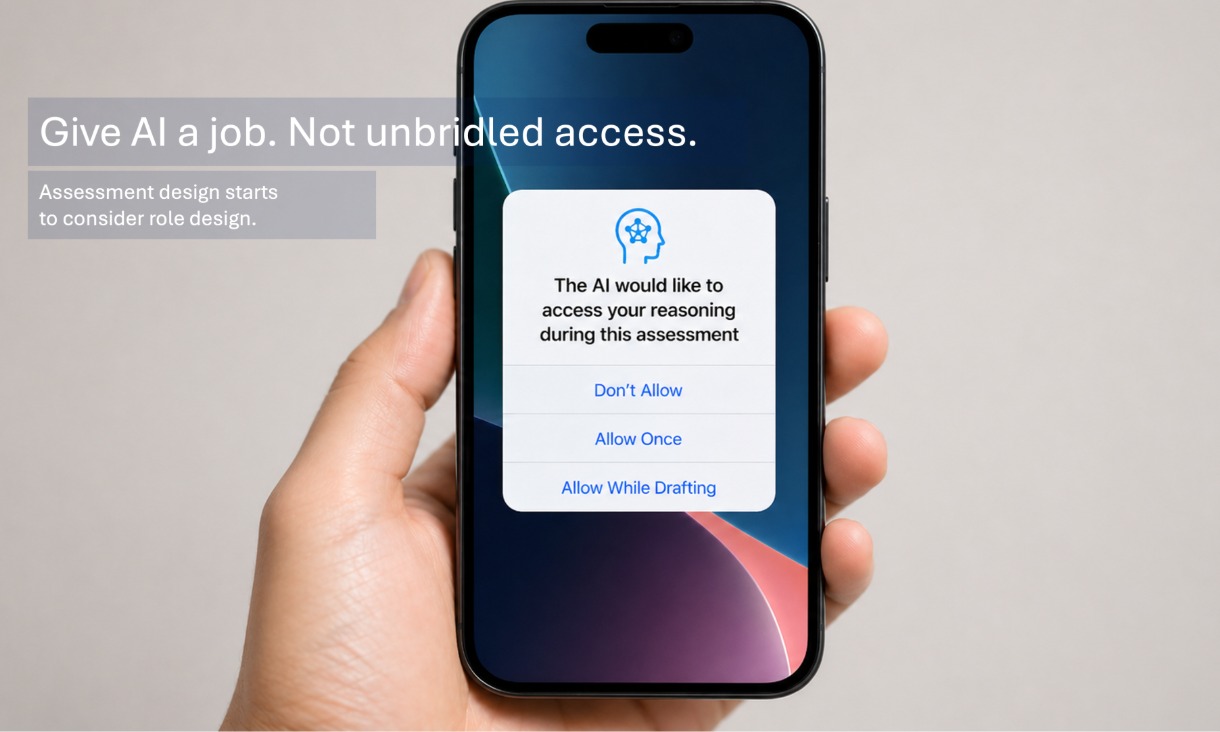
Hand holding a smartphone displaying a permission request from AI asking to access reasoning during assessment, with text above reading “Give AI a job. Not unbridled access. Assessment design starts to consider role design.”A person holding a smartphone displaying a permission prompt asking to access the learner’s reasoning during an assessment. The options—“Don’t Allow,” “Allow Once,” and “Allow While Drafting”—illustrate controlled, task-specific access. The accompanying message, “Give AI a job. Not unbridled access,” reinforces the importance of defining clear boundaries for AI when designing assessments.

Collaborating with the School of Health and Biomedicine, the Learning with AI engagement model is exploring how educators can build assessment sequences where students make visible, documented choices about when and how AI contributes to their work. The aim is not to catch AI use or prohibit it. It is to design moments where students, guided by educators, own the evaluative judgement about what role AI should play in their learning — a judgement that must consider the specific capability the learning is trying to assure. 

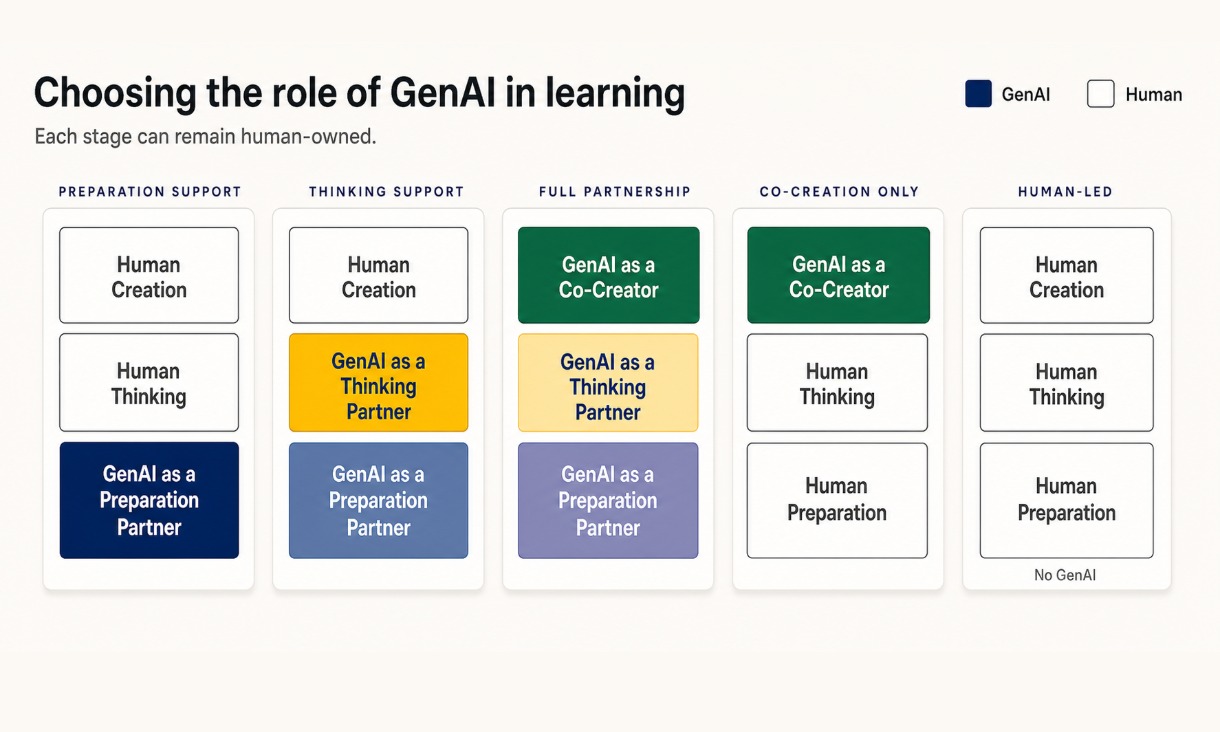
AI’s role can shift across a single piece of learning. AI can act as a preparation partner, used before the task to build foundational understanding. It can act as a thinking partner, used during the task to test reasoning and surface gaps. It can act as a co-creator, collaborating directly on the assessed output itself. Each role asks something different of the student, and each is legitimate in the right context — the work is deciding, deliberately, which role fits the capability being assessed.

Table showing different roles of GenAI and humans in learning, across preparation support, thinking support, full partnership, co-creation only, and human-led stages, illustrating various levels of AI and human involvement.The image presents five ways GenAI can participate in learning—from supporting preparation through to full partnership, co-creation only, or no GenAI use. Coloured boxes indicate GenAI involvement, while outlined boxes show stages that remain human-owned. It highlights that preparation, thinking, and creation can each involve different levels of human and AI participation.

The issue, then, is not simply access to AI, but the distribution of regulatory responsibility: what the learner controls, what the educator structures, what the task demands, and what the system supports. Students who use AI well are therefore not merely proficient users of tools. They are learners who can set goals, monitor progress, evaluate output, recognise when AI is doing too much of the cognitive work, and decide when the thinking needs to remain visibly their own.

GAILE’s AI Role has been building toward the same conclusion from a different direction: the goal is not constraining AI access, but equipping students to consciously decide, directed by educators, what role AI plays in their learning. The work ahead for RMIT is calibration: determining what preparation, independent thinking, feedback, critique or co-creation should look like for a given cohort, at a given capability level, in each discipline, against a given professional standard. 

What this could mean for curriculum design

If the artefact is no longer sufficient evidence of learning, curriculum and assessment design has to account for what came before it. That means building in structured opportunities for students to demonstrate their reasoning process — not as an add-on, but as a core design requirement.

At the program level, this means asking not just whether individual tasks are well-designed, but whether the program creates a coherent picture of a student's development over time. TEQSA's document calls for institution-wide infrastructure to support this. RMIT's signature pedagogy already provides the philosophical foundation. The design work is in making that foundation operational in a gen AI context — building assessment sequences where students are visibly doing the thinking, making the judgements, and knowing what role AI does and doesn't play in their learning.

The work also points towards a future which learning is increasingly hybrid: neither wholly human, nor wholly AI-Generated but shaped through purposeful collaboration between the two. In this context, the educational challenge is not to exclude AI from learning, but to ensure students develop the judgement, critical thinking, ethical reasoning and self-regulation needed to use it effectively. The focus shifts from assessing what students produce alone to understanding how they learn, decide and adapt while working with AI.


References considered in this Blog post: 

Lodge, J. M., de Barba, P., & Broadbent, J. (2024). Learning with generative artificial intelligence within a network of co-regulation. Journal of University Teaching and Learning Practice, 20(7), 1–12. https://doi.org/10.53761/1.20.7.02

Molenaar, I. (2022). The concept of hybrid human-AI regulation: Exemplifying how to support young learners’ self-regulated learning. Computers and Education: Artificial Intelligence, 3, Article 100070. https://doi.org/10.1016/j.caeai.2022.100070

Tertiary Education Quality and Standards Agency. (2026). Assuring quality learning in a gen AI-integrated future: The role of adaptive capabilities. TEQSA. https://www.teqsa.gov.au/guides-resources/resources/corporate-publications/assuring-quality-learning-gen-ai-integrated-future-role-adaptive-capabilities

Lan, M., & Zhou, X. (2025). A qualitative systematic review on AI empowered self-regulated learning in higher education. npj Science of Learning, 10, Article 41. https://doi.org/10.1038/s41539-025-00319-0

Wolterinck, C., Poortman, C., Schildkamp, K., & Visscher, A. (2024). Assessment for Learning: Developing the required teacher competencies. European Journal of Teacher Education, 47(4), 711–729. https://doi.org/10.1080/02619768.2022.2124912
21 July 2026

More GAILE blogs

aboriginal flag float-starttorres strait flag float-start

Acknowledgement of Country

RMIT University acknowledges the people of the Woi wurrung and Boon wurrung language groups of the eastern Kulin Nation on whose unceded lands we conduct the business of the University. RMIT University respectfully acknowledges their Ancestors and Elders, past and present. RMIT also acknowledges the Traditional Custodians and their Ancestors of the lands and waters across Australia where we conduct our business - Artwork 'Sentient' by Hollie Johnson, Gunaikurnai and Monero Ngarigo.

Learn more about our commitment to Indigenous cultures