

(Not) thinking with machines: the AI-augmented PhD

(Not) thinking with machines: the AI-augmented PhD

As AI becomes increasingly embedded in academic work, what might the future PhD look like? A speculative design workshop at GeneratED 2026 suggests that our responses to AI may reveal as much as the technologies themselves.

Blog by: Chi Ryan (RMIT sessional academic and PhD candidate)
 

During the inaugural GeneratED 2026 conference, hosted by RMIT’s Generative AI Lab for Education (GAILE), a speculative design workshop was held to explore Artificial Intelligence (AI) and doctoral scholarship: ‘Thinking with Machines: The AI-Augmented PhD’. Participants were invited to imagine futures where emerging technology is integrated into the labour of academic research by interrogating how AI is transforming the academic ecosystem. This workshop was designed, co-hosted, and facilitated with Associate Professor Michelle Douglas, an Associate Dean at the School of Design. 

Traditional doctoral study is characterised by manual intellectual labour, immersion, and human-led discovery, whereas emerging AI models and tools can accelerate research, literature review, drafting, analysis, and outputs. Rapid shifts in technology require reframing the PhD not only as a measure of competent intellectual labour, but as an indicator of ethical, human-AI collaboration. With a room full of eager educators and academics engaging in analogue activities before switching into ‘thinking with machines’ mode for the second half of the workshop, a notable reluctance to engage with AI tools was observed.

Prototyping a speculative future

The workshop, attended by 50+ higher education professionals, applied Research through Design Fiction (RtDF) to provide a safe ‘storyworld’ space. RtDF produces speculative artefacts (or diegetic prototypes) which are relics from fictional futures that force us to confront the realities of today. 

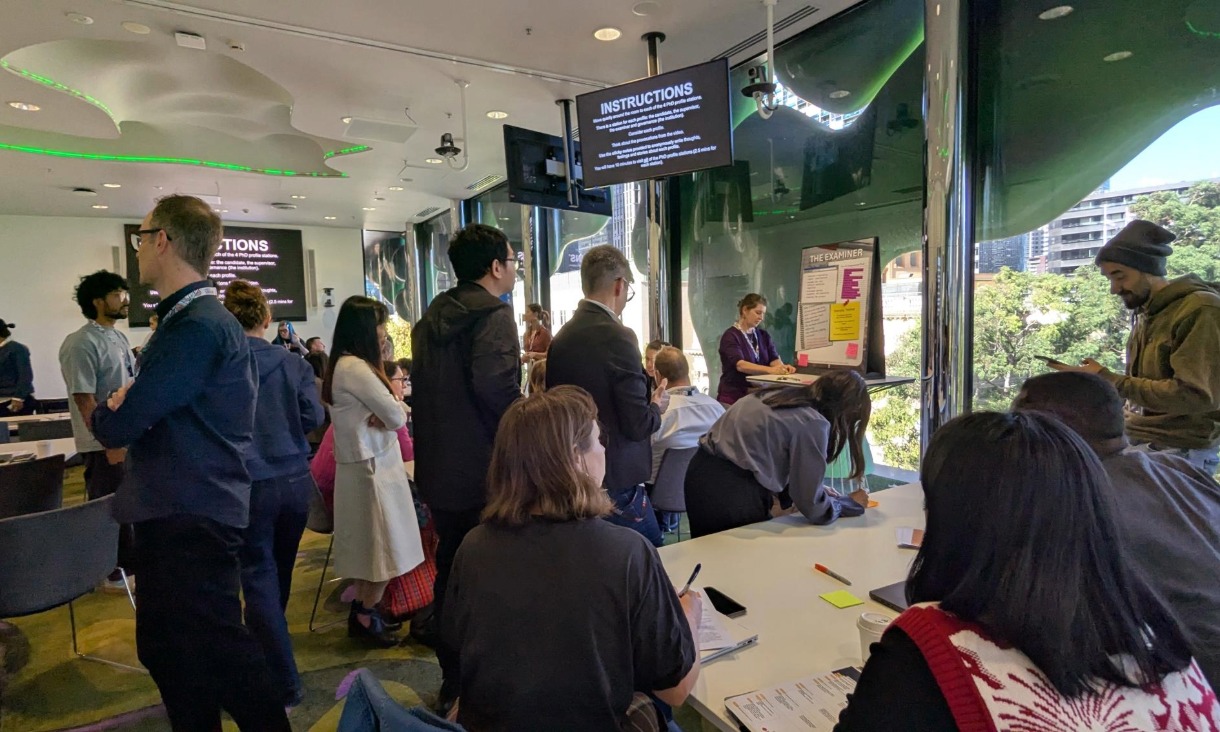
The physical space was divided into four distinct PhD archetypical stations. Each archetype contrasted traditional academic structures with an AI-augmented future, proposing new competencies and posing questions about the nature of scholarship. These archetypes served as entry points for participants to map systemic tensions with anonymous sticky notes before co-designing speculative futures (for example, AI-driven marking rubrics or supervisor-bots) using RMIT’s AI platform, Val.

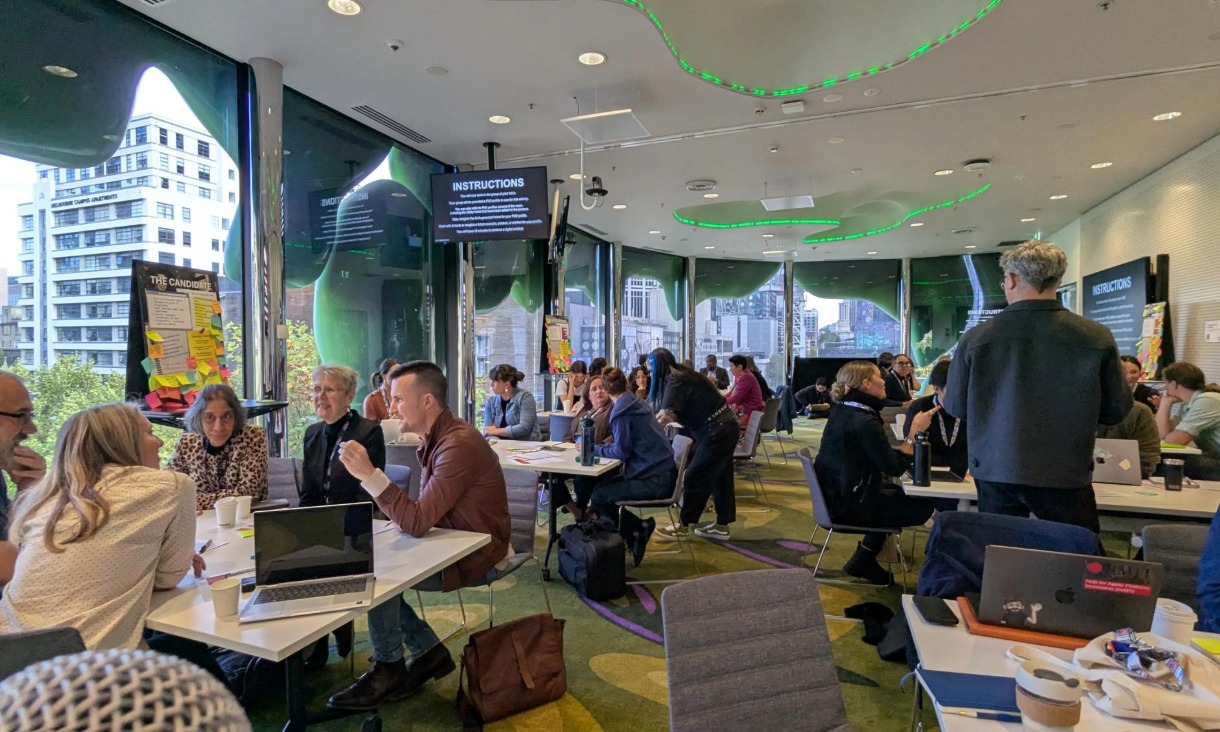
Participants collaborate in groups during the speculative design workshop ‘Thinking with Machines: The AI-Augmented PhD’ at RMIT University’s inaugural GeneratED 2026 conference, hosted by Generative AI Lab for Education (GAILE).

The four archetypes of the academic ecosystem

1. The Candidate

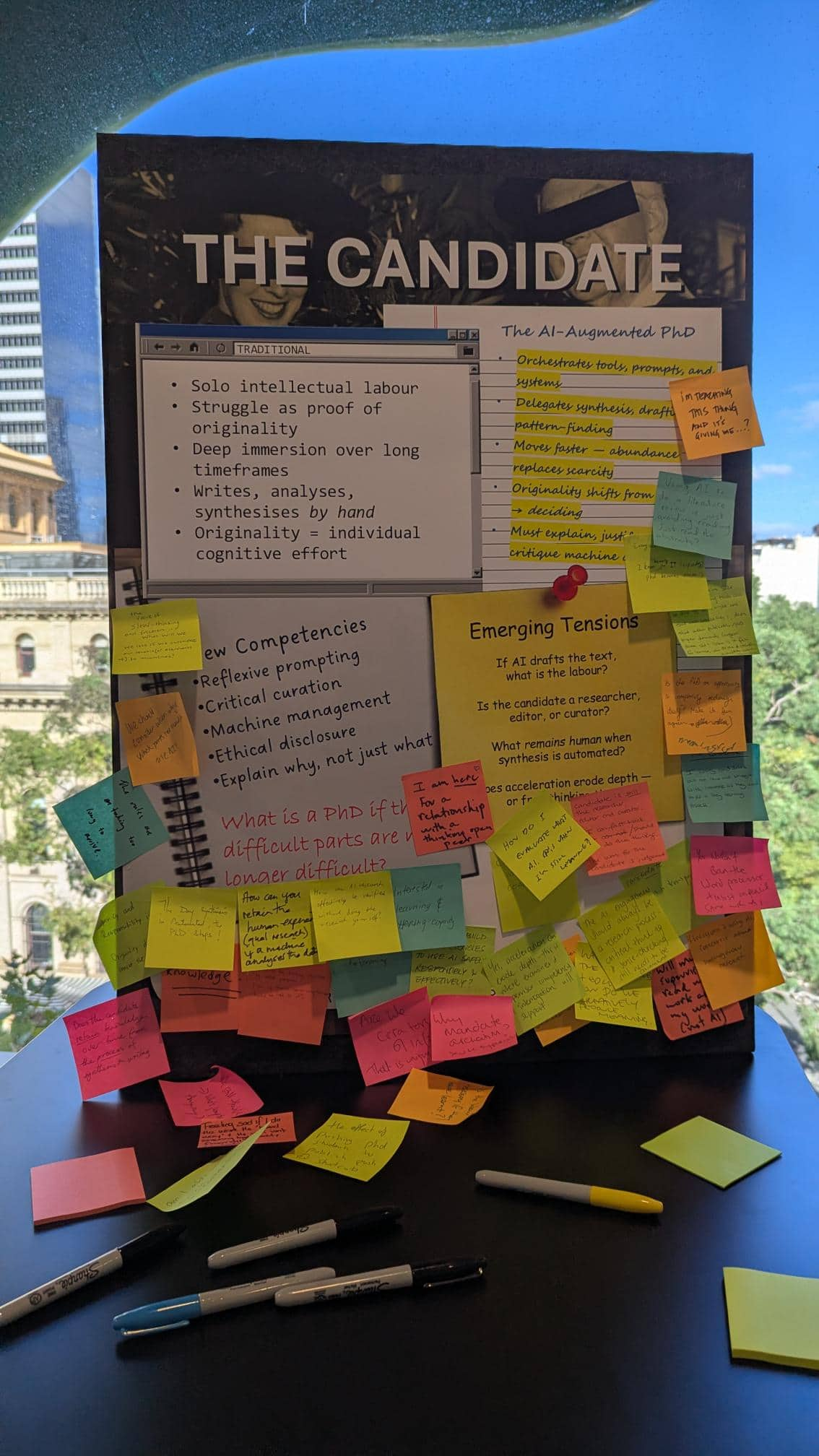
Solo intellectual labour defines the traditional, pre-AI PhD journey: the candidate independently writes, analyses, and synthesises knowledge, while sustained immersion and scholarly struggle serve as proof of originality and cognitive effort.

In the AI-augmented PhD, the candidate orchestrates tools, prompts, and systems. They delegate synthesis, drafting, and pattern-finding to machines, moving faster as abundance replaces scarcity and originality shifts from doing to deciding. The candidate must now explain, justify, and critique machine output, requiring new competencies in reflexive prompting, critical curation, machine management, and ethical disclosure. 

The Candidate archetype contrasted traditional doctoral study with a speculative AI-augmented future. Participants added sticky-note reflections to explore how AI may reshape intellectual labour, originality, decision-making, and the experience of undertaking a PhD.

Thematic analysis of workshop responses highlighted a continuing desire to preserve a human element and suggested candidates value human supervisor relationships over pure machine efficiency, and slow, deliberate thinking alongside increasing AI capability.

2. The Supervisor

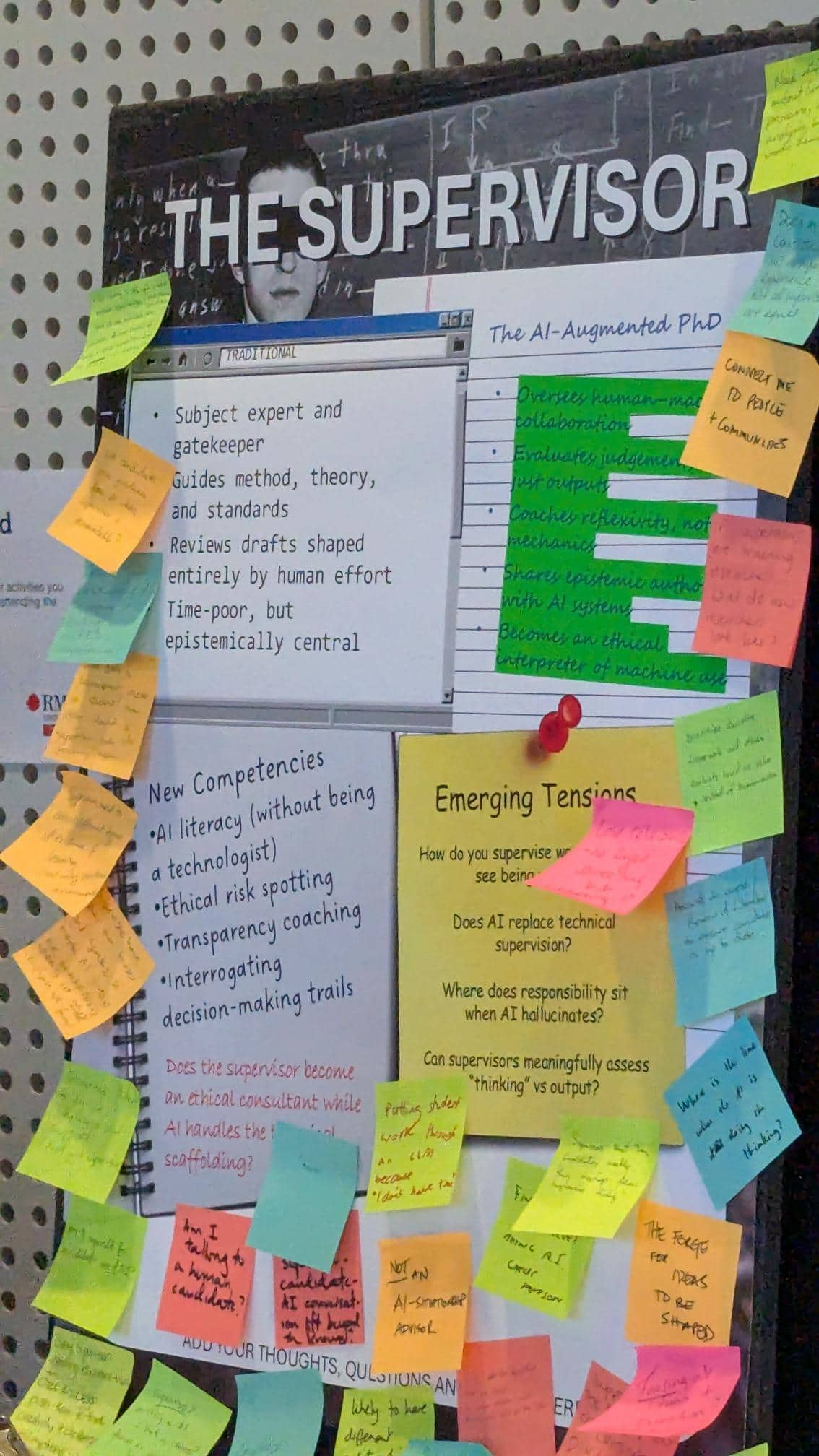
The traditional supervisor acts as a subject expert and epistemic gatekeeper. They guide methods, theory, and standards; reviewing drafts shaped by human effort. 

The AI agent supervisor, however, oversees human-machine collaboration. They evaluate the candidate’s judgement rather than outputs, fostering reflexivity. In this future, the supervisor shares epistemic authority with AI systems and becomes an ethical interpreter. This requires distinct new competencies, including AI literacy (without necessarily being a technologist), ethical risk spotting, transparency coaching, and the ability to interrogate digital decision-making trails. 

Participant reflections on the changing role of the PhD supervisor in an AI-mediated research environment.

Participants reinforced the importance of mentorship in doctoral education. Significant tensions emerged around where participants perceived the boundary between human judgement and machine assistance. These discussions highlighted questions regarding the future role and value of human mentorship within higher research.

3. The Examiner

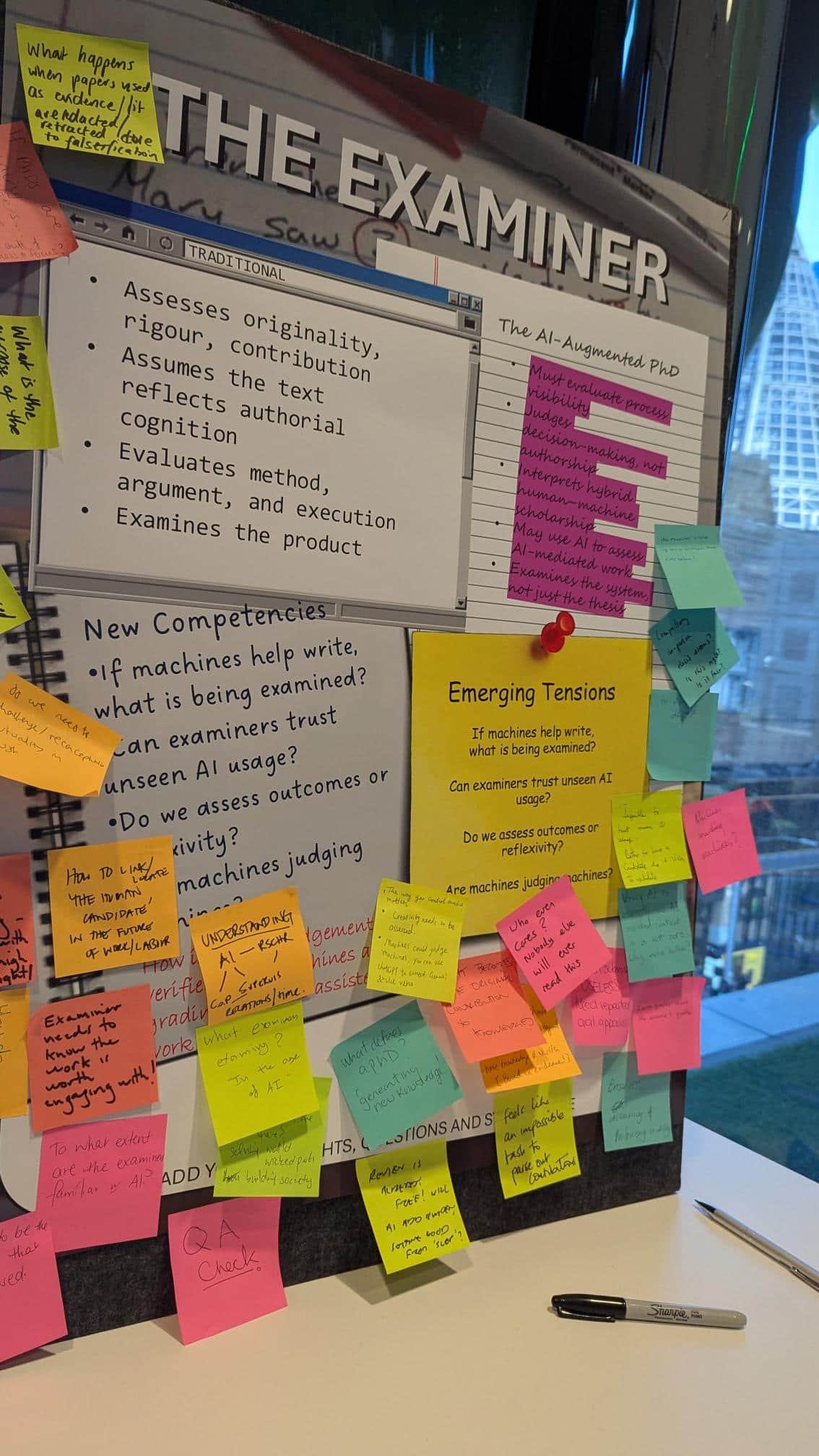
The traditional examiner assesses originality, rigour, and contribution by evaluating methods, arguments, and execution. Crucially, this model assumes the output inherently reflects authorial cognition; the examiner examines the final product.

In an AI-augmented landscape, the examiner must evaluate process visibility. They judge the candidate’s decision-making rather than their authorship, interpreting hybrid human-machine scholarship. The future examiner examines the system, not just the thesis, and may even use AI to assess AI-mediated work. 

Layered with participant reflections, the Examiner archetype captures the uncertainty and debate surrounding the future assessment of AI-mediated scholarship.

Workshop observations suggest that review quality is viewed as a direct reflection of individual examiner quality. In response to concerns about assessing AI-mediated scholarship, consideration of oral examination formats—like the viva voce—be used as an alternative to the potential of ‘PhD by AI surveillance’.

4. The Institution (governance and policy)

The institution traditionally sets compliance expectations, regulates misconduct, updates policy slowly, encouraging emerging technology as optional add-ons or essential tools, and focusing on research output quality.

The AI-augmented institution envisions itself at the forefront of exponential technological change, balancing innovation, reputation, and risk while seeking to govern practices that have become ubiquitous. The institution risks irrelevance or reputational damage if policy development cannot keep pace with rapidly evolving technologies and industry demands. Workshop participants highlighted immense structural friction because governance is fundamentally slower than AI development, resulting in universities governing ‘on the fly’. The group discussed the challenges institutions face in balancing academic integrity, equity, innovation, commercial realities, and an increasingly diverse credentialing landscape.

The analogue resistance and academic anxiety

While the four archetypes provided a framework for speculative futures, participants’ physical responses in the workshop revealed a sharp contrast between the GeneratED conference’s overall focus on generative AI and the participants’ receptiveness to the technology on offer.

During the initial tension-mapping activity, attendees eagerly used analogue materials. They moved quickly, writing intensely on sticky notes and placing them onto the archetypal posters. Yet, when instructed to transition to the second activity—working in groups to co-design speculative artefacts using Val—the dynamic in the room shifted. Attendees conversed, pointed at screens, and continued to write on paper, but digital devices remained largely untouched. Overall, participants rarely engaged with AI itself. 

Participants moved around the room, adding reflections on sticky notes for each archetype.

This limited engagement may reflect being unfamiliar with AI tools or the requirement to shift in pace from analogue artefacts to digital tools. However, the analogue responses indicate broader questions of trust surrounding AI-assisted academic work, including concerns about authorship, privacy, professional visibility, and intellectual ownership.

Conclusion

In the final stages of the workshop, participants were asked to produce tangible, digital artefacts from the future using AI tools based on instructions provided. With minimal tool engagement, participants inadvertently delivered a much more profound outcome: acting out a future scenario rather than producing artefacts. Their intense discussions and handwritten notes, alongside clear hesitation to digitally engage collectively, function as a behavioural prototype of the AI-augmented PhD.

Importantly, the workshop was designed to capture participant responses and workshop outputs, rather than investigate the motivations underlying technology adoption decisions. The interpretations should be understood as reflective readings of observed behaviour, rather than definitive explanations.

The workshop was a highly engaging, interactive success—thank you to the participants for their energy and lively debate, and to GAILE for hosting the session. Interestingly, the key outcome of the workshop is the absence of artefacts. Rather than using AI to inspire new ideas, participants enacted a plausible, immediate vision of an AI-augmented HDR environment in which adoption is uneven; trust remains contested, and engagement with AI is governed by professional caution. As a speculative design outcome, the absence of artefacts may be the most revealing insight produced from the workshop.

27 October 2026

More GAILE blogs

aboriginal flag float-starttorres strait flag float-start

Acknowledgement of Country

RMIT University acknowledges the people of the Woi wurrung and Boon wurrung language groups of the eastern Kulin Nation on whose unceded lands we conduct the business of the University. RMIT University respectfully acknowledges their Ancestors and Elders, past and present. RMIT also acknowledges the Traditional Custodians and their Ancestors of the lands and waters across Australia where we conduct our business - Artwork 'Sentient' by Hollie Johnson, Gunaikurnai and Monero Ngarigo.

Learn more about our commitment to Aboriginal and Torres Strait Islander peoples