The Gen AI Skills Continuum: building AI capability and confidence in tertiary education

The Gen AI Skills Continuum: building AI capability and confidence in tertiary education

The Generative AI Lab for Education (GAILE) is launching a new practical AI capability map specifically designed to support and guide educators in understanding the use of AI in teaching and learning practice and connecting them to resources for continuous professional development.

Written by: Toni Jones, Lead Education Gen AI at RMIT University and Fleur Hardisty, Communications Coordinator at RMIT University

As generative artificial intelligence becomes embedded across tertiary education, universities face a dual challenge: enabling innovation while safeguarding educational quality, ethics and equity.

On the ground, this adds to the complexities educators already face every day: guiding students responsibly, staying current in their disciplines, redesigning courses and assessments, and improving their own teaching, all at once, and across very different fields.

Whilst there are a plethora of frameworks and models that aim to solve this challenge, we found that there was still a gap for practical guidance that mapped the new environment and showed educators how AI could support their everyday work such as creating learning materials, aligning lesson plans with outcomes, and designing personalised learning experiences. 

The Gen AI Skills Continuum was thus built to address this, and our team at GAILE are taking the opportunity to turn it into a tool for all tertiary education educators.

The Continuum offers a pedagogically grounded map that supports educators and students to develop AI capability over time, fostering reflective practice and supporting sustainable change in learning and teaching.

AI capability is a strategic imperative for universities

The integration of AI across the university sector is no longer speculative, it is a defining feature of contemporary tertiary education. 

Despite growing consensus on the importance of AI literacy, universities face significant challenges in implementation. Educator readiness varies widely, shaped by differences in disciplinary norms, access to professional learning and prior experience with digital technologies. Many educators report uncertainty around AI tools, including concerns about accuracy, bias, data privacy and ethical use (UNESCO, 2025).

Graduates are expected to enter the workforce with high levels of digital and AI literacy, including the ability to use AI ethically, responsibly and in alignment with industry and societal expectations. 

Educators are expected to guide students in responsible AI use while simultaneously staying current with technological developments within their professions (OECD, 2026). They must also adapt courses, assessments and teaching practice in ways that maintain academic integrity and educational quality which for many represents a significant expansion of their teaching role.

This requires curriculum that encourages critical engagement and supports ethical decision-making alongside technical competence. Tertiary education institutions also require more than tools or policy responses, they need frameworks, and practical guides that support university-wide capability development.

The Continuum offers a shared language that allows individuals and teams to articulate their practice, identify which skills they have and which skills they didn’t know were possible with AI, and plan next steps at personal, course and program levels. It’s also a starting point for supporting the planning of where AI fits in curriculum design and assessment. 

Over time the Continuum grew to include higher-order capabilities as well, including evaluating the quality of AI–generative outputs, developing foundational understanding of how AI systems actually work, how to support students to use AI, and redesigning curriculum to integrate AI. 

Every time we share the Continuum with educators and show them how they can use it, there's an immediate reaction of relief and a sense of ‘finally there is something that fills that gap’.

The Gen AI Skills Continuum: building educator confidence and capability over time

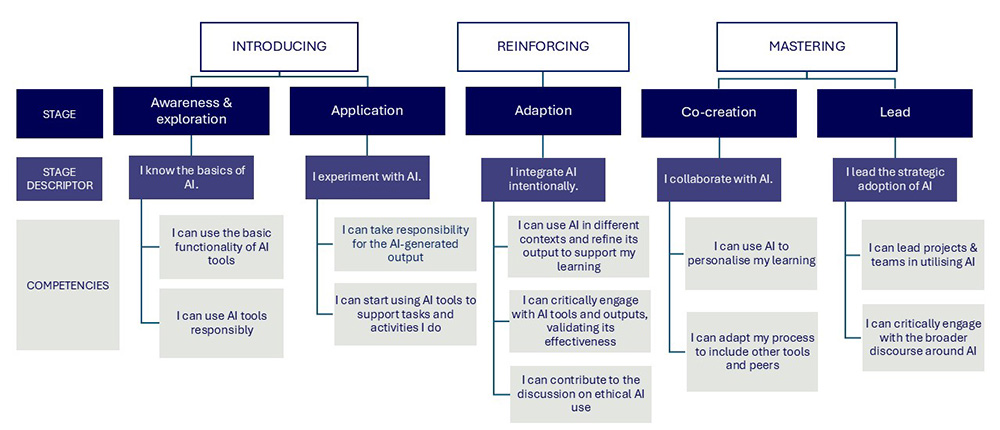
The Gen AI Skills Continuum is structured around three interconnected components: stages, competencies and skills. Together, these elements illustrate how AI capability can span from foundational awareness to confident applied practice.

The Gen AI Skills Continuum maps educator AI capability across three overarching phases, organised into five stages with descriptors and competencies. The Introducing phase contains two stages. Awareness & exploration ("I know the basics of AI") covers using the basic functionality of AI tools and using AI tools responsibly. Application ("I experiment with AI") covers taking responsibility for AI-generated output, and starting to use AI tools to support tasks and activities. The Reinforcing phase contains one stage. Adaption ("I integrate AI intentionally") covers using AI in different contexts and refining its output to support learning, critically engaging with AI tools and outputs to validate their effectiveness, and contributing to discussion on ethical AI use. The Mastering phase contains two stages. Co-creation ("I collaborate with AI") covers using AI to personalise learning, and adapting one's process to include other tools and peers. Lead ("I lead the strategic adoption of AI") covers leading projects and teams in utilising AI, and critically engaging with the broader discourse around AI.

The stages represent common patterns of capability development, offering a way to describe broad shifts in confidence, understanding and application.

Competencies sit at a macro level and articulate what AI capability looks like within each stage. Framed as “I can” statements, they translate abstract understandings of literacy into practical and measurable capability. 

Skills then break these competencies into smaller practical actions to demonstrate how AI is used in real contexts. This layered structure connects strategic intent and everyday practice, enabling the Continuum to be applied meaningfully across diverse disciplines and roles. For a breakdown of the skills, view the Gen AI Skills Continuum page.

Confidence is a critical factor in meaningful AI adoption and educators need the opportunity to experiment responsibly, develop fluency at the right levels and build trust in their own judgement. 

The Continuum supports this by specifically acknowledging that progression does not require mastery of every AI modality or platform but instead emphasises depth of understanding and purposeful application.

By framing capability development as progressive and contextual the Continuum supports a culture of responsible experimentation and a ‘work-in-progress' mindset rather than risk aversion.

A living practical skills map

The pace of change means integrating generative AI into teaching and learning cannot be treated as a one-off intervention or finalised solution, it must be supported by consistent critical thinking around educational impact, ethical implications and broader social consequences.

The Continuum is deliberately nonprescriptive and non-linear. Skills at each stage illustrate the kinds of behaviours and capabilities associated with that stage, not a checklist to be completed. Progression does not require demonstrating every skill, and it adapts across disciplines, teaching contexts and institutional priorities. The tool also supports self-reflection and professional judgement.

What we've found the most interesting during this process has been that everyone who looks at the Continuum sees a different way they could use it to either support themselves or support others they work with.

As AI technologies and practices evolve the Continuum is expected to evolve with them. Skills that currently sit at more advanced stages may become foundational as tools become more integrated in everyday practice. 

Despite AI technology developing rapidly and new tools emerging, we wanted to make sure that the skills were generic enough that they could be applied no matter what the tool was, but also flexible enough to be adapted to suit different contexts and disciplines. 

By treating the Continuum as a living practical skills map ensures its continued relevance in a rapidly changing landscape. The version of the Skills Continuum you see today is not the same one we initially created as it has evolved over the last few years alongside the technology, and we invite educators across the sector to contribute, provide feedback and help us continue to shape it. 

References

OECD. (2026). OECD digital education outlook 2026: Exploring effective uses of generative AI in education. OECD Publishing. https://doi.org/10.1787/062a7394-en

UNESCO. (2025). Two-thirds of higher education institutions have or are developing guidance on AI use. https://www.unesco.org/en/articles/unesco-survey-two-thirds-higher-education-institutions-have-or-are-developing-guidance-ai-use

09 June 2026

More GAILE blogs

aboriginal flag float-starttorres strait flag float-start

Acknowledgement of Country

RMIT University acknowledges the people of the Woi wurrung and Boon wurrung language groups of the eastern Kulin Nation on whose unceded lands we conduct the business of the University. RMIT University respectfully acknowledges their Ancestors and Elders, past and present. RMIT also acknowledges the Traditional Custodians and their Ancestors of the lands and waters across Australia where we conduct our business - Artwork 'Sentient' by Hollie Johnson, Gunaikurnai and Monero Ngarigo.

Learn more about our commitment to Indigenous cultures