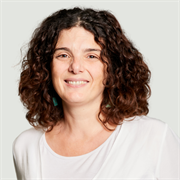
Dr. María Gabriela Irrazabal
Details
 College: RMIT Europe
 Department: RMIT Europe
 Campus: Barcelona Spain
 gabriela.irrazabal@rmit.edu.au
 ORCID: 0000-0003-1611-9084
About
I am a sociologist and Research Fellow at RMIT Europe in Barcelona, with a PhD in Social Sciences from the University of Buenos Aires. My research explores the intersection of sociology, health, culture, and beliefs, with a strong focus on how social and cultural determinants influence wellbeing. I study how belief systems and social structures shape health practices and policies, particularly for vulnerable populations, and I bring this perspective into projects that connect local realities with global health challenges.
At RMIT Europe, I contribute to European initiatives such as the Horizon 2020 IDEAHL project, which designed a Digital Health Literacy Strategy for Europe. I also co-designed the Global Atlas of Literacies for Health, an interactive tool mapping health and digital health literacy worldwide. This Atlas was highlighted as an excellent innovation by the Euorpean Commission's Innovation Radar. In addition, I am developing a project on the impact of art and culture on health, exploring how creative practices can foster wellbeing and social inclusion, and I parcipate as social science expert in medtech or clinical projects. At RMIT Europe I am also co-leading the development of the Health Futures Cluster, an initiative to strengthen our health research portfolio and create strategic partnerships across Europe and internationally. Through this Cluster, I focus on building opportunities and projects in health promotion, equitable access to care, and innovative approaches to address contemporary health challenges — with the aspiration of contributing to communities where everyone can flourish, in equity, social justice, and in respect for cultural and gender diversity.
I am the President of the Global Open Science Association (GLOSA). I am also a member of the International Sociological Association (ISA), the International of Science and Belief in Society. I was awarded a Fulbright Scholarship to study pluralism, and I have also received grants from the AUIP, LASA, BID. I have recently completed a specialization in Design Health, along with professional updates in science diplomacy. These experiences reflect my commitment to engaging with international academic communities and advancing knowledge in sociology, health, and cultural studies.
I come from Argentina, where I've been a Researcher at the National Scientific and Technical Research Council (CONICET) and a Full Professor at the University of Buenos Aires. In my academic role, I led a team of eight assistant professors and teach over 1,800 students annually in the course “Introduction to Society and the State.” I've also taught research methodology and trained over 1,500 undergraduate and graduate students in this area over the past 15 years. I have specialized in translating my research into teaching, developing innovative programs for health-related degrees, such as “Sociology of Birth,” a pioneering initiative in the obstetrics program at UNAJ in Latin America, as well as training on perinatal death and practical case studies on bioethical dilemmas, particularly regarding rejection of biomedical treatment. I have led more than ten funded research projects focused on sociology, health, religion, culture, bioethics, and human rights. I apply mixed methods, ethnography, creative methods, participatory approaches, and co-creation techniques in my research. My work includes large-scale surveys with over 12,000 participants and has explored topics such as reproductive rights, end-of-life care, genetic testing, complementary and alternative medicine, and the social and cultural determinants of health.

Research fields
- 441011 Sociology of health
- 500101 Bioethics
- 500405 Religion, society and culture
- 420606 Social determinants of health
- 420603 Health promotion
- 440706 Health policy
- 440505 Intersectional studies



