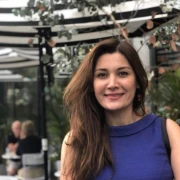
Dr. Leila Irajifar
Details
 Department: School of AUD
 Campus: City Campus Australia
 leila.irajifar@rmit.edu.au
 ORCID: 0000-0001-9108-1624
Open to
- Masters Research or PhD student supervision
About
Leila is a Senior Lecturer, Regenerative Future Fellow and Program Manager of the Master of Disaster, Design, and Development (MoDDD) at RMIT University's School of Architecture and Urban Design. Her teaching and research explore the intersections of systemic design, disaster resilience, smart cities, and digital solutions for urban resilience.
Leila’s research addresses the challenges of operationalising urban resilience in the face of climate change and growing urban complexity. Her recent work focuses on the application of systems thinking to enable regenerative and adaptive urban futures. During her PhD, she developed a disaster resilience model based on empirical data from the 2011 Brisbane floods, offering insights into the interconnected dynamics of social, environmental, and infrastructural systems.
Leila has contributed to international research and policy initiatives, including her work with UN-Habitat’s City Resilience Profiling Program in Barcelona and as a Postdoctoral Research Fellow at the Institute for Great Lakes Research at Central Michigan University. Prior to her academic career, she gained extensive professional experience as an architect, urban planner, BIM modeller, and spatial analyst in both public and private sectors.

Supervisor projects
- Developing the Smart Urban Resilience Framework (SURF): Integrating Smart City Technologies and Urban Resilience Governance in Australian Cities
- 16 Feb 2026
- Participation as Inhabitation: Designer-Citizens Negotiating Postdisaster Housing Reconstruction
- 1 Nov 2018

Teaching interests
Leila leads and teaches across core and elective courses in the MoDDD program, where she integrates theory with practice through experiential, interdisciplinary, and collaborative learning methods. Her teaching is informed by real-world challenges and international projects, bridging design education with humanitarian response and sustainable development.
She has introduced innovative pedagogies such as flipped classrooms, simulations, industry-partnered projects, and reflective practices, enhancing student engagement and deep learning. Leila’s courses emphasize systems thinking, design for complexity, and resilience planning.
Key teaching areas include:
- Systemic Design for Sustainable Development
- Building Urban Resilience
- Rebuild by Design
- Climate Change Adaptation
- Shelter and Settlements after Disasters
- Disaster, Design, and Development
- Industry-Partnereed Project Implementation

Research interests
Leila’s research explores how cities can build resilience through systemic, adaptive, and regenerative design strategies. Her work is grounded in practical challenges around operationalising urban resilience, especially in the face of climate change and increasing uncertainty. She investigates the role of smart cities, digital tools, and systems thinking in enabling sustainable urban transformation.
Her PhD research focused on developing a disaster resilience model based on data from the 2011 Brisbane flood, offering insight into interdependencies within urban systems. Her current research continues to examine the potential of systemic design and digitalisation to shape resilient and inclusive urban futures through collaborative initiatives with Natural Hazards Research Australia (NHRA) and Regenerative Futures Initiative (RFI).




