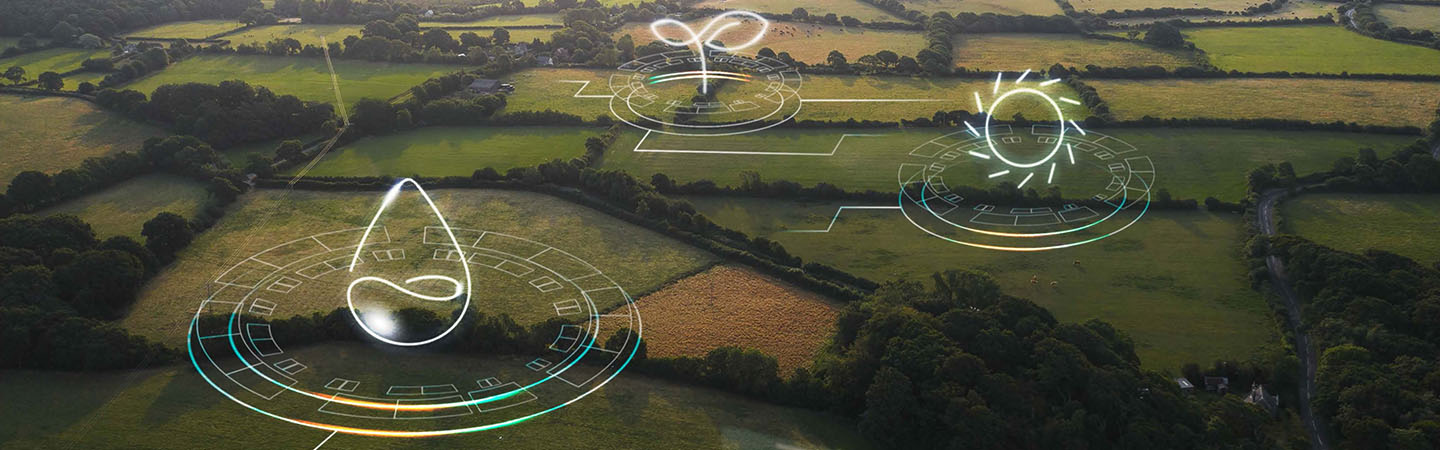
A multi-disciplinary Hub, the transformation proposed by IC-SensE will rely on innovations in photonics, sensing materials and edge processing intertwined with user-centric socially acceptable designs that incorporate the needs of the end-user. This will dramatically boost productivity, resilience and competitiveness across sectors and fundamentally change how Australian industries monitor, analyse and respond to contaminants in environments such as air, water and soil.

Miniaturised contaminant sensors
Creating deployable technology platforms for detecting target contaminants in complex environments.
Academic Leaders

Sensor Edge Signal Processing, Predictive AI, enabling autonomous decision-making for real-time contaminant assessment
Creating advanced on-device signal processing and AI algorithms, transferring raw sensor data from Program 1 into meaningful, actionable insights and risk assessment tools.
Academic Leaders

End-user uptake of sensor technology through socially responsible design, data security and trustworthy data representation
Focussed on social adoption of solutions deployed in Programs 1 & 2 to ensure user-focussed design, data security and ethical AI frameworks for sensing technologies developed.
Academic Leaders
The environmental monitoring industry has an opportunity to transform and integrate itself with major end-users for mutual benefits and future relevance by taking advantage of the advances in photonic sensors, electrochemically/optically responsive sensing materials, and neuromorphic edge contaminant assessment and data analytics in power-limited environments where network connectivity is unavailable, IC-SensE will deliver efficient machine learning frameworks that enable continuous analysis of sensor data, forecasting contamination trends, predicting potential contamination events, and identifying early signs of equipment or process failures.
A major strength of IC-SensE will be a co-designed approach, underpinning the three Research Programs, to ensure strong end-user update of the developed technologies.
The benefits of IC-SensE are:
Hub Director, RMIT University

Deputy Hub Director, Adelaide University

Deputy Hub Director, Macquarie University

Node Lead, Swinburne University
Node Lead, Adelaide University

Chief Operating Officer, IC-SensE




Developing intelligent contaminant-sensing technologies that will enhance productivity by approximately 30% over the next decade through lower costs for contaminant mitigation and maintenance, the Hub is set to work with Partner Organisations from across the agriculture, healthcare, space, sustainability sectors, on Work Programs incorporating the fields of materials science, chemistry, physics, AI, signal processing, computer science, electronics, optics, engineering, biochemistry, microbiology and social science.
For organisations interested in working with our Chief Investigators across any of our Research Programs, please contact us at icsensehub@rmit.edu.au
As an ARC Industrial Transformation Research Hub, IC-SensE will build and elevate the workforce in the field of AI-enabled, miniaturised sensors capable of detecting chemical and biological contaminants through the employment of Research Fellows. To be located at our Hub universities, working our Chief Investigators and Partner Organisations, Research Fellows will be key in delivering Work Programs across three principal research themes. Chief Investigators will also be looking for suitable PhD candidates seeking an opportunity to help transform Australia’s environmental monitoring into a user-responsive industry spanning key users in agriculture, water and built environments.
The Hub is currently in the Establishment Phase; we anticipate recruitment for Research Fellows and PhD candidates will commence mid-2026.
For further information please contact us at icsensehub@rmit.edu.au


RMIT University acknowledges the people of the Woi wurrung and Boon wurrung language groups of the eastern Kulin Nation on whose unceded lands we conduct the business of the University. RMIT University respectfully acknowledges their Ancestors and Elders, past and present. RMIT also acknowledges the Traditional Custodians and their Ancestors of the lands and waters across Australia where we conduct our business - Artwork 'Sentient' by Hollie Johnson, Gunaikurnai and Monero Ngarigo.
Learn more about our commitment to Aboriginal and Torres Strait Islander peoples