The Community-Led Air Quality Network Victoria project supports local governments to deploy low-cost sensor networks through community co-design, improving local air quality monitoring, decision-making, and public awareness across Victoria.
Project summary
The Community-Led Air Quality Network Victoria project, led by RMIT University under the Air Quality Improvement Precincts (AQIP) Grant Program 2025, aims to enhance localised air quality monitoring and evidence-based decision-making across Victoria. The project responds to growing concerns regarding uneven exposure to air pollution, particularly in communities located near major transport corridors, construction sites, industrial zones, and port areas. These environments often experience higher concentrations of pollutants yet are not always adequately captured by existing regulatory monitoring networks. As a result, there is a need for more granular, place-based data to better understand local air quality dynamics and inform targeted interventions.
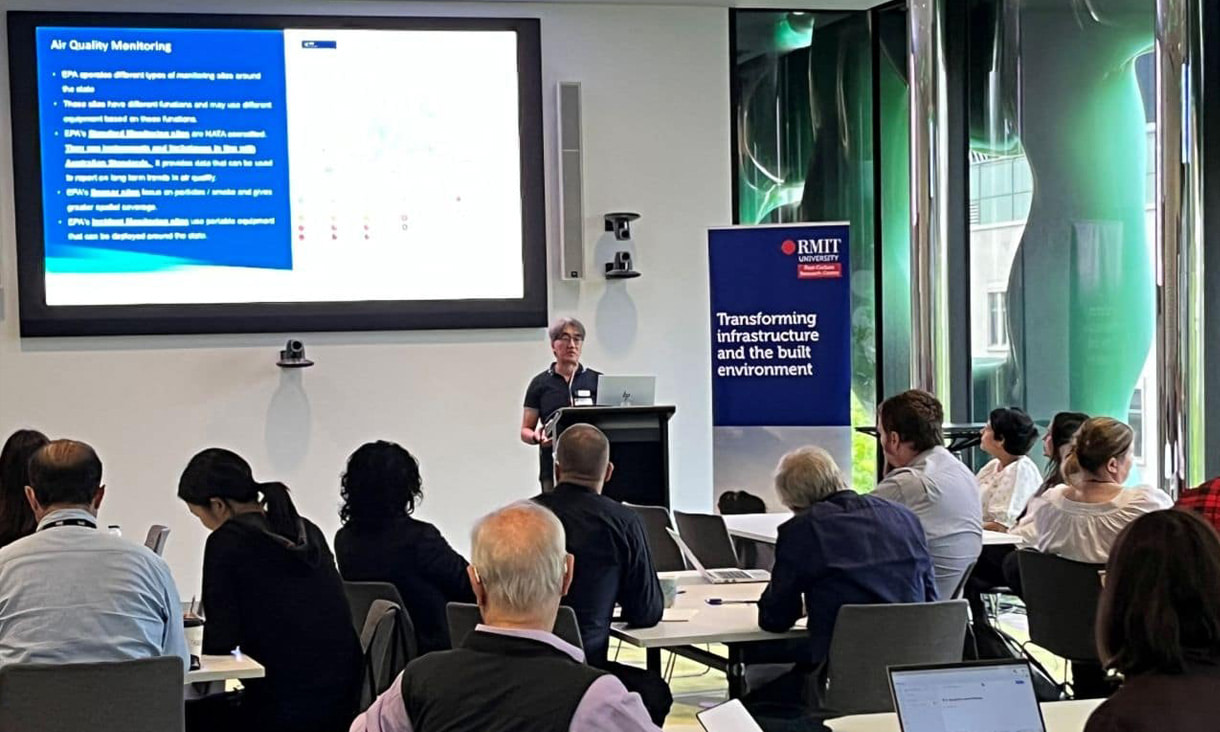 A stakeholder engagement workshop for the Post-Carbon Research Centre.
To address this gap, the project adopts a community-led and participatory approach to air quality monitoring. It seeks to support local governments in establishing and operating low-cost air quality sensor networks, co-designed with community stakeholders. This approach not only enables the generation of hyperlocal data but also fosters community engagement, ownership, and awareness of air pollution issues.
A key objective of the project is to build institutional capacity within local governments. Through knowledge transfer, training, and the development of best-practice guidelines, the project aims to equip councils with the skills and tools required to independently manage air quality monitoring initiatives in the long term.
The project comprises several interrelated activities and deliverables. These include stakeholder engagement workshops to identify local priorities and build partnerships; co-design and deployment of sensor networks; development of a centralised website and data-sharing platform; and data analysis and reporting through dashboards, heat maps, and community-focused outputs. The digital infrastructure developed through the project will facilitate real-time data visualisation and integration with broader national systems, supporting transparency and accessibility of air quality information.

The project will be delivered through a collaborative partnership involving RMIT University, the University of Canberra, Natirar Pty Ltd, EPA Victoria, and HEAL Network. A structured governance and evaluation framework will ensure alignment with best practice and support effective project implementation. Through its integrated and participatory approach, the project aims to contribute to healthier, more liveable urban environments across Victoria.
Project team
Lead Investigator

Dr. Shilpi Tewari
Research Fellow
Other Investigators

Professor Priya Rajagopalan
Associate Dean (Research and Innovation)

Dr. Nigel Goodman
Lecturer
Mr. Andrew Carre
Lecturer

Professor Andrew Butt
Assoc Dean, Sustain & Urban Plan
Partners
Environment Protection Agency Victoria, Natirar Pty Ltd, Healthy Environments and Lives (HEAL) Network, Municipal Association of Victoria, Asthma Australia, Commonwealth Scientific and Industrial Research Organisation (CSIRO), and participating local councils - Maribyrnong, Melbourne and Melton.



