

RCTCO: Five Elements for Higher Quality AI Outputs

RCTCO: Five Elements for Higher Quality AI Outputs

Blog by:
Patrick Lynch | Senior Learning & Teaching Specialist | College of Business & Law
Mila Keightley | Senior Learning & Teaching Specialist | College of Business & Law

The Risk of Vague Instructions

If you have used a generative AI tool recently, you have likely encountered the problem of generic results. When prompts are too broad, they lack the specific context and boundaries needed for higher education work, often resulting in vague outputs that require more time to edit than it would have taken to write from scratch. In a professional setting, this is not just inefficient; it can lead to significant risks if the information is not accurate or relevant to the task. 

The RCTCO Framework: A Structured Approach to Instructions

The solution is to move beyond simple questions and adopt a more structured approach to giving instructions. By designing prompts that align with professional standards, we can ensure the results are more reliable and fit for purpose. 

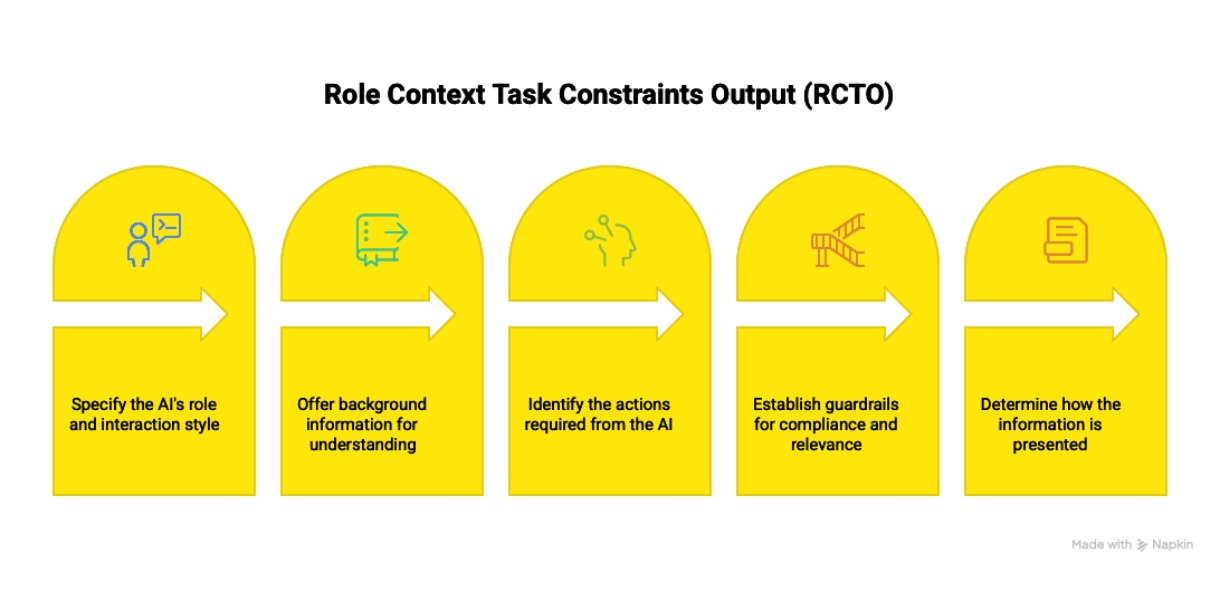
At the College of Business and Law, we are using the RCTCO framework to create a clear structure for AI instructions. This method ensures that you understand the specific requirements of a task before it begins generating a response.

Role: Defines Persona
The first step is to specify the persona the AI should adopt. Defining a role guides the behaviour and interaction style of the tool, ensuring it communicates in a way that is appropriate for the discipline.

Context: Provides Background
Context offers the background information necessary for the tool to understand the environment in which it is operating. This provides the essential details needed to ground the task in reality.

Task: Specifies Actions
A clear task identifies the distinct actions required from the tool. This removes ambiguity and ensures the AI focuses on the specific goal you want to achieve.

Constraints: Sets Boundaries
Constraints establish the guardrails for the task, ensuring compliance and relevance. This might include requirements for factual accuracy, specific evidence, or adherence to certain professional standards.

Output: Specifies Format
The final component determines how the information is presented. Specifying an output format makes the results clear and immediately actionable for your specific needs. 

A Note on Prompting Frameworks in 2026

It is fair to ask why a prompting framework like RCTCO is needed in 2026, when generative tools can often produce usable outputs from almost any instruction. A capable AI model might fill the gaps, assume a role, invent an audience, and decide for itself what a good answer looks like often quite convincingly, but may lack accuracy and specificity. A framework like RCTCO is designed to engage you more carefully with the nuance of the of what you are trying to achieve. Structured approaches require you, not the model to define the AI's role, context and the standard it is held to. Setting those requirements up front does not guarantee the model will meet them but establishes criteria you can hold against the output which reframes your constraints and outputs as evaluation tools. A structured prompt drives critical engagement rather than constraining it. Front-loading the thinking defines your purpose, meaning that evaluating the output doesn't just test the AI, it tests your own judgement to properly frame what you are trying to achieve.

Adopting a framework also helps us move from one-off tasks to a more strategic integration of tools. It allows us to identify repetitive workflows where we can build consistent personas, and system prompts to tackle specific projects that require precision. By establishing underlying principles and structure first, we build a foundation for more accurate and contextually relevant responses. 

Critical Engagement and Responsible Use

Treat these tools as provisional thinking partners rather than absolute authorities. This means the output is a draft to be questioned and revised, not a finished product to be unconditionally accepted. By embedding evaluation as a standard part of the workflow, we treat cross-referencing and source critiquing as essential steps in the process.

In practice:

1. Business/Law (pairs with"Write a case study on business ethics")

  • Role: You are a business ethics lecturer designing teaching materials for an undergraduate course.
  • Context: The case will be used in a second-year undergraduate Business Ethics course at an Australian university. Students have covered stakeholder theory and the Australian regulatory environment but not yet corporate governance. Tutorials run 50 minutes in groups of four to five.
  • Task: Write a case study about a mid-sized Australian company facing a conflict between short-term profit and an environmental obligation, with enough operational and financial detail for students to apply a stakeholder analysis.
  • Constraints: Use a fictional company so there is no risk of misstating facts about a real firm. Keep the scenario plausible within Australian and Victorian law. Leave the dilemma unresolved. Avoid concepts students have not yet met.
  • Output: A 600–800 word case study followed by four discussion questions of increasing difficulty, with clear headings.

2. Health/Science (pairs with "Explain the research on gut health")

  • Role: You are a health sciences academic preparing a self-study resource for first-year students.
  • Context: First-year nutrition undergraduate students who have completed an introductory biology unit but have no microbiology background. The resource is read before a lecture on the gut microbiome.
  • Task: Summarise the current scientific understanding of how the gut microbiome influences digestion and immune function, and identify where the evidence is strong and where it is still emerging.
  • Constraints: Separate established findings from preliminary or contested claims. Name the type of evidence behind each point (observational study, RCT, and so on) rather than making unqualified statements. Flag common myths. Keep the reading level suitable for first-year students.
  • Output: A 500-word summary in three sections, what is well established, what is still uncertain, common misconceptions, plus a short glossary of key terms.

3. Education/Design (pairs with "Make a lesson plan about climate change")

  • Role: You are a curriculum designer working with secondary school teachers.
  • Context: A single 60-minute lesson for Year 9 Geography students in an Australian school, within a unit on environmental change. Students know the basics of the carbon cycle. The classroom has one projector and no student devices.
  • Task: Design a lesson that helps students distinguish weather from climate and interpret a simple climate dataset.
  • Constraints: Align activities to the Australian Curriculum Geography outcomes for Year 9. Keep content scientifically accurate and age-appropriate. Include at least one device-free activity. Build in a check of student understanding before the lesson ends.
  • Output: A lesson plan with learning objectives, a timed activity sequence, required materials, and one formative assessment task. Use a table where it helps.

Building Your AI Capability:

Find out more about RCTCO: Heng's Quest: AI at Work is an interactive comic adventure stepping into the workplace. In this immersive experience, players are put in charge to make decisions, face challenges, and learn how to use AI effectively and responsibly at work. 

AI short courses: Explore and enrol now via the CoBL Catalogue.

  • Embracing AI in the Future of Work
    Perfect if you’re just getting started with AI. This beginner-friendly module helps you understand what AI means for your career and how to confidently navigate it.

  • Essential Soft Skills for an AI-Enhanced Workplace
    Already across the basics? This intermediate module builds on your knowledge by focusing on emotional intelligence, adaptability, collaboration, and communication the human-centred skills that will set you apart.
     

Want to continue your learning with relevant skills:

https://aiskillscontinuum.com/skill/customise-and-train-ai-tools

https://aiskillscontinuum.com/skill/apply-human-judgement-to-validate-ai-outputs 

https://aiskillscontinuum.com/skill/recognise-limits-of-ai-outputs
 

01 June 2026

More GAILE blogs

aboriginal flag float-starttorres strait flag float-start

Acknowledgement of Country

RMIT University acknowledges the people of the Woi wurrung and Boon wurrung language groups of the eastern Kulin Nation on whose unceded lands we conduct the business of the University. RMIT University respectfully acknowledges their Ancestors and Elders, past and present. RMIT also acknowledges the Traditional Custodians and their Ancestors of the lands and waters across Australia where we conduct our business - Artwork 'Sentient' by Hollie Johnson, Gunaikurnai and Monero Ngarigo.

Learn more about our commitment to Indigenous cultures