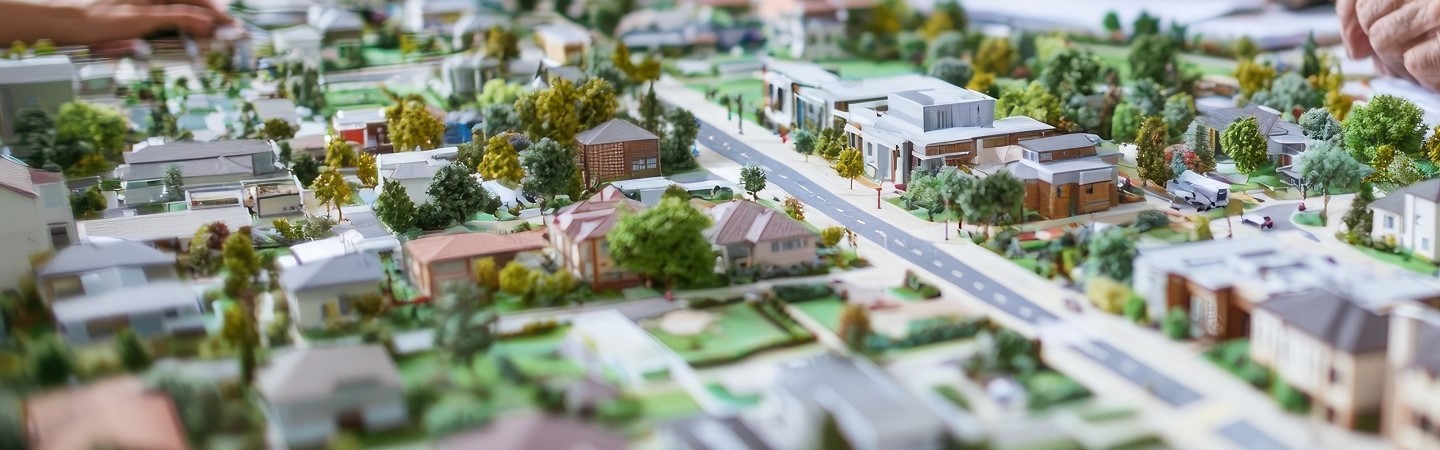

Retro-fitting urban precincts: creating liveable post-carbon communities

Join RMIT's Post-Carbon Research Centre for a panel discussion exploring the importance of retrofitting precincts. What changes to planning and building systems would enable better outcomes for sustainability at scale?

The focus on improving sustainability and post-carbon outcomes in the built environment has largely focused on individual buildings. This approach potentially misses opportunities of scale which could be achieved with a focus on precincts. This not only includes shared efficiencies across buildings but also using the spaces between buildings more effectively. While there is an increasing focus on how to make new precincts more sustainable we need to find ways to retrofit existing precincts and urban areas. A coordinated approach will be required to retrofit existing precincts to deliver affordable post-carbon precincts. 

This panel discussion will explore the importance of retrofitting precincts including how can we ensure good outcomes and what changes to planning and building systems will be required.


Presenters: 

Laura Little, Senior Policy Advisor Sunshine precinct, Department of Transport and Planning

Natash Palich, Executive Officer, Municipal Association of Victoria, Council Alliance for a Sustainable Built Environment

Trivess Moore, Associate Professor, Post-Carbon Research Centre Precincts cluster lead, RMIT University

Rebecca Yang, Professor, Digital twins and sustainability for precincts, The University of Melbourne

Please join us for refreshments following the event.


This event is hosted by RMIT's Post-Carbon Research Centre, a joint initiative of the University's College of Design and Social Context and STEM College, established in 2024. The Centre tackles the complex challenges of decarbonising the built environment and infrastructures to transition to a sustainable, equitable and resilient future. Combining multi-disciplinary research capabilities across the built environment and infrastructure sectors, our researchers execute real world applications that enable both innovation and impact and stay connected to social and political context for implementation at scale.

Share

Upcoming events

digital-harms-real-solutions-1220x732.jpg

Digital Harms, Real Solutions: Bridging Research and Policy for a Safer Australia

Icon / Small / Calendar Created with Sketch. 15 Dec 2025
Icon / Small / Location Created with Sketch. Online

As Australia's teen social media ban comes into effect, join leading researchers and government representatives for a thought-provoking conversation on how we can reduce online harm for young people, and explore ways to embed research into policy development.

rmit-games-day-reference-1220x732.jpg

Monthly RMIT Games Day 2026

Icon / Small / Calendar Created with Sketch. 25 Jan 2026 - 14 Dec 2026
Icon / Small / Location Created with Sketch. RMIT City campus

RMIT are back for RMIT Games Day 2026 tournaments!

study-expo1220x732.jpeg

RMIT Study Expo

Icon / Small / Calendar Created with Sketch. 29 Jan 2026

RMIT gets you ready for what’s next – and at our upcoming Study Expo, you’ll discover how.

aboriginal flag float-start torres strait flag float-start

Acknowledgement of Country

RMIT University acknowledges the people of the Woi wurrung and Boon wurrung language groups of the eastern Kulin Nation on whose unceded lands we conduct the business of the University. RMIT University respectfully acknowledges their Ancestors and Elders, past and present. RMIT also acknowledges the Traditional Custodians and their Ancestors of the lands and waters across Australia where we conduct our business - Artwork 'Sentient' by Hollie Johnson, Gunaikurnai and Monero Ngarigo.

Learn more about our commitment to Indigenous cultures