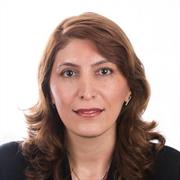
Professor Nicky Eshtiaghi
Details
 College: School of Engineering
 Department: School of Engineering
 Campus: City Campus Australia
 nicky.eshtiaghi@rmit.edu.au


Open to
- Masters Research or PhD student supervision
About
Prof. Nicky Eshtiaghi, PhD, CPEng, FIEAust, FHEA
Chemical Engineering, School of Engineering, RMIT University
Prof Eshtiaghi is an Engineers Australia (EA) Chartered Engineer and Fellow and a Fellow of the Higher Education Academy (FHEA, UK). Conferral of EA Fellow and Chartered Engineer status recognises the integrity, competence, leadership, and sustainability of her practice. Her FHEA fellowship and IChemE Morton Medal (UK) is an international recognition of her teaching excellence. IChemE medal is to recognise the work of outstanding educators and 'game changers' in chemical engineering education. Nicky has not only received multiple international awards in research and teaching, but also actively contributes to professional societies and women’s networks. She is Past President of the Australian Society of Rheology and past Chair of the Victorian Chemical Engineering Committee (EA-IChemE), inaugural chair of RMIT Women Researchers Network and streeting committee member of WATTLE enabling women career progression. She also provides mentorship to young researchers and students through her You-Tube Channel called ”Innovaticalls”.
With a consultative, evidence-based approach, a key feature of Nicky’s leadership over the past decades has been her focus on bringing together multiple partners from industries, governments, and the university sector, to set-up and deliver large research programs. Her research focuses on rheology of complex industrial fluids, particularly wastewater sludge, delivering industry-driven solutions for process optimisation and energy efficiency. She leads large collaborative programs with industry and government partners. As of May 2026, Prof. Eshtiaghi Secured one patent and published a total of 102 journal papers (% 95 at Q1 rank journal) with >50% as a corresponding author. Google scholar h-index of 35 (i10-index of 76) with a total citation of 5150 since start of publication in 2009. Her work is cited in >1000 documents published worldwide, including in China, Australia, the USA, the UK, Japan, France, India, Germany, Spain, and Italy. She also published 92 peer-reviewed conference papers and delivered13 industry consultation reports. She received 25 invited talks including Plenary, keynotes and lectures. Prof. Eshtiaghi’s high-quality research addresses major global issues and therefore attracts substantial funding including 3 ARC Linkage (one as lead CI), ARC Training Centre for Transformation of Australia's Biosolids Resource, one RACE 2030 in addition to direct industry fund. She completed on time industry-funded projects with a value of >10 million across Australia. She mentored 4 postdocs funded by her grants & supervised 22 PhD students to completion, which they employed either by industry (eg. Hunter h2O, Golder, Weir Engineering, South East Water, Gipsland Warter) or universities (eg. University of Melbourne, Edith Cowan University). Currently She is supervising 8 PhD stduents (senior suprviso of six of them).
Prof Eshtiaghi made a significant contribution toward advancing knowledge in the sludge rheology field which will help build more resilient cities through more sustainable and efficient operation of wastewater treatment plants worldwide. She also developed a novel way to treat solid waste for producing environmentally sound value-added products. She developed a novel adsorbent from olive waste to remove micro plastics and dissolved contaminants simultaneously from water assisting circular economy while removing pollutants. An invention that rapidly removes hazardous microplastics (MPs) from water using magnets featured in more than 440 news items globally, reaching 150 million people with an equivalent ad value of more than $5 million. Highlights include ABC News Breakfast TV, The World Today radio program, ABC Melbourne Breakfast radio, Channel 7. She led construction of a pilot plant of sludge pumping system in Eastern Treatment Plant - Melbourne Water under ARC Linkage project in partnership with Melbourne Water and Water Corporation (Perth) which its data are being used in building hundreds of million-dollar new anaerobic digesters and its associated equipment in Melbourne Water. The project Won Australasia Research Excellence Award in 2025.
Prof. Eshtiaghi led a team that developed an innovative design toolkit for the design and optimisation of wastewater sludge pipelines, work that contributed to her recognition as one of Australia’s 2020 Most Innovative Engineers.
List of Honours and awards:
2025 - IChemE Australasia Research Project Excellence Award for Innovative Design Toolkit: Transforming High-Solids Sludge Transport for Enhanced Efficiency and Reliability
2023 - Media Stars, STEM Top Perfomer
2021 - STEM Research Team Award: WETT Research Centre
2021 - IChemE Morton Medal, UK
2020 - Australia's Most Innovative Engineer, Engineers Australia
2019 - RMIT Research Excellence Award- Enterprise
2018 - Fellow of Higher Education Academy (UK), The HEA Fellowship provides international recognition of experience and expertise in teaching.
2017 - Citation for outstanding contribution to students learning - Australian Awards for University Teaching (AAUT)
2017 - Caltex Teaching Award, Engineers Australia Awards of Excellence in outstanding achievements in teaching chemical engineers
2017 - Future Women’s Leaders Conference Awards 2015 - Victorian Professional Engineer of the Year
2015 - IChemE Journals Best Reviewer Awards
2015 - RMIT Health, Safety and Well-being awards for the best solution to a health and safety risk (Team Award)
2014 - RMIT University Teaching Excellence Award – Early Career Academic, Higher Education
2014 - ThyssenKrupp Industrial Solutions medal of excellence in Chemical Engineering
2014 - The Ian Potter Foundation Travel Award
2013 - RMIT University Research Excellence (Team Award for Water, Effective Technologies and Tools (WETT) team)
2013 - The Research Media Star of the Year award (Team award for liquid metal marbles team)
2013 - Shortlisted for L’Oréal Australia and New Zealand Woman Fellowship in Science (34 applicants shortlisted out of 230 applications)
2010 - RMIT Emerging Researcher Industry Award
2010 - Monash University Faculty of Engineering Distinguished Early Career Alumni of the Year award
1997 - Awarded Amirkabir University of Technology Distinguished Alumni of the Year, Iran
1996 - Awarded Behran Oil Co.the best apprentice of the Year, Iran

Media

Non-academic positions
- Senior Process Engineer,
- Petrochemical Industry
- Iran
- 2003 – 2006
- Technology Development Researcher
- Electricity and Power Technology Centre
- Iran
- 2000 – 2003

Supervisor projects
- Photocatalytic Precision Depolymerization of Polyolefin Waste to High-Value Chemicals: Carbon Skeleton Retention and Selectivity Control
- 15 Sep 2026
- Zero-Pollution Electrochemical Conversion of Wastewater Microplastics into Reusable Chemical Resources
- 19 Aug 2026
- Primary Sludge Pumping
- 1 Jul 2026
- Investigation on the migration of microplastics from packaging to solid foods and the development of sustainable mitigation strategies through advanced filtration and traceability frameworks
- 9 Jun 2026
- Study of Layered Double Hydroxide-based Composites for Water Treatment Applications
- 29 Apr 2026
- Microplastics in FOGO – Influence of Pretreatment and Fate in Composting and Anaerobic Digestion
- 21 Apr 2026
- Dark fermentation of various organic wastes for simultaneous generation of bio hydrogen and value added products
- 29 Sep 2025
- Electrobiomethanation of organic waste for resource recovery and circular economy
- 14 Mar 2025
- LCA of Metal Recovery Process from Lithium ion battery waste
- 11 Mar 2025
- Synthesis of Carbon Nanofibers from Biopolymer Blends and its Applications
- 11 Sep 2024
- Impact of Non-Degradable Organic Matter (Ndo) on Sludge Rheology and Dewaterability
- 14 Dec 2023
- Phyto-synthesized activated carbon as electrode materials for supercapacitors application
- 14 Aug 2023
- Studies on the Enhancement of Organic Waste Valorization for Circular Economy
- 8 Aug 2023
- Feasibility analysis biogas and other products production by anaerobic digestion
- 20 Feb 2023
- Turbulent Pipe Flow of Non-Newtonian Fluids
- 1 Jan 2022
- Enhancing Chicken Litter Anaerobic Digestion Through Co-digestion Optimisation and Integrated Downstream Effluent Management
- 7 Oct 2021
- Investigation of Spontaneous Fires at Municipal Solid Waste Landfill for Development of an Integrated Fire Prevention Mechanism
- 31 Aug 2021
- Optimization of Greenfuel (Biohythane) Production through Co-digestion of Rice Straw, Potato Peel and Iron as an Additive using Anaerobic Digestion
- 30 Aug 2021
- Experimental Investigation of an Efficient Pipeline Transport of Highly Concentrated Wastewater Sludge
- 17 Mar 2021
- Waste Derived Functional Materials for Removal of Pollutants and Hydrogen Production
- 13 Sep 2019
- Pipeline Transportation of Sanitised Sewage Sludge
- 25 Sep 2018
- Shear and Solid-liquid Separation Behaviour of Lagoon Anaerobic Digested Sludge and Scum
- 1 Mar 2018
- Valorization of Organic Wastes by Anaerobic Digestion for the Generation of Value-Added Products
- 30 Dec 2016
- The Role of Rheological Properties of Sludge in Anaerobic Digestion Process: Biogas Production and Dewaterability
- 8 Aug 2016
- Rheological behaviour of aerated sludge.
- 31 Mar 2015
- Rheological Characterisation of Thermally Hydrolysed Waste Activated Sludge
- 4 Mar 2013

Teaching interests
Courses taught in BH079 - Bachelor of Engineering (Chemical Engineering) are:
Heat and Mass Transfer, Capston Design Project, Capston Research Project, Process System Design, Process Ststem Integration, Process Control, Advanced Process Control, Sustainable Engineering
Sludge Rheology

Research interests
Area of research: Sludge Rheology,Suspension Rheology, multiohase flow, Sludge management/ treatment, Anaerobic digestion, Hydrothermal treatment, Hydrothermal carbonization, converting biomass to added value product (Circular economy), Dewatering/Solid Liquid Sepration, Li battery Recycling, Granulation
She has research projects and interest in the following areas:
- Measurement and application of Sludge Rheology, Suspension Rheology, and Shear Rheology in Engineering Hydrodynamics especially during pumping and mixing of sludge.
- Multiphase flow and non-Newtonian Fluid Mechanics including particle settling or bubble propagation in non-Newtonian fluid
- High Solid, Sludge/Slurry pipeline transport, pump management
- Engineering particle to achieve end users desired properties through granulation process
- Utilizing biomass for producing added value products such as biogas, hydrogen and hydrochar
- Li Batter recycling
- Process and material development for removing emerging polutants such as microplastics, PFAS, Pecticides, Pharmacuticals, heavey metals, dyes.




