Blog author: Toni Jones – Lead, Education Gen AI, GAILE
GeneratED presenter: Mark Brown – Senior Learning Designer, CoBL
After attending Mark Browns’ Integrated Intelligence: A Blueprint for Scaffolding AI Competencies into Courses at GeneratED, there's a more compelling alternative: designing curriculum that doesn't just tolerate AI but actively builds graduates who are ready to work with it.
At RMIT, this shift also presents a chance to make our Signature Pedagogy explicit. When AI is integrated through real tasks, industry-aligned tools, and deliberate reflection, it strengthens rather than distracts from the Active, Applied and Authentic (AAA) learning RMIT is known for. Designing for an AI-capable graduate and designing for experiential, practice-facing learning aren't competing priorities; they're the same project.
Students already believe AI is essential for their future careers. Yet they also report feeling underprepared, under-supported, and unsure how to use it responsibly. Meanwhile, research warns us that AI can create "false mastery", short-circuiting the cognitive effort required for deep learning (OECD, 2026).
So it’s time to start asking, “How do we integrate AI in ways that build capability, not dependency?” rather than just “Should we integrate AI?”
This presentation offered a practical, step-by-step scaffold that any educator can adopt, regardless of discipline. Here's what it means for how we design our courses.
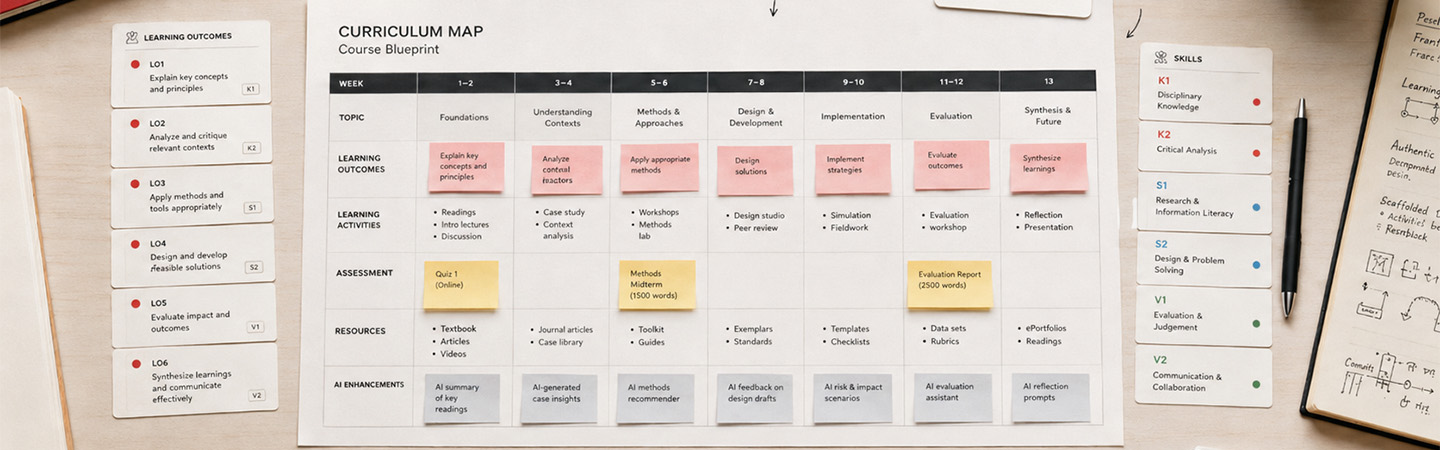
If AI is going to be meaningfully embedded, it must be visible in the CLOs. As Mark put it: "It all starts with the outcomes… The Course Learning Outcomes will need an addition or update to include the new AI elements."
Students can't develop AI capability if it's not formally recognised as a learning expectation. Updating CLOs signals that AI literacy is not optional, but it’s core to professional practice.
Some examples of CLOs that target different dimensions of human skills: critical evaluation, purposeful application, and ethical reflection.
Assessment is where AI integration succeeds or fails. The goal is not to "AI-proof" tasks, but to design assessments that require human judgement, reflection, and discipline-specific reasoning.
The 4P's Framework introduced by Fawns, Boud and Dawson (2026) offers a useful lens for thinking about the types of evidence of learning students will demonstrate in an assessment:
One of the most practical ideas from the session: different parts of an assessment can carry different AI permissions. For example:
Knowing and communicating the role AI should play within the learning is one of the most important professional skills they’ll need and moves the conversation away from policing.
Students learn better when what they're producing resembles what their industry produces. So, when you're designing AI-integrated tasks, ask: what does AI-assisted work authentically look like in this field?
The artefact should feel like something they’d encounter on the job, not something invented to make marking easier. This is one of the key takeaways from Mark’s session: AI integration builds capability rather than shallow dependence.
This is where the GAILE GenAI Skills Continuum plays a role. The task is to map three things: where students currently sit on the skill spectrum (introducing, refining or mastering), what skills are required to complete the task, and what skills the industry is demanding (job ads are now shockingly explicit about this).
If students lack foundational AI skills, they can default to over relying on AI – the “false mastery” risk flagged earlier. It is critical to consider which AI skills students already have and which may need scaffolding, so they can use AI as you intend.
Critical AI skills worth scaffolding include refining prompts, validating AI outputs against credible sources, converting outputs into different formats, applying AI in discipline-specific contexts, and ethical reasoning and bias detection.
Don’t assume students already know how to use AI responsibly and effectively.
This was the moment in the session that landed hardest, and it's worth quoting directly:
"The thing you do is the thing you learn."
Here's what that means in practice. If your task is "Prompt AI to generate examples of good design," students learn what AI thinks good design is. They don't learn how to design.
But if the task is "Generate an AI summary, extract the factual claims, and verify them against credible sources," students learn critical evaluation, a skill that transfers across every context they'll ever work in.
The cognitive action matters. Before you finalise any AI-integrated activity, ask: what is the student actually doing here, and is that the thing I want them to learn?
Tool choice should be intentional, not convenient.
Criteria to consider:
Different tools serve different purposes: VAL for visual and branding artefacts, Adobe Firefly for creative production, Perplexity for research validation, Runway for video generation, Claude for long-form reasoning. Students need exposure to the tools they'll actually encounter in industry, not just the ones we personally prefer.
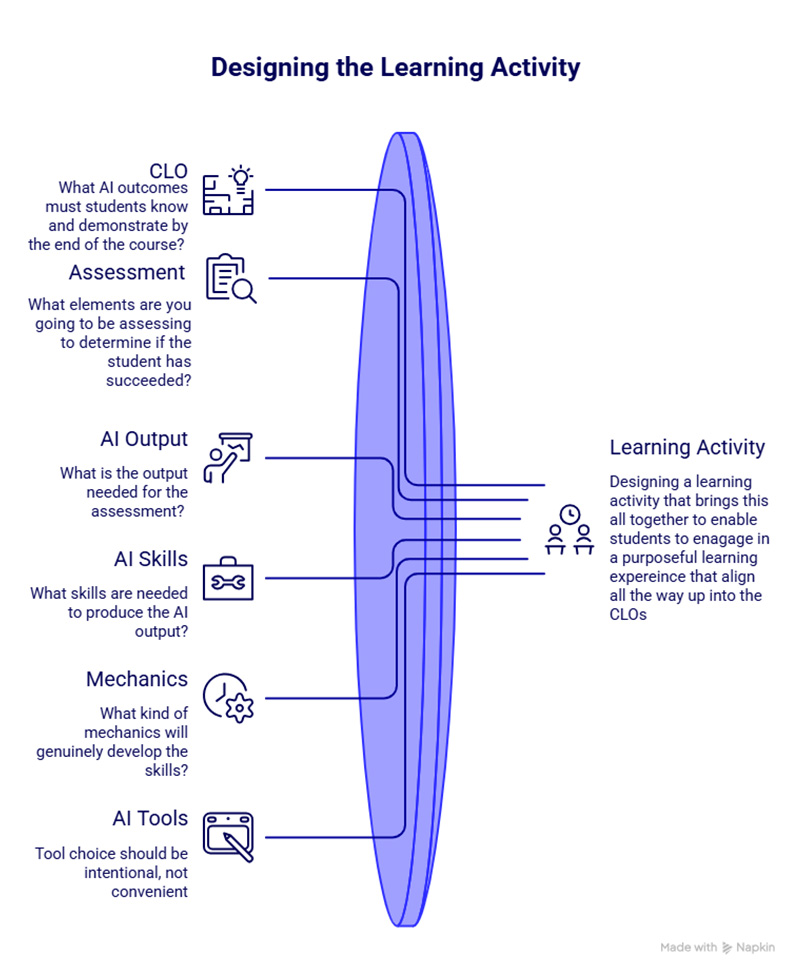
The learning activity is where it all comes together and it's the most critical step in the process, because a well-designed activity is what actually bridges the gap between a CLO on paper and a student who can genuinely demonstrate that capability.
Image description: A diagram titled "Designing the Learning Activity" illustrating a seven-step scaffolded process for AI-integrated course design. Six components feed sequentially into a central Learning Activity, represented visually as a layered oval shape with each element nesting inside the next.
When designing, ask: How complex is the task? What prerequisite skills are needed? How much time will students need, and will they need feedback before submitting? Where does this fit in the weekly content flow - is it building on something, or preparing students for what comes next?
For RMIT educators, this is also where our Signature Pedagogy comes to life. The Active, Applied and Authentic (AAA) framework isn't a separate consideration but the design lens. An AI-integrated activity that is Active gets students doing something cognitively demanding, not just prompting and accepting. One that is Applied connects AI use to real disciplinary practice and industry-relevant tools. One that is Authentic places that practice in a context that mirrors the challenges students will face beyond graduation. When all three are present, AI stops being a novelty and becomes a legitimate part of how students learn to work.
A worked example from the session illustrates this well: "Generate a brand activism website with AI, then edit, update, and customise the theme and imagery." The student isn't just using AI; they're making judgments, solving problems, and producing something that resembles real professional work. That's AAA in action.
The broader principle holds across all disciplines: AI should be embedded in authentic learning contexts, not quarantined in "AI weeks" that treat it as a topic separate from the course's real work. When AI is woven into the fabric of how students learn their discipline, capability follows.
Don't skip the unpacking with students!
Most educators design a good AI activity and then stop. The unpacking and the structured reflection that follow are where the real learning about responsible AI use happens, and they're the steps most likely to get cut when time is short. As Mark put it simply: "Now that they have done 'the thing' – what does it mean, and what could be the flow-on effects?"
After students have completed the task, push them into questions that don't have easy answers:
Reflection is where students develop the monitoring and adaptation skills that research identifies as the real foundation of responsible AI use. It's not a bonus. It's the point.
The biggest takeaway from the presentation wasn't a tool or a technique. It was this: AI integration is only successful when it increases student agency, not replaces it.
Student agency doesn't happen by accident. It's designed in through outcomes, assessments, and activities that put students in control of how and why they use AI. That's the work in front of us.
Ready to put this into practice? Mark Brown’s full scaffolded process is available as a one-page resource (PDF 3.2 MB), with everything you need to get started in one place.
Fawns, T., Boud, D., & Dawson, P. (2026). Identifying what our students have learned: a framework for practical assessment validation. Assessment & Evaluation in Higher Education, 1–17. https://doi.org/10.1080/02602938.2026.2620053
OECD. (2026). OECD digital education outlook 2026: Exploring effective uses of generative AI in education. OECD Publishing. https://doi.org/10.1787/062a7394-en

RMIT University acknowledges the people of the Woi wurrung and Boon wurrung language groups of the eastern Kulin Nation on whose unceded lands we conduct the business of the University. RMIT University respectfully acknowledges their Ancestors and Elders, past and present. RMIT also acknowledges the Traditional Custodians and their Ancestors of the lands and waters across Australia where we conduct our business - Artwork 'Sentient' by Hollie Johnson, Gunaikurnai and Monero Ngarigo.
Learn more about our commitment to Indigenous cultures