RMIT is dedicated to identifying and removing barriers to women's inclusion and progression, with a strong focus on achieving pay equity.
Our Employee Lifecycle Policy, Inclusion Diversity and Equity Policy and various Action Plans outline commitments to ensuring equitable pay and opportunities.
We understand that our success relies on attracting and retaining top talent, empowering all students and staff to thrive, which benefits the entire community.
RMIT values diversity and is committed to eliminating gender stereotypes, roles, and prejudices. We recognise that gender inequality can be compounded by other forms of disadvantage, such as race, ethnicity, disability, and sexual orientation, as noted in Section 6(8) of the Victorian Gender Equality Act 2020.
By addressing gendered expectations that create inequalities, we enhance the learning and workplace experience for everyone.

2022-2025 Gender Equality Action Plan (staff)
Our plan has been developed to provide a framework for identifying and addressing the remaining barriers to inclusion and progression for women in employment at the University.
In adopting and implementing this Gender Equality Action Plan, RMIT demonstrates how it values the richness of diversity among its staff and recognises its responsibility to take University-wide transformative actions to enhance inclusion for all.

Student Gender Equity Action Plan 2023 – 2026
The Student Gender Equity Action Plan 2023-2026 (SGEAP) aims to address key issues facing students who are female-identifying and/or female-expressing. These issues relate to addressing gender-based violence, limited gender roles including leadership roles and gender segregation in fields of study such as women in STEMM. It also aims to address the gender pay discrimination which reveals that women receive lower rewards from investing in their tertiary education than men, especially those completing postgraduate study.
The SGEAP aligns with aspirations of the RMIT's Inclusion, Diversity, Equity and Access (IDEA) Framework as well as RMIT’s long-standing commitment to addressing gender-based violence.
RMIT's Response to Victorian Gender Equality Act 2020/2021
The Victorian Gender Equality Act 2020 is the first of its kind in Australia. The Act sets requirements for the Victorian public sector, local councils and universities, to take positive action towards workplace gender equality.
IImplementing the Act aligns with RMIT’s strategic goals, values and continued commitment to identifying and addressing the remaining barriers to gender diversity and women’s inclusion and progression.
Our 2022-2025 Gender Equality Action Plan outlines a range of objectives and targeted strategies that we will implement across the next four years, in response to the Act.
With this action plan, we demonstrate the continued commitment and importance RMIT places on equity and inclusion.
The main elements of the Gender Equality Act 2020 are:
- Workplace Gender Audit and Survey
- Gender Impact Assessments
- Reporting on the progress of Gender Equality Action Plans
Student gender equity
RMIT is committed to advancing gender equity
Through policy, strategy and institutional practice, RMIT ensures that students and staff are not limited by gender stereotypes, expectations or prejudice. This commitment is embedded across:
- Student Gender Equity Action Plan (2023-2026) with targeted initiatives to increase access, participation and success for women and gender diverse people, especially in areas they are underrepresented, through outreach programs, scholarships, admission adjustments, mentoring and industry engagement.
- Staff Gender Equality Action Plan which evidences RMIT’s pursuit of gender equality to date and outlines a structured approach to enable a more equitable workplace.
- Silver accreditation awarded by Athena Swan, the world's leading accreditation framework for advancing gender equity recognises the University’s sustained progress and measurable impact in advancing gender equity.
- Dedicated mentoring and activities through the Women in STEMM program to enable women and gender diverse people succeed in science, technology, engineering, mathematics and medicine (STEMM).
- A commitment and action plan to create a safe and respectful community, to prevent and respond to Gender Based Violence.
Gender equity impact and outcomes
Since 2023, the proportion of women commencing in higher education (HE) at RMIT has grown steadily, reaching 49% of all HE commencements in 2025.
Increases of women commencing across colleges from the 2023-2025 year are as follows:
| College of Design and Social Context (DSC) | 9.0% |
| College of STEM | 9.7% |
| College of Business and Law (CoBL) | 15.1% |
Commencement growth was strongest in the in the College of Vocational Education (CoVE). While CoVE recorded the smallest overall numbers of female commencements, with 507 students in 2023 increasing to 755 in 2025, this represents the strongest growth over this period.
| College of Vocational Education (CoVE) | 48.9% |
This general growth in commencement is also mirrored in overall student representation. Women’s participation increased across the University, with CoVE again recording particularly strong growth.
Between 2023 and 2025, female headcount at CoVE increased by 32.8%, from 1,105 students in 2023 to 1,467 students in 2025. This indicates that more women are not only commencing but also continuing their studies at RMIT.
The increase in female participation has been accompanied by strong academic outcomes. Women’s success rates, measured as EFTSL passed as a proportion of EFTSL attempted, have increased across all colleges, reaching a record high of 92.7% in 2025. This exceeded the equivalent success rate for men, which stood at 90.1% in the same year.
These trends are ultimately reflected in program completion outcomes. With the exception of 2024, RMIT has consistently recorded more female program completions than male completions. Together, these results demonstrate that RMIT is not only attracting more women into HE, but is also continuing to support their progression, success, and completion.
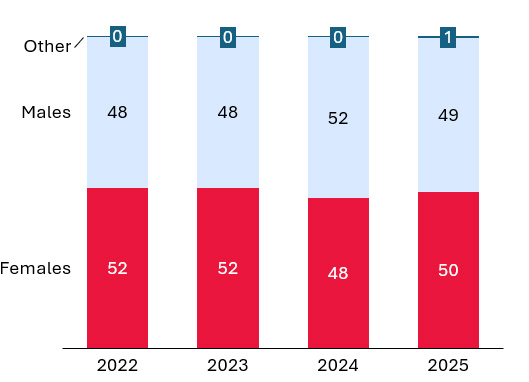 Figure showing program completions at RMIT (in %) according to gender from 2021 to 2025.
Gender equity through mentoring, scholarships and access
RMIT recognises that mentoring, scholarships and equitable access are key enablers of gender equity. Initiatives include:
-
A range of mentoring programs including one of the largest and most unique 1-to-1 career mentoring programs in Australia, as well as the Women in STEMM Ambassador program, the Women in STEMM Role Model initiatives and the bespoke STEM mentoring for Women and Gender Diverse Students in Engineering and IT.
-
Scholarships and grants awarded to students who identify as women, with the number increasing year on year, with 1,583, or 59% of scholarships, valued at $4,807,425 awarded to women in 2025.
-
Outreach, inclusive education and equity access schemes that are successfully increasing access to programs of study where women are underrepresented, and secondary school outreach initiatives that targets and supports the growth and leadership skills in future STEM leaders.
Student gender equity outcomes
RMIT strategies and policies to advance gender equity are continuing to achieve the desired outcomes as female students close the gap in access, and outcomes. RMIT tracks commencement, participation, attrition and successful completion by gender (and a range of other priority equity groups) and the most recent indicates that there are not large discrepancies at an institutional level between male and female students. However, the headcount of male and female students at a college level indicates more work is still required to address gender segregation.
RMIT tracks women's likelihood of graduating compared to men's and has in place schemes to close the gap. RMIT reports on these matters to its Academic Board, its key governance body overseeing student matters. In the most recent report:
- Higher education students listing their gender as ‘female’, including those in ‘non-traditional areas’ for women, continue to record outcomes and evaluations mostly consistent with or better than the HE domestic student population overall. Women in these non-traditional disciplines have higher service availability and helpfulness ratings than men, as well as significantly higher scores for Student Progress, Good Teaching, and Overall Satisfaction. Women also have higher scores for ‘graduates in employment’ than men in those non-traditional areas and disciplines.
- Vocational education students who selected ‘female’ as their gender also had a higher ‘module load completion rate’ than those who selected ‘male’. They also recorded higher scores for ‘good teaching’ and ‘overall satisfaction’. However their employment rates were around 3 percentage points lower than men’s.
Workplace Gender Equality Agency Compliance Report
In accordance with the requirements of the Workplace Gender Equality Act 2012, RMIT lodges its annual public report with the Workplace Gender Equality Agency (WGEA) yearly in May.
As an RMIT staff member, you may make comments on the report by contacting the Inclusion, Diversity, Equity and Access Team at diversity.inclusion@rmit.edu.au or by submitting a comment to WGEA. Please refer to the WGEA guidelines on this process on their website.
- Download Employer statement - WGEA Pay Gap Publication 2025 (PDF 65.7 KB)
- Download RMIT WGEA Report 2025-2026 (PDF 885KB)
- Download RMIT Training WGEA Report 2025-2026 (PDF 924KB)
- Download RMIT Online WGEA Report 2025-2026 (PDF 926B)
- Download Certificate of Compliance with the Workplace Gender Equality Act 2012 (PDF 262 KB)
- Download RMIT EOCGE Certificate (PDF 89.2 KB)
Athena Swan Gender Equality in STEMM
RMIT‘s efforts to improve gender equity have been acknowledged with an Athena Swan Bronze award, part of the Science in Australia Gender Equity (SAGE) initiative. This program promotes women’s career development in STEMM and provides support to encourage staff success.
RMIT has joined the Science in Australia Gender Equity (SAGE) Athena Swan Pilot to improve gender equity and diversity in the Science, Technology, Engineering, Mathematics and Medicine (STEMM) disciplines.
- For membership information including login details please contact People Connect (people.connect@rmit.edu.au)
- SAGE Athena Swan
- Women in STEMM Gallery

Celebrating Women in STEMM
The College of Science Engineering and Health - Celebrating RMIT's women in STEMM.
Flexibility, Carer and Parenting Toolkits
RMIT has a responsibility to ensure their people have the opportunity to take care of their life just as they take care of work.
To support this, RMIT will increase the promotion of flexible work practices that supports all people with parental, caring and other responsibilities to manage their work life balance.
Women Researchers Network (WRN)
RMIT’s Women Researchers Network (WRN)
-
The Women Researchers’ Network (WRN) was established in 2013 to enable RMIT female academic staff and research fellows at all career stages to connect with each other, share opportunities, access resources and participate fully in positive, active professional development.
What is Safer Community?
At RMIT, we are committed to providing a respectful and safe place to study and work through our policies, provisions and developmental programs for staff and students. Safer Community is RMIT's dedicated service for students and staff to report unwanted or threatening behaviour.
This includes sexual harassment, assault, and family violence, as well as other concerning or inappropriate behaviours.
If you are feeling unsafe or unsure what to do about threatening or unwanted behaviour, you can talk to us about your concerns and options – even if the behaviour happened off campus.
Days of significance
- International Day of Girls and Women In Science - 11 February
- International Women's Day - 8 March
- Equal Pay Day - Aug/Sept
- International Day of the Elimination of Violence Against Women - 25 November

Employer of Choice for Gender Equality
RMIT is proud to be an Employer of Choice for Gender Equality, recognised by the Workplace Gender Equality Agency. As an Employer of Choice for Gender Equality with the Workplace Gender Equality Agency, RMIT has made the latest application for this citation available publicly.
Download 2019-2020 application (PDF 3.4 MB)
Download 2021-2023 application (PDF 7.2 MB)
Download 2023-2025 application (PDF 837 KB)
For feedback or questions regarding this submission, please contact diversity.inclusion@rmit.edu.au