
Goal 2 - Zero Hunger

RMIT contributes to goal of ending world hunger through research, education, and institutional programs that strengthen food security and reduce waste across food systems.

The University leads applied research in food technology, sustainable supply chains, and circular food economies, partnering with industry and government to build more efficient and equitable food systems. On campus, RMIT supports food access for staff and students through cost-of-living and food relief initiatives. Through innovation, collaboration, and community engagement, RMIT is driving practical solutions that reduce food waste, improve food resilience, and promote fair access to nutritious food.

Highlights of recent SDG 2 aligned activity are included below, with more information available in our 2024 Sustainability Annual Report (PDF 23 MB), with our 10 years of reporting progress outlined on the Sustainability Annual Report webpage.

Broader sustainability contributions are also highlighted in our organisational Annual Report, which are tabled in the Victorian Parliament.

2024 Case Studies

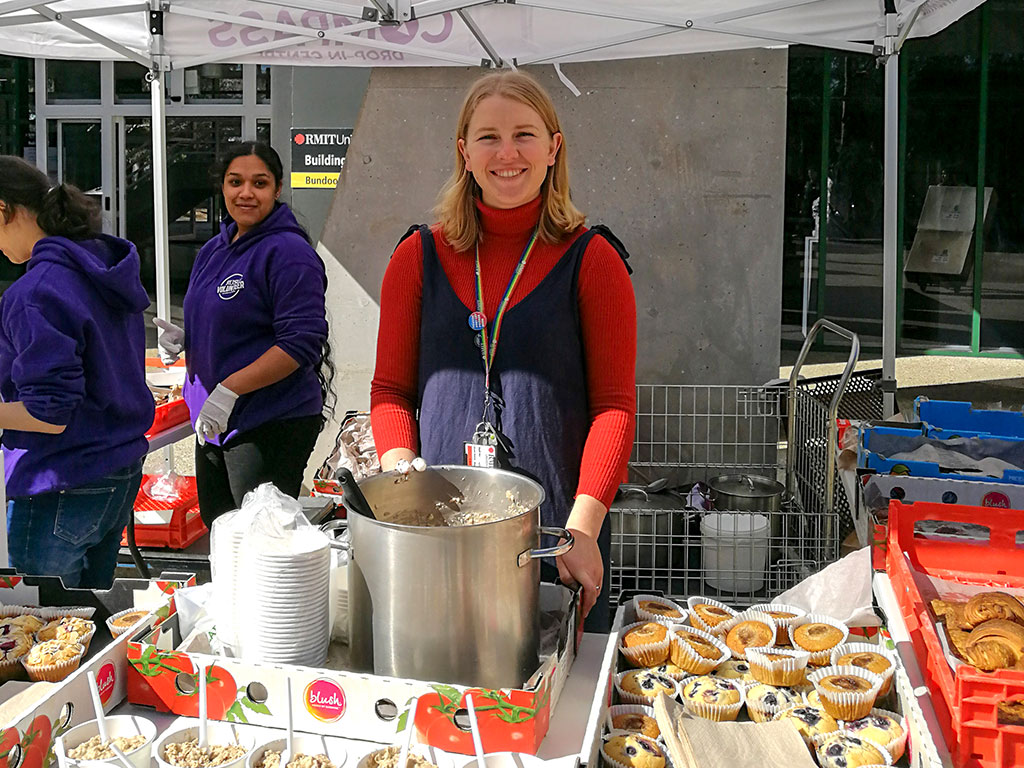
For many students on low incomes, eating regular, healthy meals can be challenging due to the cost of living and general life pressures. In recognition of the need for food security amongst the student population, and to promote healthy food choices, the RMIT University Student Union (RUSU) provides free healthy breakfasts and lunches to students every week. 

RUSU’s food access program also includes providing students with fresh fruit and vegetables at pop up events, pantry staples through our Compass Cupboards and healthy student snacks through our Welfare on Wheels trolley, operating at RMIT libraries throughout the peak study period. RUSU Compass also runs a yearly Marketplace distributing free grocery and fresh produce bags and collaborates with the Just Food Collective to fight food waste and provide free lunch and grocery packs to students. 

A total of over 87,000 free meals were served to RUSU students across RUSU led events in 2024 including:

  • 34,140 free breakfasts, served across 7 locations
  • 52,800 free lunches, served across 6 campuses 
  • 2,295 students accessed the free grocery packs through the Compass Cupboard
  • 7,040 serves of fresh fruit and 460 fresh fruit and vegetables boxes were distributed
  • 1,170 grocery meals kits distributed through Compass Marketplace
  • 7,200+ students were reached and provided with snacks through Welfare on Wheels across 24 events

An RMIT University study for End Food Waste Australia is helping small and medium-sized cafés reduce food waste and strengthen financial resilience, directly advancing SDG 2: Zero Hunger. 

Led by Professor Tania Lewis, the research identified practical strategies such as shorter, seasonal menus, better supplier relationships, and improved stock control to cut unnecessary food production and spoilage. 

By demonstrating how cafés can use more of their ingredients, repurpose excess food, and normalise practices like doggy bags, the project supports both environmental sustainability and food security. It also highlights how waste reduction contributes to cost savings and greater business viability across Australia’s extensive café industry, which accounts for over 16% of national food waste. 

Through this work, RMIT is helping build a more sustainable, efficient, and equitable food system that values resources, reduces hunger, and enhances resilience within the hospitality sector.

In 2024, RMIT partnered with the SDG 2 Advocacy Hub’s ‘Chefs’ Manifesto’ to launch Australia’s first SDG 2 Action Hub, hosted at the Oxford Scholar in Melbourne. 

The event, co-led by Professor Tania Lewis and Keren Allen, focused on ‘Upcycling food for a zero-waste future’ and brought together chefs, food experts, and researchers to explore circular economy solutions in the food system. 

Key speakers included Chef Chris Locke, Chef Laura Boulton, food critic Pat Nourse, and food systems researcher Savannah Supski. The Action Hub created a collaborative space for sharing ideas and scaling solutions aligned with Zero Hunger (SDG 2). As noted by Paul Newnham, CEO of the SDG2 Advocacy Hub, chefs are key players in transforming food systems through sustainable, low-waste practices. 

The event was captured in a short film by RMIT graduate Kevin Tud, now used to promote SDG 2 engagement across the national Chefs’ Manifesto network.

SDG Alignment Mapping Overview

As reported in the 2024 Sustainability Annual Report, there were 47 course units and 137 research projects aligned with SDG 2 in 2024, representing a wide range of initiatives related to addressing hunger.

Other research insights are captured in the data below.

  • Course Units (Total): 47
  • Research Projects (Total): 137
  • International Research Partnerships (Total): 31
  • Publications (Total): 54
  • Publications in Top 25% Journal Percentiles by SJR (%): RMIT - 72.9 vs. Global Average - 60.5
  • Citations per Publication: RMIT - 10.7 vs. Global Average - 1.7
  • Field-Weighted Citation Impact (FWCI): RMIT - 9.9 vs. Global Average - 1.2
  • National Publication Contribution (%): 1.8%
  • International Collaboration (%): RMIT - 61.1 vs. Global Average - 28.6
  • Developing Country Collaboration (%): 63%
  • Low to Lower-Middle Income Country Collaboration (%): 35%

Research Projects and Initiatives Over the Years

The following research projects have been specifically aligned to Sustainable Development Goal 2 and the aim to end hunger, achieve food security and improved nutrition and promote sustainable agriculture. These projects and initiatives are examples of the University’s contribution to the SDGs over the years.


aboriginal flag float-start torres strait flag float-start

Acknowledgement of Country

RMIT University acknowledges the people of the Woi wurrung and Boon wurrung language groups of the eastern Kulin Nation on whose unceded lands we conduct the business of the University. RMIT University respectfully acknowledges their Ancestors and Elders, past and present. RMIT also acknowledges the Traditional Custodians and their Ancestors of the lands and waters across Australia where we conduct our business - Artwork 'Sentient' by Hollie Johnson, Gunaikurnai and Monero Ngarigo.

More information