
Bioinformatics Network

The Bioinformatics Network supports RMIT researchers with the advancement of their bioinformatics, through fostering collaborations, providing training and the dissemination of cutting-edge research.

The Bioinformatics Network is a hub for advancing bioinformatics at RMIT through industry, national and international partnerships. Facilitating cross-disciplinary collaborations, connections, and knowledge sharing, we support students and staff to develop their skills across all areas of bioinformatics and computational biology. Through online training, interactive workshops and HDR courses we improve data literacy in all omics areas, including genomics, transcriptomics, proteomics and the microbiome.  

Network leads

Dr. Jennifer Boer

Dr. Jennifer Boer

Postdoctoral Research Fellow

  • Location Bundoora West Australia
  • Department Research & Innovation Capability
Dr Jennifer Boer is the Theme Leader for Immunity and Metabolism within the Accelerator for Translational Research and Clinical Trials (ATRACT) centre and a research fellow in the Cancer Aging and Vaccines Laboratory (CAVA). Jennifer’s translational research centres on leveraging high-dimensional transcriptomics and big data methodologies to elucidate the complex immunomodulatory effects of both conventional and nanoparticle-based vaccines across the critical domains of infectious diseases and oncology, with particular focus on age and sex differences. Her profound cross-disciplinary expertise spans biotechnology, immunology/vaccinology and advanced bioinformatics. She has been recognised with competitive research accolades, including a 10X Genomics single-cell RNA sequencing (scRNAseq) fellowship and several major supercomputer merit allocations, such as 2 consecutive awards of the RACE Merit Allocation Scheme and the NCI Adaptor Grant (with over ~250kSUs). Jennifer is the co-founder and co-leader of the RMIT Bioinformatics Platform and the founder and leader of the graduate course, Bioinformatics and Multi-omics Analysis. She serves as a Board Member on the RMIT Research Compute Governance (RCG) Committee, the Australian Society of Immunology (ASI) Systems Immunology Victorian/Tasmanian State Representative, and provides expert bioinformatics/biostatistics input to clinical, biotechnology, and platform infrastructure organizations
Dr. Alice Johnstone

Dr. Alice Johnstone

Senior Lecturer

  • Location City Campus Australia
  • Department School of Science
Miss Mikaela Barresi

Miss Mikaela Barresi

Research Fellow (Level A)

  • Location Bundoora West Australia
  • Department Health and Biomedical Sciences
I am a developmental neuroscientist specialising in the molecular and cellular basis of early brain development. I combine gyrencephalic animal models, patient-derived induced pluripotent stem cells, cerebral organoids, and bioinformatics to investigate how the cerebral cortex develops and how disruptions to that process shape long-term brain health.  As an award-winning science communicator and researcher, my work has been highlighted at numerous conferences, and I´ve contributed to key publications in the field. My technical expertise spans RNA sequencing, cell culture, and gene transfection, with a commitment to interdisciplinary collaboration and high-impact research. I’m committed to producing high-impact research that not only answers current questions but also paves the way for future discoveries.    
 Christian Krohn

Christian Krohn

Research Fellow (Advanced)

  • Location Bundoora West Australia
  • Department School of Science
Dr Christian Krohn a molecular ecologist and environmental biotechnologist working on anaerobic digestion, the biology that turns organic waste into renewable biogas. These living systems routinely run below potential, yet operators steer them by chemical proxies rather than the biology itself. Using long-read sequencing, meta-omics and machine learning, Christian extracts biological signals from the biomass to show how its ecology varies with season and loading rates. Capturing this variation can sharpen existing industry models and help recover more renewable biogas from waste. The aim is a ‘biomass-to-screen’ diagnostic capability that shifts the biogas sector from indirect chemical proxies toward biologically informed control.   Christian completed his PhD in Soil Science and Microbial Ecology at La Trobe University, where he investigated how soil microbial diversity mediates the breakdown of persistent organic pollutants. His work has produced 25 peer-reviewed publications (Google h-index 12) and attracted multiple institutional and national awards, including the Nancy Millis Medal and the C.G. Stephens Medal. He is an active science communicator, industry collaborator, and mentor, contributing to public engagement on the microbial foundations of a circular, low-emission bioeconomy.
 Ankita Rathore

Ankita Rathore

HDR Representative

    Ankita brings over 10 years of industry experience in bioinformatics, with a focus on analyzing large-scale multi-omics NGS datasets. 

    Membership and contacting the Bioinformatics Network

    Whether you're a wet-lab biologist, a computational scientist, an early-career researcher, or a student, the network offers opportunities to connect, collaborate, and advance your bioinformatics knowledge.

    Get involved by joining the Network and attending our upcoming events. For more information, contact bioinformatics@rmit.edu.au.
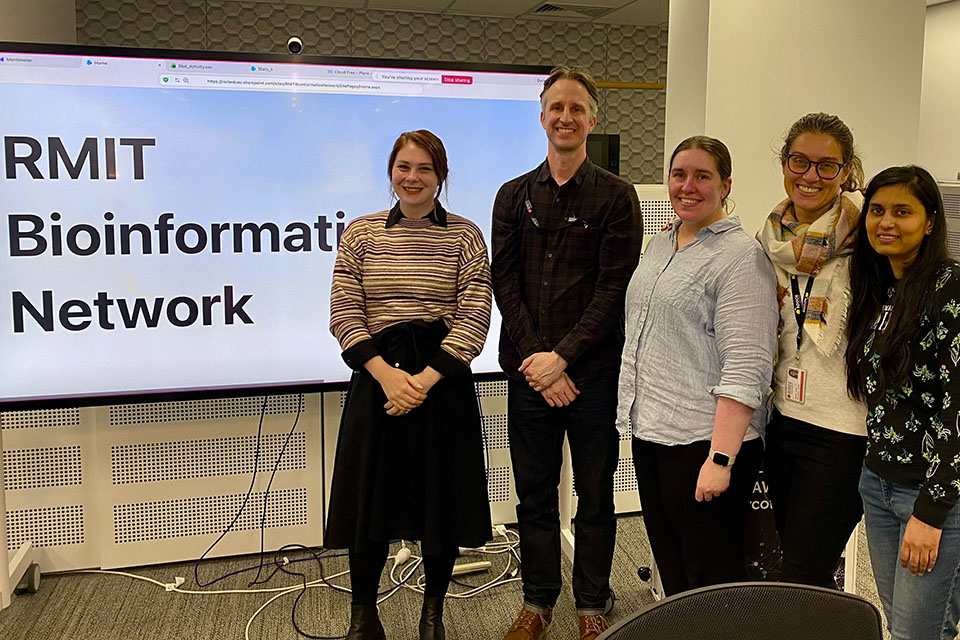
    Group shot of the Bioinformatics Network team.

    Upcoming events

    Australian Bioinformatics and Computational Biology Society (ABACBS) Annual Conference 2026

    RMIT University, Melbourne CBD campus from 16 to 20 November 2026

    Enabling Impact Platform (EIP) sponsorship

    people crossing the road with a network pattern overlayed

    Bioinformatics is supported by the following Enabling Impact Platforms:

    Biomedical Health and Innovation Brings together hundreds of, highly respected, cross-disciplinary experts who are passionately committed to addressing innovatively the rising health challenges in our society.
    Information in Society Helping society to understand, shape, and adapt to the disruptions caused by new data sources and information technologies.

    Explore RMIT Enabling Impact Platforms

    EIPs enable economic, environmental, societal, health and cultural impact with government, business and the community through research and innovation.


    aboriginal flag float-starttorres strait flag float-start

    Acknowledgement of Country

    RMIT University acknowledges the people of the Woi wurrung and Boon wurrung language groups of the eastern Kulin Nation on whose unceded lands we conduct the business of the University. RMIT University respectfully acknowledges their Ancestors and Elders, past and present. RMIT also acknowledges the Traditional Custodians and their Ancestors of the lands and waters across Australia where we conduct our business - Artwork 'Sentient' by Hollie Johnson, Gunaikurnai and Monero Ngarigo.

    Learn more about our commitment to Aboriginal and Torres Strait Islander peoples