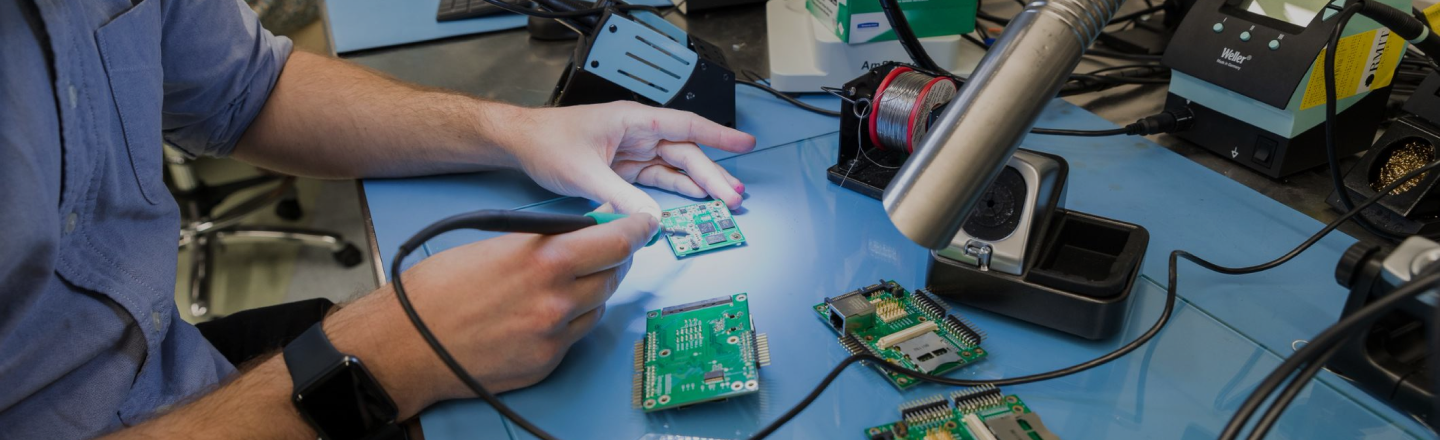
You’ll develop skills to design, validate, and evaluate electronics and communication equipment as well as systems.
You’ll also be able to manage risk, estimate and manage projects, and provide technical and sales advice.
Learn to use industry-standard software and develop skills in electronic design and programming.
An advisory committee, made up of leading industry representatives, ensures that this degree reflects current industry needs.
Develop specialised skills that will take your career across a range of industries.
You will learn skills in programmable gate array technologies, circuit simulation, printed circuit board design, digital and analogue systems and applications, amplifiers, analogue integrated circuit design, communication systems, mobile phones, global positioning systems (GPS), microwave links, embedded controllers, AM/FM, computer programming, engineering software and project management, and computational solutions.
RMIT offers a variety of learning and teaching approaches, including lectures, seminars, studios, workshops, presentations, group discussions and syndicate work.
Ongoing assessment throughout the semester includes examinations, essays, reports, oral classes, presentations, group projects, research projects, laboratory projects and practical assignments.
The types of classes you have will depend on the course you’re studying. Classes are offered in various formats designed to provide meaningful engagement with staff, industry and peers and provide for access and use of spaces where learning can be applied and active, including an array of specialised equipment.
Most RMIT courses do not include passive large-scale classes such as lectures, instead the content traditionally provided in lectures is made available online. This may be in the form of readings, videos or other on-demand learning materials. This content will also support the basis of interactive learning that takes place in on-campus classes.
The world is constantly changing, and there are universal skills that can help you adapt to the evolving nature of work and global engagement.
As part of your study experience at RMIT, we provide 6 future-focused RMIT Capabilities:
RMIT Capabilities are built into your course as well as some of our extracurricular experiences. They inform the design and delivery of your learning activities and assessments, so by the time you graduate, you’ll be ready to apply these capabilities in your life and work.
RMIT has a strong Industry Advisory Committee (IAC), which links this advanced diploma and industry and includes representatives from local computer systems industries.
The committee meets twice yearly and provides feedback on our qualifications to ensure that they reflect the changing needs of industry.
You’ll also be able to connect with industry representatives through participation in seminars, marketing events, industry awards and scholarships.
This course is competency-based and has been designed to help you develop the practical skills and knowledge necessary to work effectively in your chosen field. You will learn and be assessed by practising and demonstrating your capabilities, all of which can be readily applied in the workplace.
In addition to the specific vocational skills you build throughout this course, you will also develop a set of essential employability skills, including communication, planning, organising, and problem solving, self-management, initiative and teamwork. These foundational skills will enable you to navigate the world of work, collaborate effectively with others, and successfully get the job done.
This advanced diploma blends practical experience with electronics and communications applications built on a strong theoretical foundation.
You'll learn how to test, assemble, install,and maintain equipment and systems, manage risk, estimate and manage projects, and provide technical advice.
You'll gain skills in computer-aided drafting and electronic design, computer interfacing, microprocessor programming, design, commissioning electronics systems, computer programming, and perform simulations using various software packages.
The qualification is structured to deliver competencies, knowledge and skills required by the nationally-accredited Electrotechnology Training Package.
Areas of specialised study include:
Choose a plan below to find out more about the subjects you will study and the course structure.
International student visa holders can only study full-time.
As a graduate of this advanced diploma, your skills will be applicable to a wide range of business, manufacturing and operational occupations where electronics and communications underpin the business.
You may work in a range of industries and fields such as:
You need to satisfy all of the following academic (entry) requirements to be considered for entry into this course.
You must have:
There are no prerequisite subjects required for entry into this qualification.
A selection task is not required for entry into this qualification.
You need to satisfy all of the following requirements to be considered for entry into this course.
You must have successfully completed a qualification recognised by RMIT as equivalent to the Victorian Certificate of Education (VCE) with a minimum average of 50% (see calculator below).
Equivalent qualifications may also include completion of the RMIT Foundation Studies course or a recognised post secondary diploma in the relevant discipline with the required grades.
Meeting the minimum academic requirements does not guarantee entry. Your application will still need to be assessed and accepted.
If you don't meet the entry requirements, there may be other RMIT programs you are eligible for that can lead you to your preferred program. Explore pathways below to find out more.
There are no prerequisite subjects required for entry into this qualification.
A selection task is not required for entry into this qualification.
To study this program you will need to complete one of the following English proficiency tests:
Note: RMIT does not accept scores from 'at-home' or 'online' testing.
For detailed information on English language requirements and other proficiency tests recognised by RMIT, visit English language requirements and equivalency information.
Don't meet the English language test scores? Complete an English Language Pathways (Academic English) Upper Intermediate at RMIT University Pathways (RMIT UP).
A pathway is an alternative way to get into a course. RMIT's pathways can help you move through different levels of study to reach the qualification you're aiming for, even if you don't meet the requirements for your destination course.
This course has pathways available.
The Advanced Diploma of Electronics and Communications Engineering provides credit and guaranteed entry into further study.
You can gain entry to this advanced diploma from RMIT Foundation Studies or a range of vocational study courses.
When you successfully complete the Advanced Diploma of Electronic and Communications Engineering you are guaranteed entry in the Bachelor of Engineering (Electronic and Computer Systems Engineering) (Honours) and will receive three semesters of advanced standing (equivalent to 144 credit points).
Alternatively, you may be eligible for entry to other RMIT undergraduate study courses.
Credit, recognition of prior learning, professional experience and accreditation from a professional body can reduce the duration of your study by acknowledging your earlier, relevant experience.
Credit and exemptions will be assessed consistent with the principles of the RMIT Credit Policy.
Credit may reduce the duration of your study by acknowledging your earlier, relevant study experience.
When you are submitting an application, please indicate that you want to be considered for credit and provide detailed course syllabus (also known as course outline), outlining volume of learning, course content and weekly topics, learning objectives/outcomes, assessment types and their weightings, and reference to the learning resources such as prescribed textbooks and recommended readings.
The tuition fees you will pay depends on your eligibility for government subsidies.
Not sure which fee type applies to you? Learn more and check your eligibility.
Fees are adjusted on an annual basis and these fees should only be used as a guide.
You may be eligible for a fee concession if you hold a valid Commonwealth Health Care Card, Pensioner Card, or Veteran's Gold Card, or are enrolled in the Asylum Seeker VET program. Find out more about fee concessions.
| Item | Description | Cost (AUD) |
|---|---|---|
| Tuition fee student pays
The total tuition fee you will be charged for a full-fee place
|
The total tuition fee you will be charged for a full-fee place
|
$44,000.00 |
| Student services and amenities fee (SSAF)
Based on 2026 cap of $373 per calendar year
|
Based on 2026 cap of $373 per calendar year
|
$746.00 |
| Material fees
Total cost of material fees associated with this course |
Total cost of material fees associated with this course
|
N/A
|
| Estimated total cost to you
Includes all fees listed above |
$44,746.00 |
The tuition fees shown include the Victorian Government contribution. This amount is reflected in your fees and is paid directly to RMIT by the Government: $ per nominal hour ($ total).
| Item | Description | Cost (AUD) |
|---|---|---|
| Tuition fee student pays
Tuition fees after government subsidy
|
Tuition fees after government subsidy
|
$16,000.00 |
| Student services and amenities fee (SSAF)
Based on 2026 cap of $373 per calendar year
|
Based on 2026 cap of $373 per calendar year
|
$746.00 |
| Material fees
Total cost of material fees associated with this course |
Total cost of material fees associated with this course
|
N/A
|
| Estimated total cost to you
Includes all fees listed above |
$16,746.00 |
The tuition fees shown include the Victorian Government contribution. This amount is reflected in your fees and is paid directly to RMIT by the Government: $14.85 per nominal hour ($32,076.00 total).
| Item | Description | Cost (AUD) |
|---|---|---|
| Tuition fee student pays
Tuition fees exempt for eligible students in a government subsidised place
|
Tuition fees exempt for eligible students in a government subsidised place
|
$0.00 |
| Student services and amenities fee (SSAF)
Based on 2026 cap of $373 per calendar year
|
Based on 2026 cap of $373 per calendar year
|
$0.00 |
| Material fees
Total cost of material fees associated with this course |
Total cost of material fees associated with this course
|
N/A
|
| Estimated total cost to you
Includes all fees listed above |
$0.00 |
The tuition fees shown include the Victorian Government contribution. This amount is reflected in your fees and is paid directly to RMIT by the Government: $14.85 per nominal hour ($32,076.00 total).
Generated on 25 June 2026 | RMIT University's Registered Training Organisation (RTO) Code is 3046 | Payment and refund information
VET Student Loan cap for Advanced Diploma of Electronics and Communications Engineering (C6178): $19290
Any tuition fees above the cap must be paid upfront to RMIT by their due date. Caps are indexed annually by the Commonwealth Government. Eligibility applies.
Learn about eligibility for VSL|
$0
|
|||||
|
|||||
$ per nominal hour ($ total).
Choose the specific course plan to see relevant fee information:
VET Student Loan cap for (): $
Any tuition fees above the cap must be paid upfront to RMIT by their due date. Caps are indexed annually by the Commonwealth Government. Eligibility applies.
Learn about eligibility for VSLIn addition to tuition fees you also need to pay for:
You also need to account for your living expenses. Estimate the cost of living in Melbourne.
In addition to tuition fees, you will be charged an annual student services and amenities fee (SSAF), which is used to maintain and enhance services and amenities that improve your experience as an RMIT student.
Find out more details about how fees are calculated and the expected annual increase.
Find information on how to apply for a refund as a continuing international student.
RMIT awards more than 2000 scholarships every year to recognise academic achievement and assist students from a variety of backgrounds.
Use our Frequently Asked Questions to learn about the application process and its equity access schemes, find out how to accept or defer your offer or request a leave of absence, discover information about your fees, refunds and scholarships, and explore the various student support and advocacy services, as well as how to find out more about your preferred program, and more.

RMIT University acknowledges the people of the Woi wurrung and Boon wurrung language groups of the eastern Kulin Nation on whose unceded lands we conduct the business of the University. RMIT University respectfully acknowledges their Ancestors and Elders, past and present. RMIT also acknowledges the Traditional Custodians and their Ancestors of the lands and waters across Australia where we conduct our business - Artwork 'Sentient' by Hollie Johnson, Gunaikurnai and Monero Ngarigo.
Learn more about our commitment to Indigenous cultures