Today I'm going to introduce you to the Victorian Teaching and Learning Model 2.0 or more commonly referred to as the VTLM 2.0. This model has been developed by the Victorian Department of Education as an evidence-based framework to support highquality teaching and learning in all Victorian government schools. As RMIT pres-ervice teachers, understanding the BTLM 2.0 Zero will help you connect what you're learning at university with what you see and do on your professional experience placements and it will also help prepare you for future employment in Victorian schools.
The VTLM 2.0 is Victorian government's updated framework for how teaching and learning should be designed and enacted in government schools. It sets out both how students learn, the elements of learning, and the teaching practices that most effectively support that learning or the elements of teaching. At its core, BTLM 2.0 is an evidence-informed instructional model that places explicit teaching at the center of classroom practice. It is being progressively implemented from 2025 and is expected to be fully embedded across Victorian government schools by the start of 2028.
It's a framework that guides teacher practice and should form part of a balanced and considered pedagogical toolkit. You'll notice that many ideas within the VTLM 2.0 connect directly to what you're already studying here at RMIT. These include concepts like cognitive load, attention and motivation, explicit teaching, culturally responsive practice, and positive classroom management strategies. The first part and probably most important part of the VTLM model is the elements of learning. This is basically what do we know from research about how students learn. The VTLM 2.0 Z highlights four key areas. I'm going to walk you through each of these and try to link them to some ideas that you're already covering at university.
The research is clear. If we don't have levels of student attention, then we don't have very much learning going on. The first element, attention, focus, and regulation, speaks to this point. It includes ideas around gaining and maintaining attention. And so the importance of clear starts to lessons, routines, and strong cues from a teacher that signals to a student this is important. It speaks to active engagement that students are more likely to learn when they're doing something with the content that might be answering questions, discussing, practicing, or solving problems.
It speaks to the idea of supporting regulation. So this includes behavioral but also emotional and cognitive regulation. So things like predictable routines, scaffolds, and engagement strategies um help students manage and self-regulate their learning uh behaviors. On placement, you might ask yourself, what's the teacher doing to help these students focus? How are the classroom routines, transitions, and expectations supporting learning rather than distracting from it? The second element is knowledge and memory which connects directly to some past learning on cognitive load theory and some coursework learning around the information processing model.
Some key ideas underpin this second element including the idea that working memory is limited that students can hold and process a small amount of new information at once. It connects to the idea of long-term memory that learning is all about building and strengthening connections to what students already know. And that's important that we activate prior knowledge and then build on that to help students transfer information into their long-term memory. The third learning element is retention and recall. This is about understanding that learning sticks best when students revisit information over time.
You might see conversations or examples of strategies like retrieval practice, spaced practice, and regular reviews as being emphasized in the BTLM 2.0. When we think about retention, we're thinking about the need to manage students cognitive load. And this is where explicit well sequenced teaching and the careful use of examples and work solutions come in. Here we're reducing the unnecessary load on students so they can focus on key ideas and build from there. As pre-ervice teachers on placements, you'll want to notice how teachers are chunking information, checking for understanding, and perhaps using retrieval activities like low stakes quizzes, quick reviews, or exit tickets.
The final element is mastery and application. So, it's not just enough for students to be able to recall information. they need to be able to use it. The BTLM model emphasizes consistent practice and retrieval and the necessity of guided practice that leads to independence. So this is where we move from teacherled modeling to joint instruction then to independent application. It's based on the idea of that we need to demonstrate mastery through application. So this is where students apply what they've learned to new questions, problems, texts, contexts, and increasingly more complex tasks.
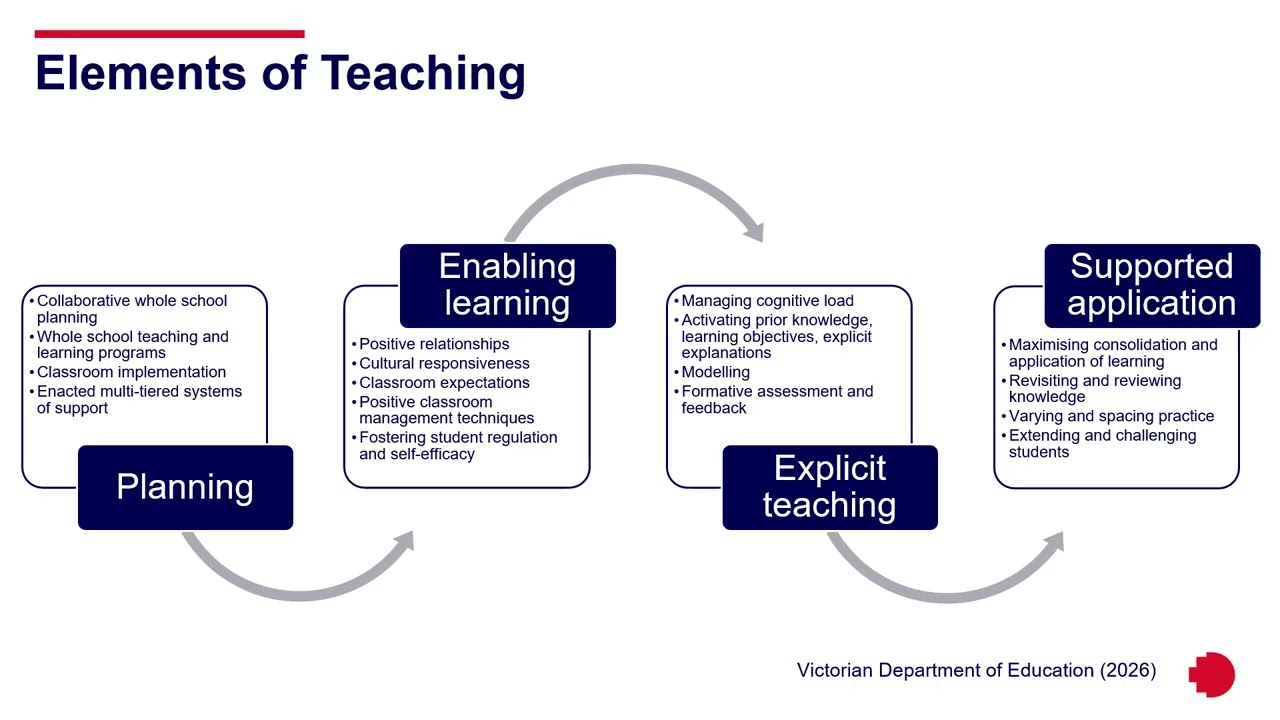
This is where you might see explicit teaching and more open-ended, richer tasks working together. First to build and secure knowledge, then to stretch and apply it. There are four elements of teaching which underpin the BTLM 2.0, zero and they lead on from the ideas of the elements of learning that we just discussed. The four elements of teaching include planning, enabling learning, explicit teaching and supported application. These four elements are designed to align teaching practice with the research that outlines how students learn best. Let's have a look at planning. Planning is about deciding what students need to learn, how learning will be sequenced and how we're going to assess their progress. Key ideas around this include the need to identify clear learning goals which are linked to the Victorian curriculum, considering students prior knowledge and misconceptions, how we're going to sequence content from simple to more complex, designing assessment opportunities that help check for understanding, and planning for responsive teaching and ongoing support.
The second element, enabling learning, focuses on creating the conditions that allow such good quality learning to occur. It's underpinned by key ideas including the need to establish predictable routines and expectations in a classroom, reducing distractions as to help manage cognitive load, creating safe, inclusive, and orderly learning environments, looking for opportunities to develop students self-regulation and self-efficacy, and looking to support engagement, attention, and active participation in every lesson. You might see in practice that a teacher is explicitly teaching classroom routines or using really clear transitions between activities to help build a culture where students feel comfortable in understanding the task, making mistakes, and asking questions.
The third teaching element is explicit teaching. It's probably the most emphasized element within the VTLM 2.0. Explicit teaching is about directly teaching new knowledge and skills rather than expecting students to discover them solely independently. The department highlights practices in this element such as the need to focus learning using explicit explanations and modeling practices using scaffolds and monitoring progress. You might also see that a teacher works on breaking content into manageable chunks, modeling using worked examples, checking for understanding regularly, and providing immediate forms of feedback and correction.
The final element includes supported application. And this is where students consolidate and deepen learning through practice and application. Key ideas associated with this final element include opportunities for guided and independent practice, the need for students to apply knowledge in different contexts, how teachers might gradually fade or reduce scaffolds, and the need for really valuable and constructive forms of feedback during practice. This final element is based on some evidence that students need multiple opportunities to use and retrieve knowledge before it becomes more durable and transferable. So the four elements are aiming to work together. It's intended to be a cyclical approach. A teacher plans the learning, establishes the conditions for success, explicitly teaches new content, and then supports students as they practice and apply their learning.
The teacher is engaged in ongoing monitoring and observing of student progress that will then inform the next cycle of planning and teaching. At the core of the BTLM 2.0 model is explicit teaching. We know that explicit teaching starts by activating students prior knowledge. So before launching into something new, the teacher deliberately helps students connect today's learning to what they already know. That might look like a quick re quick review question on the whiteboard, a short discussion, or asking students to recall yesterday's key ideas. Next, explicit teaching makes the purpose of a lesson really clear by setting out the learning goals. You'll often see this as learning intentions and success criteria in a classroom.
We follow this with a core emphasis on teaching content in manageable chunks. Because students working memory can be limited, the VTLM 2.0 encourages teachers to break complex content down into smaller logical steps and to follow a gradual release of responsibility model that uses the I do, we do, and you do approach. This helps link directly back to the ideas of supported application spoken previously. Finally, explicit teaching builds towards independent application. So after a teacher models, shares works and offers opportunities for guided practice, students are given opportunities to apply their new learning independently. This independence is crucial for mastery and application.
It's how students are going to demonstrate that the knowledge or skill has really been learned and can be used flexibly, not just copied. As a pres-ervice teacher, understanding the BTLM 2.0 Z is important for you in three key ways. First, it helps you connect theory to practice by giving you a very practical or visual way to see concepts from our coursework like working memory, retrieval practice, cultural responsiveness, and positive classroom management strategies are being used in a real life classroom. Second, it provides a common language that you can use with your own mentor teacher, other teachers in a school and school leaders in planning meetings, staff meetings, and professional learning communities.
Finally, understanding this model is valuable for your future employment. As you move into the workforce, you're likely to be asked about evidence-based practice, explicit teaching, and how you best support learning for all students. Being able to reference the VTLM 2.0 Zero shows how you understand the priorities of the system, but also how you're able to talk about your practice using researchinformed language. When you next go on placement, I encourage you to use the VTLM 2.0 to structure your observations and reflections at the whole school level.
Consider questions like what aspects of this model are already embedded in practice and what areas that you can see are still being developed? How does the school support teachers to implement the model consistently across classrooms? At the classroom level, you might want to consider reflective questions like, how did the teacher make the learning intentions and success criteria clear to all students? How is explicit teaching used to introduce new knowledge or skills? And how did the teacher support students to practice and apply their learning? You might also want to think a little bit more about how the teacher created conditions within the classroom that enabled learning for all students, including students with diverse learning needs and backgrounds.
If you'd like to explore the VTLM 2.0 and the research behind it in more depth, the Victorian Department of Education has published resources and professional learning materials on the ARC or ARC evidence to action site. The web page link is noted on the screen. Now, when you're on placement in Victorian government schools, your mentor teachers and perhaps school leaders might also refer you to internal departmental resources or professional learning modules that you can look at. To wrap up this short video, the VTLM 2.0 gives you an evidenceinformed map of how students learn and how teachers can best support that learning. It connects strongly to the theories and strategies that you're learning about at RMIT, especially around cognitive load, explicit teaching, and inclusive practices.
It provides you a really valuable shared language that you can use on placement and in future job applications and interviews. It offers a reflective lens that you can use to interpret what you see in classrooms and to refine your own teaching over time. The BTLM 2.0 Zero will form part of a broad and responsive pedagogical toolkit as you grow in strength as a teacher.