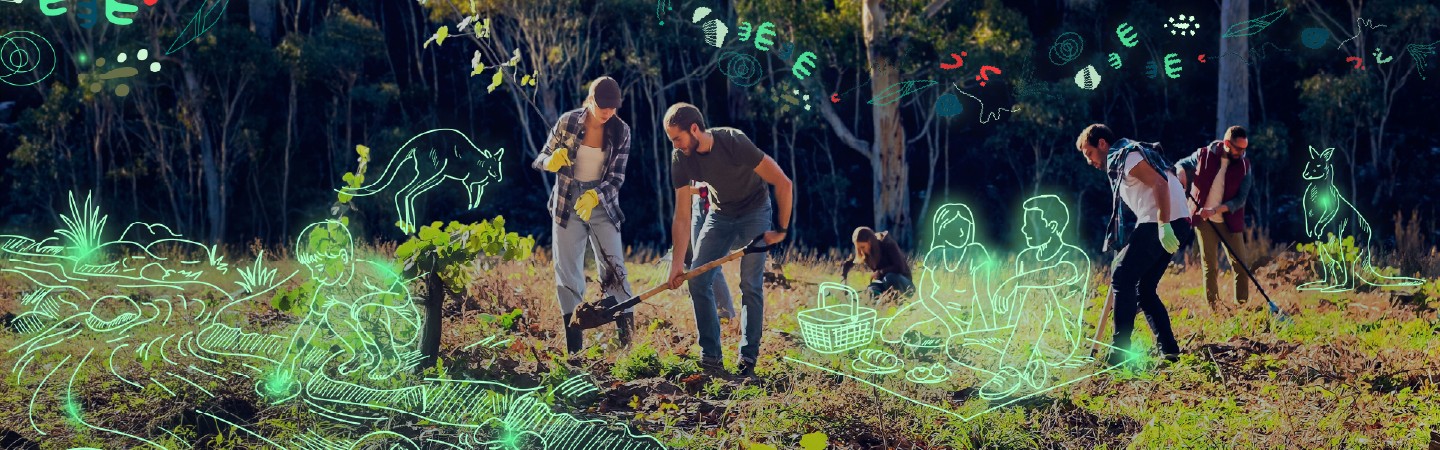
The Regenerative Futures Minor is designed for students who aspire to go beyond sustainability and actively contribute to solutions for the future. While sustainability often focuses on minimising harm, regeneration emphasises restoring, renewing, and enhancing ecological, social, and economic systems.
This minor is open to students from a range of undergraduate degrees and is accessible regardless of your background. This minor is open to all students, regardless of background or experience.
By choosing this minor, you will learn to think systemically, collaborate effectively, and lead regenerative projects across diverse fields such as design, business, IT, engineering, international studies, and the creative arts.
Work on live challenges with industry, government, and community partners to design solutions that restore and renew social, ecological, and economic systems.
Collaborate with peers from design, business, engineering, technology, and the humanities, acquiring the systems thinking and leadership skills that employers demand.
Develop expertise in climate literacy, circular economies, and regenerative design—skills that are in high demand globally, which will help you stand out in any career path.
The Regenerative Futures Minor is deliberately interdisciplinary, and industry and community partners are integrated into the learning process. This means you will collaborate with peers from other disciplines, hear directly from industry leaders, and apply your skills in real-world projects.
Instead of studying theory in isolation, you’ll learn to connect ideas and disciplines. For example, you could:
Students enrolled in the following undergraduate programs can register for the Regenerative Futures Minor in their second or third year:
Try adjusting them or reset all filters to see more options

 2027 Guaranteed ATAR 70.00, 2026 ATAR 67.00*
 February, July
 On campus
 Melbourne City
2027 Guaranteed ATAR 80.00, 2026 ATAR 75.20* February, July On campus Melbourne City
Melbourne City
2027 Guaranteed ATAR 80.00, 2026 ATAR 75.20* February, July On campus Melbourne City 2027 Guaranteed ATAR 80.00, 2026 ATAR 80.05* February, July On campus Melbourne City
 Range of criteria* February, July On campus Melbourne City
 ATAR 70.25* February, July On campus Melbourne City
ATAR 82.25* February On campus Melbourne City
ATAR 70.25* February, July On campus Melbourne City
ATAR 82.25* February On campus Melbourne City ATAR 70.20* February, July On campus Melbourne City
 Range of criteria* February, July On campus Melbourne City
 ATAR 80.30 February, July On campus Melbourne City
 Range of criteria February, July On campus Melbourne City
 ATAR 60.85 February, July On campus Melbourne City, Brunswick
 2027 Guaranteed ATAR 70.00, 2026 ATAR 70.15* February, July On campus Melbourne City
ATAR 83.35* February On campus Melbourne City
2027 Guaranteed ATAR 70.00, 2026 ATAR 70.15* February, July On campus Melbourne City
ATAR 83.35* February On campus Melbourne City ATAR 61.80* February, July On campus Melbourne City
 Range of criteria* February, July On campus Melbourne City
 2027 Guaranteed ATAR 70.00, 2026 ATAR 70.00, Science/Teaching package 75.15* February, July On campus Melbourne City
 ATAR 60.80* February, July On campus Melbourne City
The Regenerative Futures Minor consists of 6 subjects (2 core and 4 choice) totalling 48 credit points:
Choose 4 subjects (total 24 credit points) from the following options.
Semester 1, 2027
Semester 2, 2027
This minor provides a broader perspective while equipping you with practical skills that are sought after by employers. Regardless of your degree, the Regenerative Futures Minor will help you develop:
These skills are not abstract; they are directly tied to industry demand. Employers across business, design, technology, and policy are looking for graduates who can creatively tackle global challenges using systems thinking and collaboration.
This minor enhances your degree, regardless of your discipline. Graduates might:
Wherever your career takes you, you will have the ability to address significant regenerative challenges effectively.
Apply for your desired undergraduate degree. Once successfully enrolled, if your degree structure allows, you will be able to select this minor in year 2 or 3 of your degree.
If the undergraduate degree you're enrolled in allows for a minor, you will be able to select the minor in years 2 and 3 of your degree.


RMIT University acknowledges the people of the Woi wurrung and Boon wurrung language groups of the eastern Kulin Nation on whose unceded lands we conduct the business of the University. RMIT University respectfully acknowledges their Ancestors and Elders, past and present. RMIT also acknowledges the Traditional Custodians and their Ancestors of the lands and waters across Australia where we conduct our business - Artwork 'Sentient' by Hollie Johnson, Gunaikurnai and Monero Ngarigo.
Learn more about our commitment to Aboriginal and Torres Strait Islander peoples